Curiosity Cracked Open a Rock on Mars And Revealed a Huge Surprise

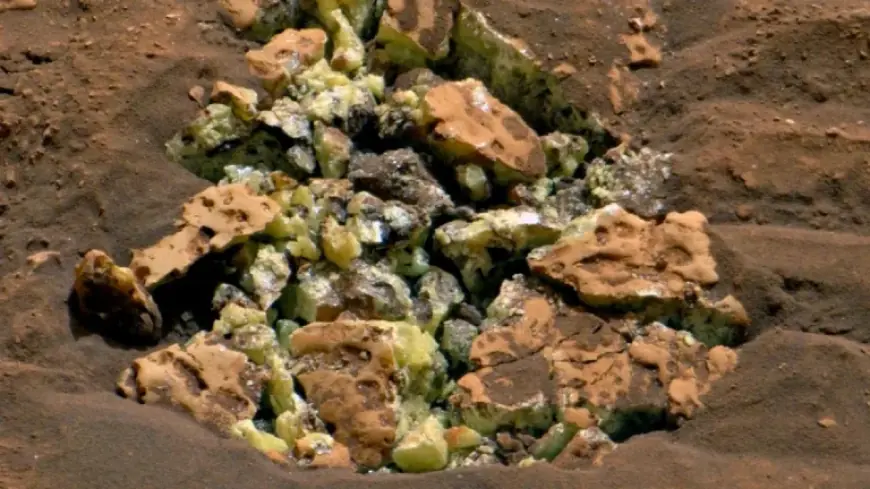
The Curiosity rover unexpectedly exposed a pocket of pure sulfur when it rolled over a fragile rock, and a separate study of hardened dunes in Gale Crater suggests groundwater once moved beneath the surface of mars — findings that together deepen questions about the planet’s chemical history and past habitability.
Elemental Sulfur Field Discovered on Mars
When Curiosity rolled its 899-kilogram (1, 982-pound) body over a fragile lump in May 2024, the rock cracked open and spilled yellow crystals identified as elemental sulfur, known as brimstone. While sulfates are common on Mars, this was the first identification of sulfur in its pure elemental form on the planet.
The deposit was found in the Gediz Vallis Channel. The discovery gained urgency because nearby stones resemble the cracked specimen, suggesting elemental sulfur may be abundant in some places of the channel. Curiosity’s instruments were able to analyze and identify the sulfur once the rock split; had the rover not taken a route that crushed the specimen, the material might have remained hidden for some time.
Curiosity project scientist Ashwin Vasavada called finding a field of pure sulfur “like finding an oasis in the desert, ” and said the presence of elemental sulfur in that region “shouldn’t be there, ” prompting new questions about local geological processes. Pure sulfur forms under a narrow range of conditions that are not known to have occurred where Curiosity made the discovery, so researchers say further work is needed to explain how it arrived and persisted on the surface.
Subsurface Water Clues From Hardened Dunes Strengthen Habitability Case
A separate investigation of ancient sand dunes in Gale Crater examined how dunes slowly hardened into rock after interacting with groundwater moving beneath the surface. Researchers compared Curiosity’s observations with similar formations in deserts on Earth that formed under comparable conditions, and concluded that moisture moved upward through sand layers, leaving minerals such as gypsum.
The study was led by Dimitra Atri with collaborators including Vignesh Krishnamoorthy, and involved comparisons with related work by other research groups. The findings suggest water from a nearby Martian mountain seeped into dunes through tiny fractures, and as the moisture migrated it deposited minerals that can capture and preserve traces of organic material. These deposits are considered promising places for future missions searching for evidence of ancient life because they can protect and record biochemical signatures.
Atri summarized the implication: “Our findings show that Mars didn’t simply go from wet to dry. ” The work strengthens the idea that, even after lakes and rivers disappeared, small amounts of water continued to move underground and created protected environments that could have supported microscopic life.
Together, the sulfur discovery and the hardened-dune study highlight gaps in understanding of the planet’s geologic and aqueous history. The sulfur field raises fresh questions about local chemistry and surface processes in Gediz Vallis Channel, while the dune analysis points to extended, localized groundwater activity in Gale Crater.
Researchers say the next steps will include detailed modeling of geological evolution to explain how elemental sulfur could form and remain on the surface in that region, plus continued examination of gypsum-bearing rocks that may preserve organic traces. Both lines of inquiry are likely to inform target selection and scientific priorities for future missions aimed at testing whether mars held environments suitable for life.