Jürgen Habermas, Influential German Philosopher, Dies at 96

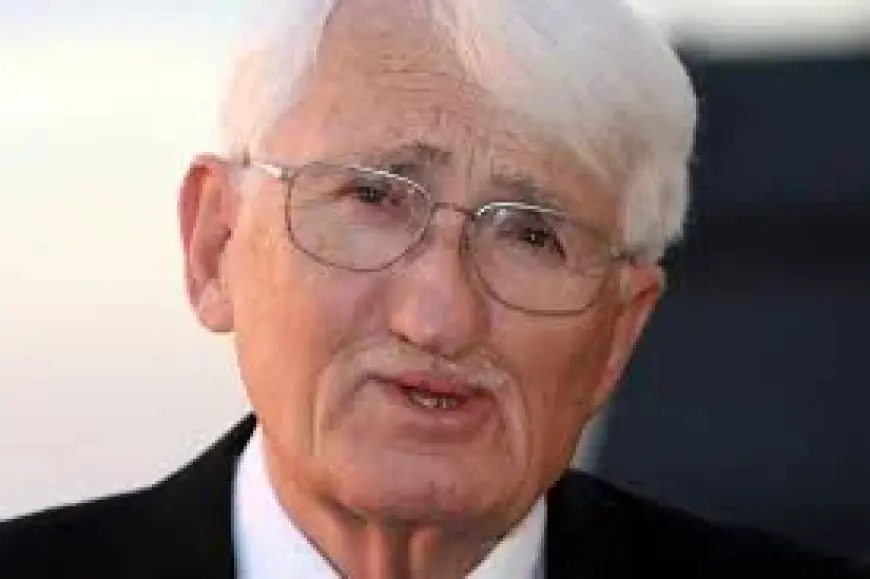
Jürgen Habermas, the influential German philosopher and sociologist best known for his theory of political consensus-building, has died at the age of 96, his publisher, Suhrkamp Verlag, said he died on Saturday in Starnberg, near Munich.
Jürgen Habermas’s Work and Public Influence
Habermas was a towering figure in the intellectual history of postwar Germany whose career spanned seven decades. He is widely considered one of the most influential philosophers of the 20th century. Central to his work was a theory that the formation of public opinion is vital for democracies to survive, a belief that underpinned his continued writing of books and newspaper articles into old age.
His work shaped debates about the foundations of social theory, democracy and the rule of law and helped frame discourse around European integration and the formation of the EU. Though his background lay in the neo-Marxist Frankfurt school and he had a reputation as a court philosopher of the Social Democratic party, his influence cut across party lines. The German chancellor, Friedrich Merz, described him as “one of the most significant thinkers of our time, ” adding that Habermas’s analytical acuity had shaped democratic discourse far beyond Germany’s borders.
Controversies and Later Interventions
Habermas remained an active public intellectual whose interventions sometimes provoked controversy. In a 2015 interview with, he criticised the then chancellor Angela Merkel for what he described as gambling away Germany’s postwar reputation during the Greek debt crisis. More recent interventions drew criticism from younger intellectuals.
In 2022, he criticised Germany’s then Green party foreign minister, Annalena Baerbock, calling her condemnations of Russia’s war of aggression in Ukraine “aggressively self-confident” and “shrill. ” His pronouncement that Israel’s war on Gaza following the 7 October Hamas attacks was “justified in principle” was met with disbelief by many philosophers following the Frankfurt school’s tradition of critical theory, who published a condemnatory letter.
Personal Background, Final Book and Legacy
Born on 18 June 1929 into a bourgeois family in Dusseldorf, Habermas underwent two surgeries after birth and in early childhood for a cleft palate, which resulted in a speech impediment. That impediment is often cited as having influenced his work on communication; he said he had experienced the importance of spoken language as “a layer of commonality without which we as individuals cannot exist” and recalled struggling to make himself understood.
He was raised in a staunchly Protestant household. His father, an economist who headed the local chamber of commerce, joined the Nazi party in 1933 but was described by Habermas as no more than a “passive sympathiser. ” Habermas himself joined the Hitler Youth at the age of 10, as most German boys did at the time, and at 15 avoided being drafted into the military by hiding from military police.
His most recent work, Things Needed to Get Better, was published in December last year. In it, he refused to “let defeatism have the last word, ” arguing it is possible to “confront the crises of the present aggressively and finally overcome them after all. ” His publisher said he is survived by two of his three children.