USS Tripoli and 31st MEU Ordered to Middle East: 2,500 Marines and F-35Bs Join Iran War Buildup

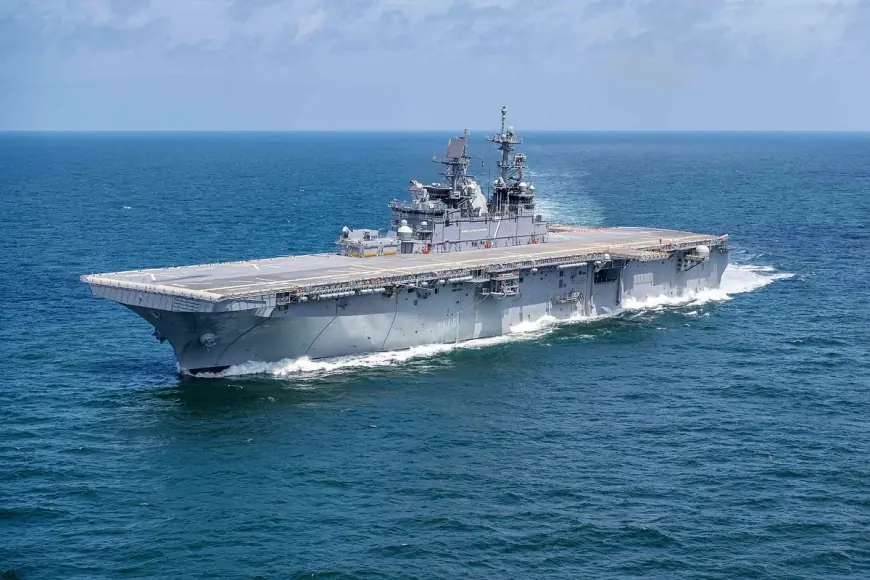
The USS Tripoli and the 31st Marine Expeditionary Unit are heading to the Middle East right now, Defense Secretary Pete Hegseth confirmed Friday after approving a request from U.S. Central Command. The deployment adds up to 2,500 Marines, multiple warships, and a squadron of F-35B stealth fighters to Operation Epic Fury — the largest American naval force assembled in the Middle East in decades.
USS Tripoli Ordered to Middle East: The Basics
Big deck amphibious warship USS Tripoli (LHA-7) and its embarked Marines are heading to the Middle East as the U.S.-Israeli war with Iran enters its third week, two defense officials confirmed. The amphibious assault ship and elements of the 31st Marine Expeditionary Unit will join the Gerald R. Ford and Abraham Lincoln carrier strike groups already operating in the region.
The USS Tripoli is based in Japan and could arrive in the Middle East in one to two weeks, according to defense officials. The deployment adds several warships and F-35 fighter jets to support those already in the region alongside approximately 2,500 U.S. Marines.
Tripoli Expeditionary Strike Group: Full Composition
The entire Tripoli Expeditionary Strike Group includes the 31st Marine Expeditionary Unit, the USS Tripoli, guided-missile cruiser USS Robert Smalls, and guided-missile destroyer USS Rafael Peralta.
At least 2,000 U.S. Marines constituting the 31st MEU, headquartered in Okinawa, are currently aboard the USS Tripoli and the USS New Orleans. Prior to receiving orders, the Tripoli and her Marines were participating in exercises in the Pacific Ocean near the Philippines.
What the 31st MEU Brings to the Fight
The 31st MEU fields roughly 2,200 Marines and sailors organized as a Marine Air-Ground Task Force. The composite air element includes MV-22B Osprey tiltrotors, CH-53E Super Stallion heavy-lift helicopters, AH-1Z Viper attack helicopters, UH-1Y Venom utility helicopters, and F-35B Lightning II stealth fighters drawn from Marine Fighter Attack Squadron 121, the Green Knights. The unit is designated Special Operations Capable.
USS Tripoli also differs from traditional amphibious assault ships in that it was built without a well deck, trading surface assault capability for an enlarged flight deck and expanded aviation support. This design allows the ship to operate a significantly larger fixed-wing complement than predecessors.
Why the Marines Are Being Sent Now: Strait of Hormuz
The Marine Expeditionary Unit brings a wide range of capabilities to the fight, including additional F-35B aircraft to strike targets inland, sea control missions going after Iranian small boats using AH-1Z and UH-1Y helicopters, and the ability to airlift Marines anywhere within reach of its rotary wing component. The aviation combat element can be tailored to the mission — loading the deck with F-35s or putting higher priority on air assault capabilities.
Defense Secretary Hegseth said U.S. Central Command will continue to "destroy the Iranian Navy to ensure freedom of navigation, and this means going after Iran's mine-laying capability and destroying their ability to attack commercial vessels."
Ground Operations Option Kept Open — But Not Confirmed
A senior U.S. official confirmed the Marine Expeditionary Unit will be able to conduct ground operations if ordered, though declined to comment on that possibility. Sources said that before any escort operations could begin, the U.S. military is planning potential operations for taking out land-based anti-ship missiles Iran has deployed around the Strait of Hormuz.
Iran War Scale: 6,000 Targets, 30+ Warships, $11.3 Billion in Six Days
CENTCOM confirmed American forces have struck roughly 6,000 targets inside Iran since the war began. More than 60 Iranian ships and over 30 minelayers have also been eliminated. The first six days of Operation Epic Fury cost American taxpayers an estimated $11.3 billion, according to a person familiar with a classified Senate briefing.
The deployment adds to a U.S. military buildup officials describe as the largest American naval force assembled in the Middle East in decades. More than 30 warships are now operating in the area as part of Operation Epic Fury, including two aircraft carrier strike groups. CENTCOM Commander Admiral Brad Cooper stated that U.S. and allied forces achieved air and sea dominance over Iran within six days of the campaign's launch.
A total of 13 U.S. service members have been killed during combat actions and roughly 140 more wounded across the opening two weeks of Operation Epic Fury.