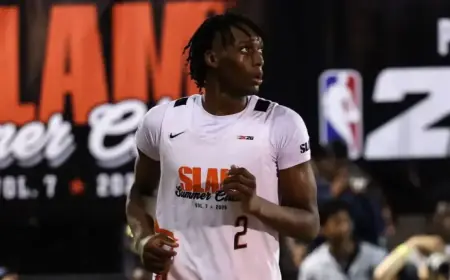
Trey Murphy trade talk exposes a Raptors roster contradiction on offseason priorities

The Toronto Raptors are being linked to perimeter scorers as they look to improve in the offseason, including trey murphy III after a strong performance against them. Yet the same trade-target chatter also underscores a tension: several proposed additions are three-point shooters who are not bigs, even as the Raptors have been looking to upgrade at that position.
Bleacher Report proposals put Trey Murphy III alongside other shooting targets
Confirmed in the context, one recent set of offseason trade targets proposed for Toronto includes Trey Murphy III, Nickeil Alexander-Walker, and Michael Porter Jr. The common thread is explicit: all three are good three-point shooters, and all three are “not bigs. ” That detail matters because the context also states the Raptors have been looking to upgrade at the big position.
Another confirmed point is that Trey Murphy III is framed as a response to offensive needs rather than frontcourt size. The argument presented is that too much energy before the trade deadline went into identifying a “perfect big man, ” and that more attention should have gone to adding offensive dynamism, especially floor spacing. In that telling, Trey Murphy III is described as having pull on and off the ball that could open up the half-court for Brandon Ingram, Scottie Barnes, and others, even while he “isn’t going to check the secondary-creator box. ”
The context also includes a performance-based hook: in the game referenced, Murphy had 28 points on 8 of 12 shooting with seven rebounds. The same context notes skepticism about whether New Orleans would want to trade him after that kind of outing, while also stating the Pelicans are building around him and view him as key to what they want to do.
Nickeil Alexander-Walker and Toronto’s “big” focus collide in the same narrative
Nickeil Alexander-Walker appears as a second named target across the context, but the underlying logic again centers on perimeter offense. One account calls him a player who could “move the needle, ” describing his contract as three years and $45. 5 million remaining, and framing that as strong value relative to his offensive strides. It adds that even if his shooting regresses, he could still help Toronto’s offense as a spacer and someone who can get into the teeth of the defense.
Confirmed performance markers are included as well: Alexander-Walker is averaging a career-high 20 points per game in his first season with the Hawks, and he is shooting 38 percent from beyond the arc. In that framing, he would provide “offensive juice” next to Immanuel Quickley and would help make up for Scottie Barnes’ offensive limitations.
Yet the context creates a documented tension: while the Raptors have been looking to upgrade at big, two separate target lists emphasize guards and wings. One write-up explicitly flags the mismatch by noting that all three proposed targets are shooters and not bigs. Another simultaneously references the pre-deadline search for a big man as a major focus, then argues the real need is offensive dynamism and spacing. The contradiction is not that either need is false; it is that the publicly discussed solutions point in different positional directions.
Toronto’s trade-market leverage questions, and what remains unclear about costs
The context also documents a separate constraint that intersects with those targets: a perceived lack of Raptors players other teams would be eager to trade for. It notes that only two Raptors players were mentioned as trade targets, once each, in the trade-target roundup referenced. Gradey Dick is listed as a trade target for the Pelicans, while Collin Murray-Boyles could be on the Kings’ radar. The implication presented is straightforward: limited outside interest in Toronto’s roster could limit options on the trade market in the offseason.
That leverage issue matters because the context describes expensive acquisition paths for the same players Toronto is being urged to pursue. For Alexander-Walker, one account says the Raptors may need to include a first-round pick or two, even while also stating the chances of him being traded are “very slim” given how much the Hawks have invested in him. For Trey Murphy III, the argument includes that he would “cost a mint in draft assets, ” while also asserting the Raptors have all of their own first-round picks and “shouldn’t be shy about throwing them around” if serious about building from the middle.
On the New Orleans angle, the context states the Raptors acquired Brandon Ingram from the Pelicans a little more than a year ago, and that he had an All-Star campaign in his first year with Toronto. It also lays out a possible trade construction: multiple first-round picks and RJ Barrett’s salary as the base to get a deal done, tied to the detail that the Pelicans are not receiving a first-round pick this year after trading it to the Atlanta Hawks for Derik Queen.
Still, the context does not confirm that Toronto is actually pursuing trey murphy III, Alexander-Walker, or Michael Porter Jr., nor does it confirm any negotiations with New Orleans or Atlanta. What remains unclear is how Toronto reconciles the stated search for a big with repeated proposals to spend heavily on non-bigs, especially when the same context flags roster issues that include struggling to hit threes and an offense that tends to fall apart in the fourth quarter.
The next clear evidence threshold would be any confirmed move that shows which problem Toronto is prioritizing: if Toronto uses significant draft assets for a perimeter shooter like trey murphy III, it would establish that spacing and half-court offense took precedence over the long-discussed push to upgrade at big.