Jennifer Garner-linked Once Upon a Farm posts strong Q4 sales as margins draw scrutiny

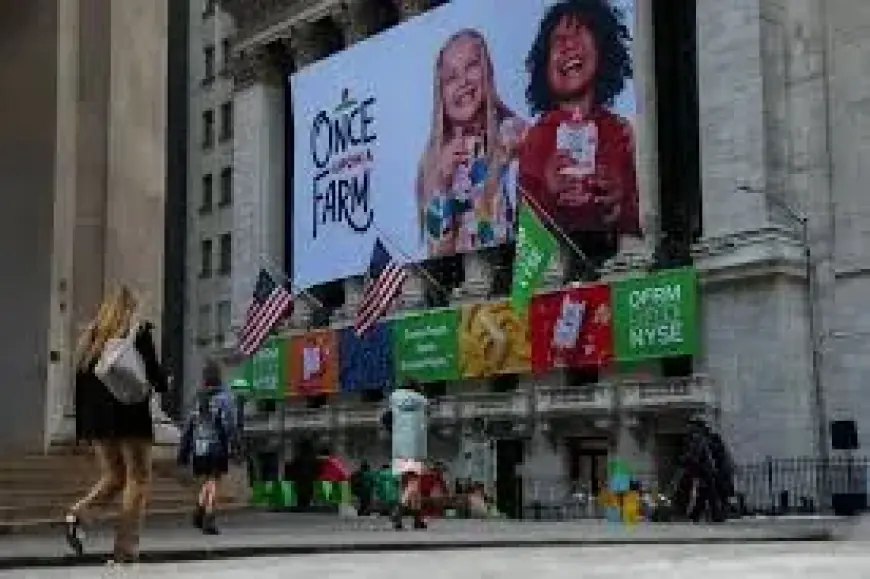
Once Upon a Farm, PBC disclosed a sharp fourth-quarter sales increase and a swing from loss to profit, soon after completing its IPO in February. Yet, even as the company projected 25% to 29% net sales growth for 2026, an analyst maintained a neutral stance, pointing to expected gross margin pressure from tariffs, product mix, and cooler-related fees. The record raises a basic tension: momentum on the top line versus uncertainty in profitability durability as costs rise.
Once Upon a Farm, PBC: Q4 net sales up 30% and net income turns positive
Once Upon a Farm, PBC said fourth-quarter net sales rose 30% to $64 million compared with the year prior. Over the same period, it reported net income of $22. 5 million, reversing a net loss of $12. 3 million the previous year. The company also stated gross margin was 47. 7% versus 46. 7%, and adjusted EBITDA was $6. 6 million compared with $2. 2 million a year earlier.
The company’s commentary framed the quarter as evidence of expanding reach and consumer uptake. Chief executive and co-founder John Foraker attributed the 30% net sales growth to broadened distribution, significant increases in household penetration, and strong velocity in the categories where the company competes, describing “underlying momentum” and “trust consumers place in our mission-driven approach. ”
Those confirmed figures and statements establish the surface narrative: rapid growth, improved earnings, and modest gross margin expansion. Still, the context shows that the company’s own 2026 financial targets and an external assessment do not fully align on how much of that performance can carry forward once cost pressures appear.
Jennifer Garner context: upbeat 2026 outlook meets projected gross-margin declines
The 2026 outlook issued by the company expects net sales of $302 million to $310 million, which it said would represent growth of 25% to 29% compared with 2025. It also projected adjusted EBITDA between $2 million and $4 million. The context does not confirm what 2025 net sales are, or how the company expects the bridge from recent quarterly results to full-year 2026 profitability to work in detail; it only provides the targets.
Separately, analyst Robert Moskow of TD Cowen maintained a Hold rating on Once Upon a Farm, PBC, keeping a $26. 00 price target. His rationale described “solid but not explosive” growth prospects and “some margin headwinds, ” characterizing management’s 25% to 29% sales growth outlook as encouraging but largely in line with expectations, rather than a clear upside surprise.
The sharper point of tension sits in the margin outlook. Moskow projected gross margins would decline in 2026, writing that tariffs, an unfavorable product mix from snacks, and cooler slotting fees could offset pricing benefits and scale efficiencies. That view does not dispute the company’s growth expectations, but it does challenge how much growth translates into durable profitability once those inputs hit. The context does not confirm how large any of those headwinds may be, or how the company plans to mitigate them beyond general references to pricing and scale efficiencies.
OFRM after the February IPO: distribution expansion plans and a cautious Hold stance
The context provides multiple strands that, viewed together, help explain why upbeat sales projections can coexist with a neutral rating. Management’s growth drivers referenced broadened distribution, increasing household penetration, and strong velocity. Moskow described a specific distribution tactic: expanding the baby cooler footprint to 5, 000 units, alongside the launch of protein pouches. He also flagged structural constraints on cooler-based distribution as a limiter on near-term upside.
That combination creates a documented pattern in the record: growth is closely tied to distribution channels that may carry their own costs. Moskow cited cooler slotting fees as one factor expected to pressure gross margins, even as cooler expansion is presented as a sales-growth lever. The context does not confirm the magnitude of those fees, whether they increase with footprint, or whether they are already reflected in the company’s 2026 adjusted EBITDA outlook.
Additional market signals in the context also point in different directions. Barclays maintained a Hold rating with a $25. 00 price target in another report released “yesterday, ” though the context does not provide a date for that note. At the same time, the context states that, based on recent corporate insider activity of 14 insiders, insider sentiment is positive because over the past quarter there was an increase of insiders buying shares of OFRM relative to earlier this year. The context does not confirm who those insiders were, the size of purchases, or whether any buying occurred after the IPO.
For now, the open question is whether Once Upon a Farm can sustain the growth implied by its 2026 sales outlook while absorbing the specific margin pressures outlined by Moskow. If a future update confirms that gross margins do decline in 2026 while net sales still land within the $302 million to $310 million range, it would establish that the company’s growth engine can run even -unit economics tighten—clarifying the balance between momentum and margin risk embedded in today’s narrative.