Jaden Bradley’s Big 12 Player of the Year win highlights a messaging gap

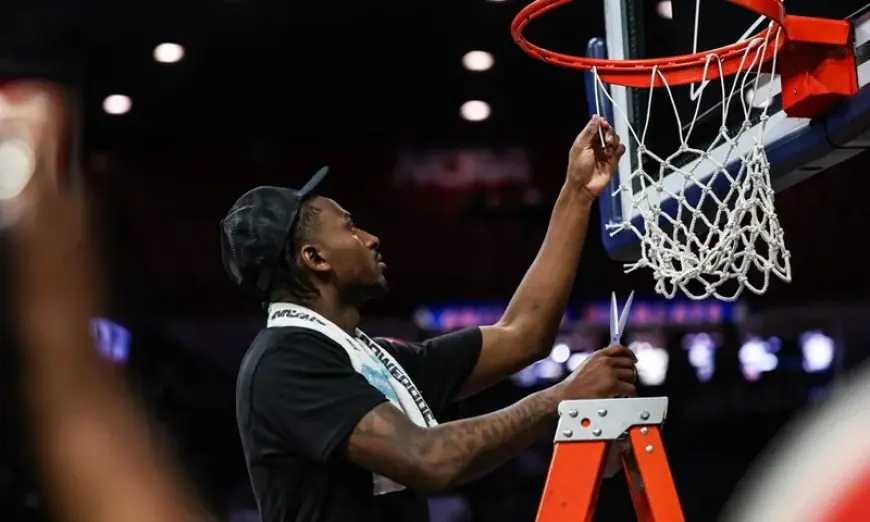
Arizona’s postseason haul included the Big 12’s top individual honor for jaden bradley, named Player of the Year after guiding the Wildcats to the league’s regular-season championship. Yet a day later, Big 12 Commissioner Brett Yormark used a public podium to promote BYU freshman AJ Dybantsa for National Player of the Year consideration, and the context shows he did not mention Bradley at all. That gap between official recognition and public advocacy is where the record becomes more complicated.
Arizona, Tommy Lloyd, and jaden bradley dominate Big 12 postseason awards
Confirmed results in the context show Arizona “cleaned up in the awards category. ” Tommy Lloyd was named Big 12 Coach of the Year, described as his second Coach of the Year award in five seasons. The context also states Lloyd’s 141 wins are the most by a Division I coach in his first five seasons, and that he led Arizona to a school-record 29 victories, including a 16-2 Big 12 mark and a regular-season title won by two games.
Arizona’s individual honors went beyond the coaching award. The context states jaden bradley was selected as the conference’s Player of the Year, while Tobe Awaka was named Sixth Man of the Year. Arizona placed three players on the Big 12’s 10-man First Team: Bradley, Brayden Burries, and Motiejus Krivas. Koa Peat made the Third Team, and Awaka received Honorable Mention. Bradley and Krivas made the All-Defensive Team; Burries and Peat made the All-Freshman Team, with Burries described as a unanimous choice for that squad.
Bradley’s season description in the context includes his position and status: a senior guard. It also states that on Monday he was named a finalist for the Bob Cousy Award, identified as an award for college basketball’s top point guard. The context lists his season averages as 13. 4 points, 3. 5 rebounds, and 4. 6 assists, and adds a program milestone: he became the 12th Arizona player to win a conference Player of the Year award, and is now eligible for the Ring of Honor.
Brett Yormark’s AJ Dybantsa push omits Jaden Bradley after coaches’ vote
The context lays out a second, separate set of confirmed facts: the Big 12’s 16 coaches vote on postseason honors, and those honors went to Arizona’s Player of the Year rather than BYU’s freshman star. In that same record, AJ Dybantsa was named Big 12 Freshman of the Year and made the All-Big 12 First Team, but did not receive Player of the Year.
Then comes the tension. The context states that on Tuesday morning, when Commissioner Yormark opened the conference tournament with remarks at a news conference before the Arizona State-Baylor game, he said Dybantsa “should be talked about for National Player of the Year honors. ” The context includes Yormark’s direct statement that he wanted to begin “national player of the year pushes” by recognizing players he felt had “earned the right” to be considered, starting with BYU’s Dybantsa. His rationale in the context centered on Dybantsa’s scoring: he “currently leads the nation in scoring” and is “on track to be the first underclassmen to lead the nation in scoring since 2021. ”
In the same account, the context says Yormark “didn’t say anything about Bradley, ” even though Bradley held the Big 12 Player of the Year designation. The context provides Bradley’s league-play averages as 13. 4 points, 3. 3 rebounds, and 4. 6 assists, but it does not provide a reason Yormark omitted him from his public remarks.
What remains unclear is whether Yormark’s comments reflected a deliberate communications strategy, a narrow focus on a national award campaign, or something else entirely. The context does not confirm any explanation from Yormark about why the league’s Player of the Year was not mentioned when he discussed national Player of the Year conversations.
Big 12 awards, BYU’s record, and the league’s national narrative
Viewed together, the context documents a pattern of two parallel storylines: one produced through a coaches’ vote for conference honors, and another promoted publicly by the league’s commissioner as part of a broader pitch about national stature. The coaches’ vote awarded Player of the Year to Arizona’s senior guard, while the commissioner highlighted BYU’s freshman for national Player of the Year discussion and did so despite the earlier award outcome.
Yormark’s broader league argument appears in the same context. He said the Big 12 should get eight or nine men’s teams in the NCAA Tournament and seven to eight women’s teams in the tournament field, and he argued that playing. 500 basketball in Big 12 conference play proves a team is “good enough to compete for a national title. ” He also cited a men’s basketball benchmark: four of the last six national championship games featured the Big 12 regular-season champion or co-champion. Those claims frame the commissioner’s interest in pushing individual national recognition, but they do not reconcile the gap between the conference’s top individual award and the league’s most prominent public promotional message from its commissioner in this account.
The context also provides Dybantsa’s statistical profile and team results entering BYU’s first-round game against Kansas State on Tuesday night: 24. 7 points, 6. 7 rebounds, and 3. 8 assists per game, with BYU finishing 9-9 in Big 12 play, tied for seventh, and 21-10 overall. Separately, the context states that Dybantsa “leads the country in scoring, ” a key point Yormark used to justify national award consideration. Still, the context does not confirm a direct comparison framework between Dybantsa and Bradley for national Player of the Year, only that Yormark elevated one name while not mentioning the other.
The record leaves one concrete evidentiary threshold for closing the gap: a direct statement from Yormark addressing the omission, or a subsequent public message that explicitly connects the Big 12’s coaches-voted Player of the Year to the league’s national award advocacy. If such a clarification is confirmed, it would establish whether the commissioner’s push was intended as a separate national campaign rather than an extension of the league’s own top honor.