Jerrod Calhoun rises in coaching carousel as Utah State’s profile grows

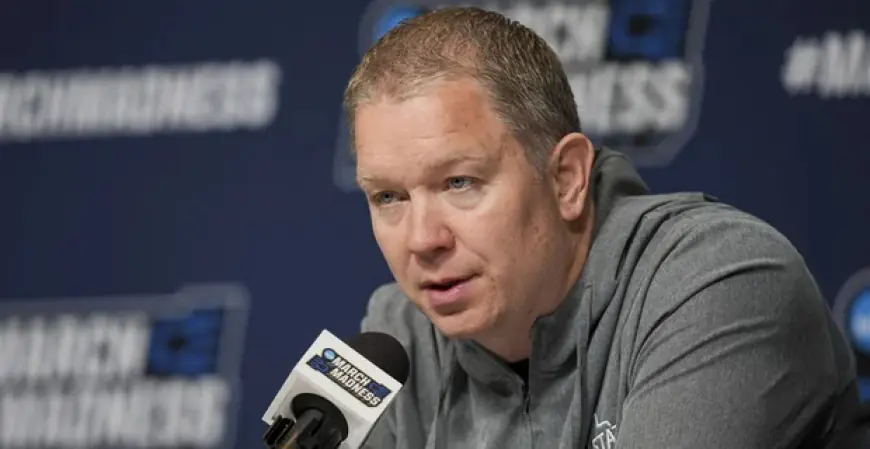
Utah State coach jerrod calhoun has moved into the center of this year’s men’s college basketball coaching carousel after going 52-14 in two seasons with the Aggies. The attention reflects a market where fast fixes are expected, but fit matters more than ever, forcing schools and candidates alike to weigh the risks of jumping too quickly.
Jerrod Calhoun and Utah State results
jerrod calhoun, 44, is described as a near-peer to Saint Louis coach Josh Schertz in this cycle’s candidate tiers, with Calhoun framed as “1B” behind Schertz’s status as the most sought-after name. The résumé anchoring that status is specific: Calhoun has the Aggies at 52-14 over two seasons, including a Mountain West championship, a 30-10 league record in two years, and back-to-back NCAA Tournament appearances. Those concrete benchmarks matter in a carousel environment driven by urgency, because they show both immediate performance and durability across two full seasons rather than a short spike.
Calhoun’s candidacy is also strengthened by the way his record is characterized: he can “maintain and also rebuild. ” That distinction speaks to hiring committees trying to separate coaches who inherit momentum from those who can create it. Calhoun’s timeline at Youngstown State is used as the proof point. He took over a losing program in 2017 and won the Horizon League in his sixth year. The pattern suggests administrators see value in a coach who has demonstrated patience and program-building, even as the broader market increasingly rewards quick turnarounds.
Georgia Tech, Syracuse, and pressure to flip fast
The carousel is moving quickly in part because early exits have become normalized at major programs. Georgia Tech’s Damon Stoudamire and Syracuse’s Adrian Autry were already fired this cycle after just three years on the job, and Providence’s Kim English is expected to be as well. The context for those decisions is explicit: the transfer portal and the ability to pay players have created the expectation that it’s possible to flip a loser into a winner quickly. The figures point to a harsher timeline for evaluation, with three years now presented as enough time for some schools to decide they are not getting the return they want.
That speed changes the incentives on both sides of the table. On the school side, the logic is partly financial: if leaders want donors to give more money to spend on the roster, then changing coaches is often described as the best way to “open wallets. ” On the coach side, the same pressures that produce quick hires can also produce quick firings, which raises the cost of choosing the wrong job. That is why the context emphasizes that mid-major coaches no longer jump at “just about any high-major opportunity, ” and why top targets may be selective even when interest is high.
Cincinnati, Wes Miller, and Pac-12 move
One potential landing spot is named directly: Cincinnati. Calhoun is described as an “obvious candidate” there if Cincinnati moves on from Wes Miller. The key word is “if, ” because the context does not confirm a change at Cincinnati, but it does make clear that Calhoun’s ties could matter in that scenario. Calhoun is a Cincinnati graduate and began his career as a student assistant for Bob Huggins, connections that can carry weight in searches where familiarity and institutional fit are prized alongside win totals.
Still, the same context argues Calhoun does not have to chase the first opening. Utah State is moving to the new Pac-12, and the program is framed as a place where good coaches can win consistently. The Aggies are also set for their fourth straight NCAA Tournament appearance—under three different coaches—and have won 20-plus games in seven of the last eight seasons. That stability reshapes the leverage dynamic: a coach producing a 52-14 start at a program with sustained 20-win seasons and a conference transition ahead may have reasons to wait for the right job rather than any job.
The next confirmed development in this cycle is administrative rather than speculative: Saint Louis and coach Josh Schertz agreed to a contract extension on Friday. With Schertz now extended and Kansas State having taken Belmont’s Casey Alexander “off the board” Thursday, the open question left by the context is which programs will actually create vacancies that match the profiles of coaches like Calhoun—and whether schools looking for speed will also pay for the patience and program fit his track record implies.