Purdue advances past Northwestern, but missing Wildcats size exposes interior gap

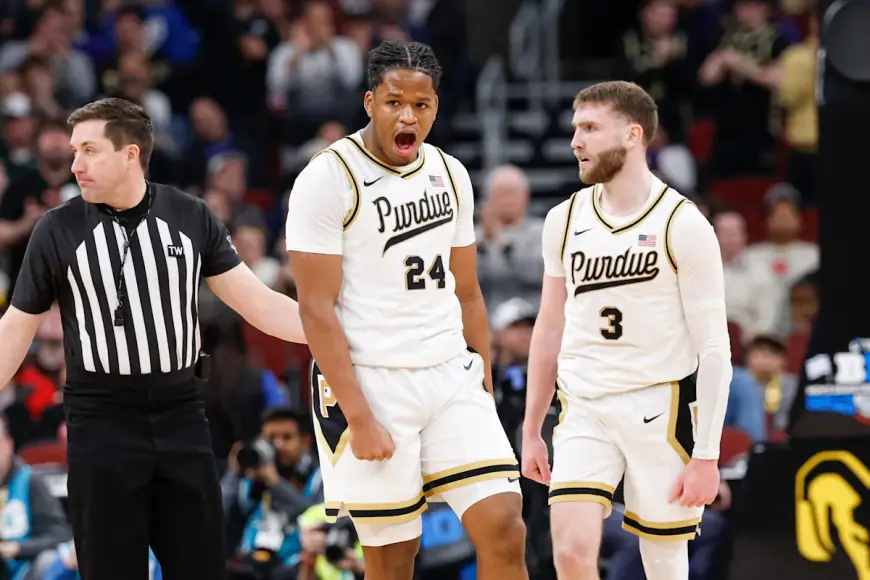
No. 18 purdue outmuscled Northwestern 81-68 on Thursday in Chicago to move into the quarterfinals of the Big Ten Tournament. The win came with a clear tension inside the box score: Purdue’s documented dominance in the paint and on the glass aligned with Northwestern playing without 6-foot-11 forward Arrinten Page, an absence the context links directly to the Wildcats’ lack of size and physicality.
Purdue 81, Northwestern 68: Braden Smith’s 16 assists and the early run
Purdue’s win was built on both production and pace. Braden Smith recorded 16 assists, and the context notes the performance pushed him to 1, 045 assists in 142 career games, moving him into second on the NCAA career list. The same notes place Bobby Hurley first with 1, 076 assists in 140 games for Duke from 1989-93, while Smith passed Ed Cota (1, 030) and Chris Corchiani (1, 038).
On the scoreboard, Purdue opened separation quickly. A 15-3 run gave the Boilermakers a 38-15 lead with 5: 47 left in the first half. Trey Kaufman-Renn started the decisive stretch with a jumper in the paint, and Omer Mayer finished it with a fast-break layup created by a Northwestern turnover. Another Kaufman-Renn basket helped build a 45-21 halftime advantage, and Purdue’s interior scoring showed up immediately in a 22-6 edge in paint points in the first half.
Individual scoring supported the lead. Kaufman-Renn and Oscar Cluff each scored 19 points for Purdue (24-8). Cluff added 10 rebounds. Northwestern’s Nick Martinelli scored 25 points, and Jayden Reid finished with 19 points and nine assists. Northwestern entered the game after advancing with wins over Penn State and Indiana on the tournament’s first two days.
Arrinten Page’s illness and Purdue’s 38-18 points-in-the-paint edge
The context ties Purdue’s interior control to a specific roster gap on the other side. Northwestern played without Arrinten Page, described as a 6-foot-11 forward who missed his fourth consecutive game because of an illness. The context states the Wildcats “definitely missed the junior’s size and physicality” as Purdue dominated inside.
The numbers underline that dominance: Purdue outrebounded Northwestern 35-23 and held a 38-18 advantage in points in the paint for the game. Those margins echo the first-half split (22-6 in the paint), suggesting the interior imbalance was not a brief stretch but a recurring feature across both halves.
Still, the context does not confirm how Northwestern’s interior defense or rotation changed without Page, beyond the direct reference to missing his size and physicality. It also does not confirm whether Purdue altered its offensive plan specifically to exploit that absence. What is confirmed is the alignment between the absence and the outcome metrics: Purdue’s edge in rebounds and paint points matched the area where Northwestern lacked a 6-foot-11 presence.
Purdue’s improved start and the next test against No. 11 Nebraska
Another documented tension sits in Purdue’s first-half urgency compared with its prior meeting with Northwestern. The context calls it “a much better start” than the regular-season game between the schools, when Purdue trailed 34-25 at halftime before rallying to win 70-66 at Northwestern on March 4. On Thursday, by contrast, Purdue built a 45-21 lead by halftime, turning the earlier pattern of a slow start into a lopsided early advantage.
That contrast raises an open question the context does not confirm: whether Purdue’s early burst reflected a deliberate emphasis on fast starts, or whether the game conditions—Northwestern’s lineup constraints and Purdue’s early paint scoring—made the difference. The record in the context supports only the endpoints: the March 4 halftime deficit and comeback, and the Thursday halftime lead created by a 15-3 run and repeated scoring inside.
Purdue’s next opponent is set. The Boilermakers will face No. 11 Nebraska on Friday, with the context noting the Cornhuskers are the second seed and had a bye through the first three rounds. If Purdue’s rebounding edge and paint production are confirmed again against Nebraska, it would establish that Thursday’s interior dominance was not only opponent-specific, but a repeatable driver of its Big Ten Tournament run.