Google launches Ask Maps and Google Maps Immersive Navigation, yet questions persist

Google has introduced Ask Maps and Google Maps Immersive Navigation, new AI-driven features it says will make finding places and driving more intuitive. This article examines a specific gap in the record: the company presents technical assurances and expansive data sources while published coverage documents explicit doubts about suggestion accuracy and leaves monetization plans unanswered.
Google confirms Ask Maps, Gemini integration and rollout details
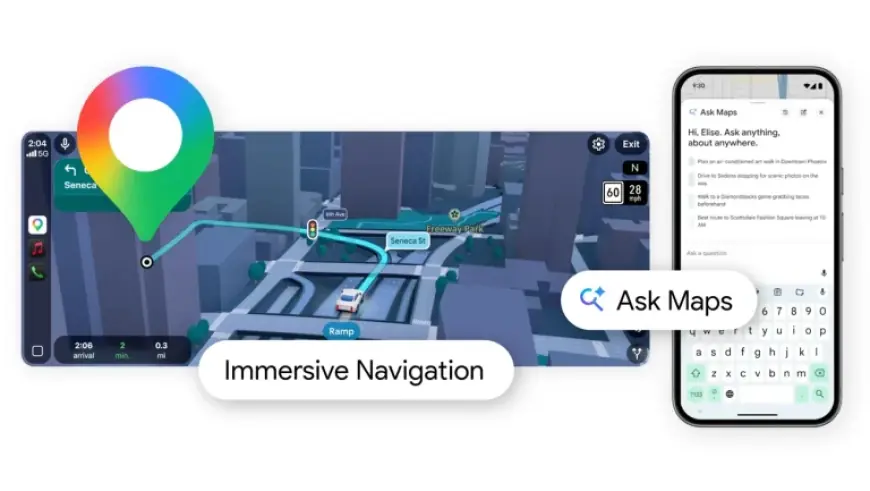
Confirmed: Google says Ask Maps brings its most capable Gemini models into Maps to answer complex, real-world questions conversationally and to produce customized maps and itineraries. Confirmed: the company states Ask Maps analyzes information from over 300 million places and more than 500 million contributors to personalize recommendations and to help book reservations, save places, and share plans. Documented: Google has begun rolling Ask Maps out in the U. S. and India on Android and iOS, with desktop coming later. This paragraph establishes the new features, the stated data scale, and the stated availability.
Google Maps Immersive Navigation and the claim that guardrails prevent hallucinations
Confirmed: Google says Immersive Navigation offers a redesigned, three-dimensional driving view that includes landmarks, medians, traffic features and terrain to help drivers orient themselves. Confirmed: the company frames this as its largest navigation upgrade in more than a decade and says the feature will provide more natural voice guidance, parking suggestions, and context for alternate route tradeoffs. Documented: coverage notes Google believes its AI guardrails are now strong enough to prevent the Gemini models behind Immersive Navigation from fabricating bogus places, a malfunction described in the industry as a hallucination. What remains unclear is independent evidence or published validation of those guardrails across the initial U. S. rollout and broader platforms such as CarPlay and Android Auto.
Pattern across facts: feature ambition collides with documented skepticism and unanswered commercial questions
Documented: multiple accounts highlight both the technical ambition—conversational itineraries, 3D renderings, and real-time route tradeoffs—and explicit skepticism about how accurate suggestions will be in practice. One coverage note states plainly that “how accurate the suggestions are is another question, ” which the record presents as documented doubt rather than a refutation. Confirmed: another element in the record is that Google executives declined to answer whether the company eventually plans to sell ads to boost businesses’ chances of being displayed in Ask Maps’ recommendations. Taken together, these facts show a pattern: Google is deploying expansive AI features that rely on massive place and review datasets while public-facing commentary raises accuracy questions and the company has not addressed potential monetization of recommendation placement.
Open question: The context does not confirm how Google will measure or disclose the accuracy of Ask Maps recommendations or Immersive Navigation renderings during the staged rollouts. Open question: The context does not confirm whether Ask Maps will incorporate paid placement in recommendations, beyond executives declining to answer that specific question. These open questions are distinct from the confirmed claims and documented doubts outlined above.
Closing — the evidence that would resolve the central tension: If Google confirms, with published validation data tied to the U. S. rollout, that Gemini-powered Immersive Navigation avoids hallucinations in real-world driving scenarios and also clarifies whether Ask Maps will feature paid placement for businesses, it would establish both the technical reliability the company asserts and the commercial transparency critics have sought. For now, the record contains confirmed technical claims, documented skepticism about accuracy, and an explicit refusal by executives to answer a monetization question.