Hail Mary Movie reviews praise Ryan Gosling while exposing tone mismatch

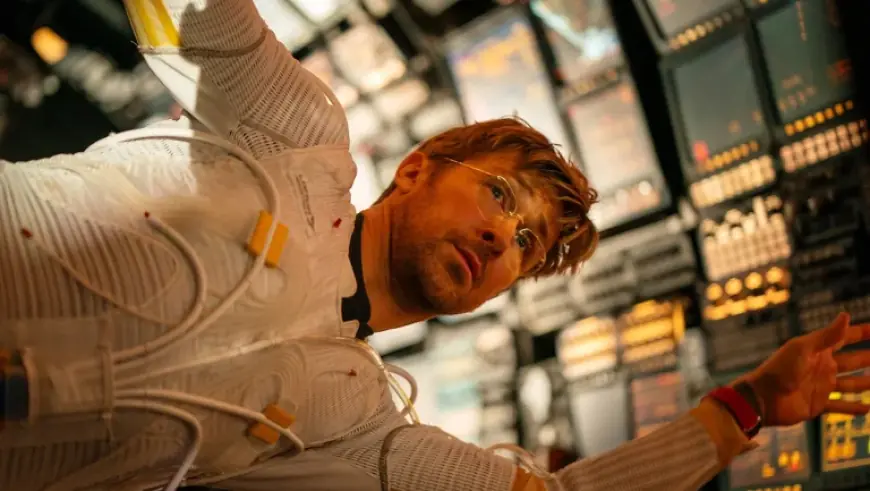
Ryan Gosling leads the hail mary movie “Project Hail Mary, ” a large-scale science-fiction story directed by Phil Lord and Christopher Miller and based on an Andy Weir novel. Two prominent reviews document the same core premise and creative team, yet reach opposing conclusions about the film’s emotional calibration. The gap is specific: one frames its humor and sentiment as a hard-won balance, while the other argues jokes repeatedly blunt the story’s loss and urgency.
Ryan Gosling, Phil Lord, and Christopher Miller: the shared record on “Project Hail Mary”
Confirmed details align across the coverage. Gosling plays Ryland Grace, a middle-school or science teacher who ends up in space on a mission tied to saving worlds. Sandra Huller also stars, and Drew Goddard is credited as screenwriter, based on the novel by Andy Weir. The film is positioned as a major science-fiction release with theatrical ambitions, described as a $200 million-plus production, rated PG-13, with a runtime of 2 hours 36 minutes and a release date of Friday, March 20.
Documented plot elements establish why tone would be central to any assessment. Grace awakens from a years-long induced coma and struggles to remember his name, mission, and crewmates. Two crewmates, Yao Li-Jie (Ken Leung) and Olesya Ilyukhina (Milana Vayntrub), have died mid-journey, leaving him alone. His destination is the star Tau Ceti, described as roughly 11. 9 light-years from Earth. Back on Earth, the story includes an existential threat: energy-hungry microbes called Astrophage devour the sun and other stars, triggering cooling that threatens Earth’s population. Eva Stratt (Huller), depicted as a government official and the head of Project Hail Mary, pulls Grace back into high-level science after he left academia.
Both reviews also point to the film’s designed accessibility, though with different valuations. The narrative uses Grace’s temporary amnesia as a structuring device, moving between past and present as memories return. Even at the level of set-piece detail, the filmmaking choices appear aimed at broad engagement: one review highlights buoyant humor and heartfelt emotion, while the other describes a steady flow of one-liners and physical comedy beats.
Hail Mary Movie tone: “buoyant humor” versus “glib jokes” in the same scenes
The tension is documented in how each review describes the same tonal ingredients. One account frames the directors’ approach as “buoyant humor and heartfelt emotion, ” calling the film’s sweetness “disarming” even when it “leans into the sentiment to an almost saccharine degree. ” Gosling is credited there with “low-key comic timing, ” presented as key to sustaining a “tricky balance” between comedy and feeling.
A second review documents the same intention to make the audience laugh and cry, but characterizes those instincts as “lumpy cross-purposes. ” The clearest example is tied to grief and isolation. Early in the story, Grace mourns dead crewmates, which the review calls “grim stuff, ” yet it says humor “keeps the full sting of loss at bay. ” Grace’s eulogies are described as “half sad, half jokey, ” and “more than a little half-hearted, ” with an added critique that he seems aware of an audience and “waiting to be entertained. ”
That split is not merely a matter of taste in adjectives; it is a documented disagreement about whether comedy functions as support or sabotage. In one view, humor helps the film sustain heart; in the other, it acts as a release valve that repeatedly drains tension from death, memory loss, and a universe-scale threat. What remains unclear is whether the film itself shifts tonal strategy across its runtime or whether the reviewers simply prioritize different emotional outcomes from the same material. The context does not confirm scene-by-scene changes beyond the examples described.
James Ortiz, “Rocky, ” and Amazon MGM: craft ambition and blockbuster pressure in tension
Another pattern emerges when the coverage is read side by side: the film is evaluated both as a character relationship story and as a test of large-scale studio ambition. One review explicitly notes that “much has been written” about Amazon MGM’s bid for a major theatrical blockbuster with a $200 million-plus production. Still, it argues that what stands out on screen is how rarely audiences now see non-franchise, original science fiction of this scale and “emotional depth. ” It also points to precedents in tone and scope, citing “Interstellar” and “Arrival, ” and mentions a nod to “Close Encounters of the Third Kind, ” with memories of “E. T. ” triggered once a central character dynamic takes hold.
That same review ties its optimism to craft choices. It emphasizes “practical solutions and physical sets” rather than relying only on digital tools, saying in-camera effects strengthen the “wraparound feel. ” The most specific example is the alien character “Rocky, ” described as a five-armed, blocky being brought to life through the puppetry and voice work of James Ortiz. Rocky appears midway through the film, pooling problem-solving resources with Grace, and becomes central to a relationship built on mutual curiosity.
The other review, by contrast, focuses less on the physical execution and more on tonal management, calling the film an “exasperatingly insistent crowd-pleaser” that makes its science-fiction plot “easily digestible” with quips and pratfalls. Put together, the documented record reveals a dual yardstick: one side measures success in emotional warmth and tactile filmmaking, while the other measures failure in a comic approach that undercuts grief, urgency, and credibility.
For now, the central question is not whether the film contains humor and sentiment; both reviews confirm it does. The evidence threshold that would resolve the contradiction is a fuller accounting of how frequently jokes land in scenes of death, isolation, and planetary stakes, and whether those moments deepen the relationship between Grace and Rocky or distract from it. If the same tonal device is confirmed to both heighten connection and dilute loss in comparable sequences, it would establish that “Project Hail Mary” is built on a deliberate tradeoff rather than an accidental mismatch.