Sea Turtles: Rare Kemp’s ridley rescue in Texas shows hidden crisis

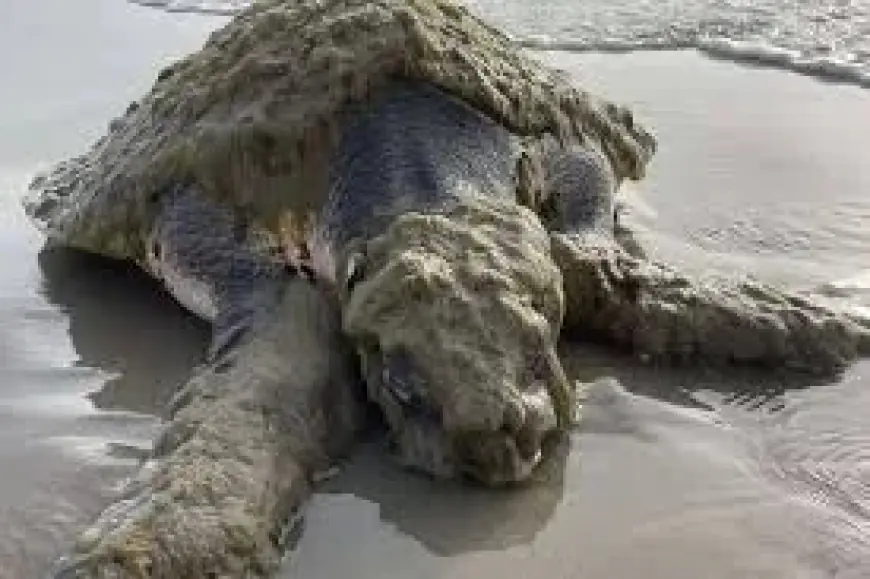
A critically endangered Kemp’s ridley was rescued after sea turtles drew attention on a beach near Galveston on Saturday, March 7, when an adult female washed ashore appearing to be covered in green “fur. ” Rescuers found her lethargic and weighed down by epibionts—organisms that had attached to her shell and body—prompting emergency veterinary care and a rapid transfer into rehabilitation.
The episode is not just an unusual beach sighting. The condition of this Kemp’s ridley points to a compounding problem: once a turtle slows down from illness, the physical burden of attached organisms can deepen that weakness and make recovery harder, even before other threats in its environment are considered.
Galveston rescue and triage
The Gulf Center for Sea Turtle Research (GCSTR) said its rescuers were called to a beach near Galveston after a report of a stranded adult female Kemp’s ridley sea turtle. The turtle’s shell and body were covered in barnacles, algae, and sediment, and she appeared lethargic. Researchers described those layers as signs she may have been struggling for some time.
After the rescue, the turtle was taken to the Houston Zoo for an emergency veterinary visit before being transported to the GCSTR rehabilitation hospital. GCSTR described her as being in critical condition, and said she is receiving care from its team along with veterinarian partners at the Houston Zoo. they are hopeful for her recuperation and eventual release back into the Gulf.
The confirmed chain of events—field response, emergency veterinary evaluation, then rehabilitation—underscores how quickly responders must act once a stranded turtle is located. The pattern suggests that in strandings like this, the visible condition on the beach can be the endpoint of a longer decline rather than a sudden, isolated incident.
Christopher Marshall on epibionts
Christopher Marshall, director of the GCSTR, described a mechanism that can turn a health issue into a downward spiral. He said “healthy sea turtles are swimming sea turtles, ” and that turtles that slow down their swimming due to health issues are quickly colonized by organisms in the water. In his description, this can create a “positive feedback loop”: the additional weight causes further slowing and energy expenditure, which then allows more epibionts to grow.
Marshall also said the stranded turtle’s slow swimming may have impacted her health and contributed to her becoming stuck on the beach. The figures and phrasing point to a simple but consequential dynamic: the organisms are not just a cosmetic oddity. In this account, the buildup is a physical load that can worsen the original problem and complicate the path back to normal movement.
That logic also explains why the turtle’s appearance—described by beachgoers as resembling green fur—became the key clue. In this case, it signaled not only that a rare species had washed ashore, but that the animal had likely been in a compromised state long enough for barnacles, algae, and sediment to accumulate heavily.
Kemp’s ridley status in Texas
Kemp’s ridley sea turtles are listed as endangered under the Endangered Species Act, and are listed as critically endangered by the International Union for Conservation of Nature. The context provided places the species’ estimated population at about 22, 300 mature adults. NOAA Fisheries also describes Kemp’s ridley as the smallest sea turtle species in the world and notes it is Texas’ official state turtle, most commonly found in Gulf waters around Texas.
In addition to this individual rescue, NOAA notes threats including habitat degradation, issues with fishing, boats, and ocean debris. The figures point to why a single adult female in critical condition can matter: for a species described as one of the rarest turtle species, each mature animal represents a meaningful share of a limited breeding population.
For now, the most concrete next step remains the turtle’s medical trajectory. Officials have expressed hope for eventual release, but no timeline was confirmed. What remains open is the outcome of her rehabilitation at the GCSTR hospital after the emergency visit with Houston Zoo veterinarians—and whether her condition improves enough to return her to the Gulf.
Separately, responders emphasized what to do when sea turtles are found in distress. NOAA and the GCSTR recommend that anyone who encounters a stranded, injured, or entangled sea turtle contact professional responders and scientists, including through the Texas statewide 1-866-TURTLE-5 hotline.