Nick Watson earns praise while banners highlight Hawthorn–Essendon rivalry contradictions

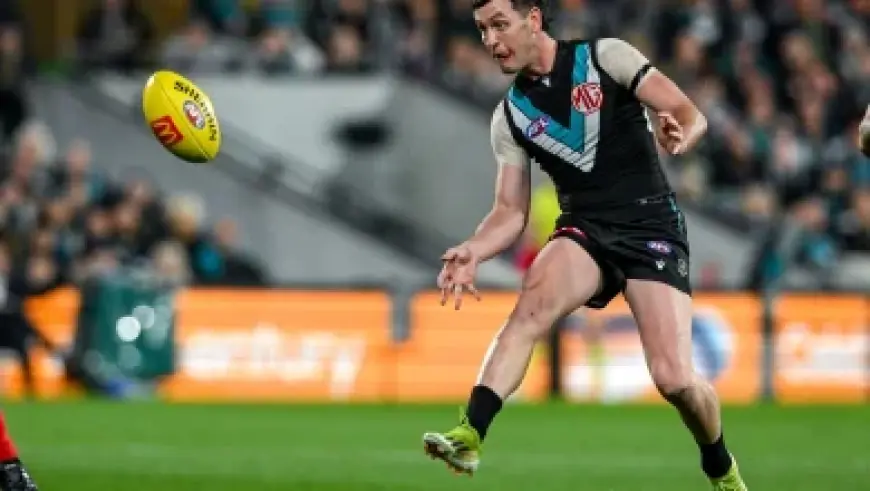
nick watson was named the Opening Round Superhero of the Week after a prominent showing for Hawthorn despite the team’s 27-point loss in Opening Round. Yet comedian Danny McGinlay’s banner referencing Watson’s 2005 birth year and Hawthorn’s premiership run frames a narrative of long-term dominance that sits uneasily beside the recent on-field result.
Danny McGinlay’s banner referenced Nick Watson, the 2005 birth year and club history
Confirmed: Comedian Danny McGinlay, known as The Banner Man, created an Essendon-Hawthorn banner that explicitly noted Nick ‘the Wizard’ Watson was born in 2005. Confirmed: the banner linked Watson’s birth year to Hawthorn’s success, saying that since Watson arrived the Hawks have won four premierships and appeared in many finals series. Documented: the banner also invoked past flashpoints in the rivalry, referencing the Line in the Sand brawl from 2004 and off-field incidents involving Hawthorn players Dylan Moore and Connor MacDonald in Arizona. Confirmed: the banner contrasted those Hawks milestones with Essendon’s last final win being in 2004.
Nick Watson’s Opening Round Superhero award and statistical impact for Hawthorn
Confirmed: Nick Watson, described in the match coverage as a 21-year-old, took out the fan-voted Opening Round Superhero of the Week. Confirmed: Watson finished the game with two goals and eight score involvements in a 27-point loss to the Giants. Documented: his match statistics included 17 disposals, seven contested possessions, four tackles, four inside 50s and three tackles inside 50. Confirmed: despite that individual recognition, Hawthorn did not win the match.
Danny McGinlay’s comedic framing, Hawthorn and Essendon Round 1 dynamics
Documented: McGinlay has made a reputation writing pre-game banners that use wit and embedded tensions between opposing clubs. Documented: he described banner writing as a short-form craft likened to a haiku, and said he enjoys adding a comedic twist; he also admitted some of his mock banners are cheeky and permitted jibes at specific players in a non-game context. Confirmed: the banner about Watson used club history and off-field incidents to sharpen the taunt aimed at Essendon ahead of a high-profile Friday night clash at the MCG against Hawthorn. Open question: The context does not confirm whether McGinlay’s banner changed supporter sentiment or had any measurable effect on players or match-day atmosphere.
Still, the record shows two contrasting threads. Confirmed: one thread is a long-form narrative highlighted by the banner—Watson’s 2005 birth year paired with a Hawks era of multiple premierships and finals. Confirmed: the other thread is immediate match reality—Watson achieved fan-voted recognition for a strong individual outing while Hawthorn lost by a margin of 27 points in Opening Round. Documented: both threads appear in the provided coverage without a clear reconciliation between the celebratory retrospective and the recent result.
Yet, what remains unclear is whether the banner’s framing aims chiefly for satire or a substantive claim about competitive balance. Open question: The context does not confirm whether Hawthorn’s historical success since 2005, as invoked on the banner, is intended as a predictive statement about the season ahead or solely as provocation aimed at Essendon fans.
Closing — The specific evidence that would resolve the tension is already scheduled in the record: Hawthorn’s Round 1 match at the MCG against Essendon. If Hawthorn defeats Essendon in that Round 1 fixture, it would establish that Hawthorn can translate the form spotlighted by fan celebration of players like Nick Watson into a victory that matches the banner’s celebratory framing. If Essendon wins, it would underscore the gap between banner rhetoric about era-spanning dominance and single-match outcomes.