Gale Warning: Met Office forecasts wintry snap as confidence gaps remain

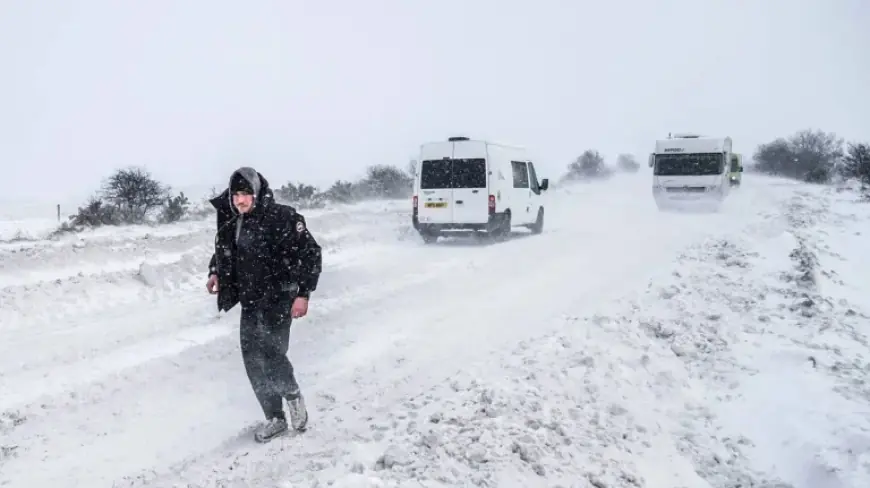
Wintry weather is set to return across the UK, with Arctic air, blustery winds and snow expected in some areas. Yet the same forecasting picture also contains a recurring tension: specific official warnings are already in place for parts of Scotland, while other projections emphasize that the “picture will become clearer closer to the time” as the week progresses and snowfall risks shift. That gap between defined warnings and evolving detail is at the center of this Gale Warning moment.
Met Office yellow warning in Scotland and snowfall totals already mapped
Confirmed warnings are in place for snow and ice across central and north-west Scotland, with expectations of 2 to 5cm of snow “fairly widely, ” including at lower levels. The same forecast outlines the potential for around 10cm in places above about 350 metres, indicating a sharper risk gradient by elevation even within the warned area.
The Met Office yellow warning for snow and ice across central and northwest Scotland is stated to be in place until 09: 00 GMT, which is 5: 00 am ET. Alongside the warning, the broader forecast describes wintry scenes as “possible” over the hills of Northern Ireland, the English Lakes and the Pennines, a framing that is less definitive than the Scotland snowfall totals and warning window.
Conditions described for the day include a mix of sunny spells and blustery showers, with hail and thunder also possible. The forecast adds that winds will be “particularly squally around the showers, ” a detail that explains why localized conditions could diverge quickly from a general regional outlook.
Jason Kelly and the Met Office caveat: forecasts flag “coastal gales” but stress uncertainty
A second confirmed strand of the forecast focuses on a wind shift and the mix of hazards expected on Friday. Jason Kelly, identified as Chief Operational Meteorologist for the Met Office, describes “a notable shift in wind direction to a north-westerly flow” that will make Friday “a markedly colder day nationwide, ” with the potential for “sunny spells, heavy showers, coastal gales, and snow over high ground. ”
That statement presents a broad national signal while still using probability language: “potential” and “possibility” rather than a firm hazard map for every region. It also introduces coastal gales as a distinct risk alongside snowfall, which complicates the public-facing headline of a simple “snow warning” story. The forecast further notes that snow “may not be confined to the northern hills, ” and adds that accumulations on lower hills are also possible.
Still, the clearest investigative gap lies in what is explicitly not locked down: Kelly states the “picture will become clearer closer to the time. ” That caveat sits beside a separate, time-bounded warning for Scotland already specified to 5: 00 am ET. Together, these details show two different levels of forecast certainty operating at once: a defined warning for one area, and a broader national outlook that signals risk but does not confirm where impacts will be most pronounced.
Weather and the March 13 to March 22 outlook: changeable patterns and low confidence
Beyond the immediate cold snap, the forecast narrative turns to a longer-range outlook from March 13 to March 22 that explicitly highlights variability. The Met Office outlook calls the period “changeable, ” with Atlantic frontal systems passing close to or across the UK at times. It anticipates occasional spells of rain or showers, most frequent in the west and northwest, and notes these could be accompanied by strong winds.
At the same time, the outlook describes drier interludes “under transient ridges of high pressure, ” with longer dry periods most likely in the south and east—though it also cautions that wet spells will still reach those areas at times. Temperatures are expected to be “near-average” overall, but with “shorter-duration colder interludes” when frost and hill snow are possible.
The documented pattern is a forecast that repeatedly pairs hazard signals with caveats about detail. The Met Office outlook says that later in the period there “may be a transition to more blocked or slower evolving weather patterns, ” while stating “confidence in the detail of this is rather low. ” Weather similarly describes March 16 to March 22 as probably “a little bit cooler overall, ” with day-to-day swings as Atlantic systems bring “spells of showery weather, ” and a continued chance of wintry showers over higher ground in the north.
What remains unclear is how the immediate hazards—snow in central and north-west Scotland, potential coastal gales, and the possibility of snow outside the northern hills—will align with the longer-range picture of alternating Atlantic systems and transient high-pressure ridges. The context does not confirm a single unified hazard timetable across the UK, even as it documents both specific warnings and wider risk language.
If forecast confidence increases and the “picture” becomes clearer closer to Friday, it would establish whether the most disruptive element of this Gale Warning period is concentrated in the already-warned Scottish zones, or whether lower-hill accumulations and coastal gales become the more broadly felt impacts nationwide.