Asteroid Approaching Earth as NASA tracks 2026 EG1’s late-night flyby

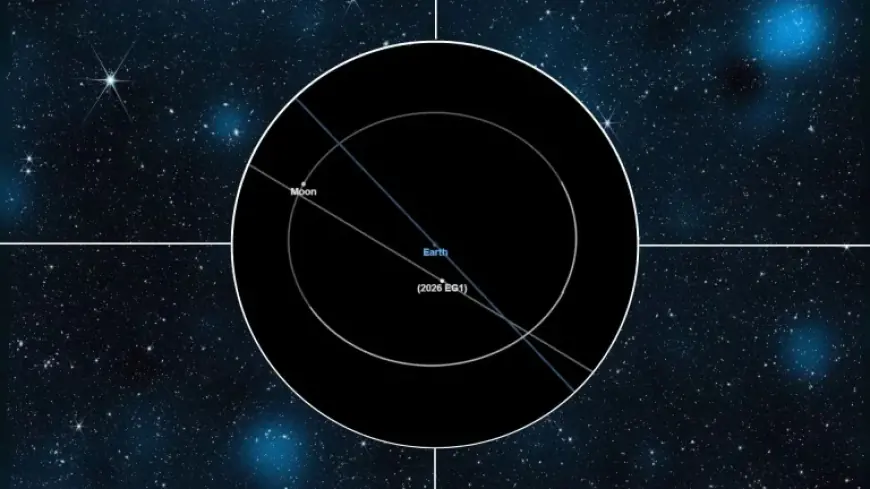
Asteroid approaching earth is not a headline most people expect to read days after an object is first spotted. Yet that is the timetable for 2026 EG1, a newly discovered, bus-sized asteroid found on March 8 and now set for a close pass late on March 12. NASA is tracking the flyby as it slips past our planet closer than the moon, with no risk predicted to Earth or its natural satellite.
NASA’s 2026 EG1 flyby, timed to 11: 27 p. m. ET on March 12
The moment at the center of the latest tracking is precise: 2026 EG1 is expected to make its closest approach to Earth at 11: 27 p. m. ET on March 12, when it will pass 197, 466 miles from the southern hemisphere while traveling 21, 513 miles per hour relative to Earth. The path takes it beneath Antarctica, a reminder that “close” in space can still mean an ocean and a continent away from most human eyes.
The asteroid is small on an astronomical scale but large enough to earn attention in everyday terms. NASA’s estimate places it in a range of 32 to 72 feet wide. Another measurement described it as around 40 feet in diameter, again putting it in the city-bus neighborhood that makes the flyby legible to the general public. Still, the guidance alongside those numbers is steady: it poses no risk to our planet or the moon as it performs a distant lunar flyby and moves on.
From March 8 discovery to a March 12 pass, “asteroid approaching earth” compresses time
The short gap between discovery and closest approach is part of what gives this event its weight. 2026 EG1 was discovered on March 8, less than one week before its late-night pass on March 12. That compressed timeline can sound unsettling, but the tracking itself is built for exactly this kind of quick turn. Observations soon after discovery established that 2026 EG1 follows a 655-day elliptical orbit around the sun, ranging from an innermost point within Earth’s orbit to well beyond the path of Mars.
That orbit carries the asteroid away again after the March 12 flyby. Its next closest planetary approach is not expected until Sept. 13, 2186, when it will pass approximately 7. 5 million miles from the surface of Mars. In other words, the object drawing attention tonight is also an object that will spend most of its time at far larger distances, looping through a solar system that is busy with traffic most people never notice.
CNEOS and a sky crowded with more than 41, 000 tracked near-Earth asteroids
NASA’s Center for Near Earth Object Studies is monitoring 2026 EG1 as part of a much broader catalog: more than 41, 000 near-Earth asteroids currently tracked by NASA and its partners. That number is expected to rise significantly, with the Vera Rubin Observatory already having discovered 2, 000 previously unknown solar system bodies in its initial dataset. Each new object adds detail to a map that is both scientific and practical, defining what is near, what is not, and what requires attention.
NASA has also offered a long-range reassurance: its Center for Near Earth Object Studies has predicted that no major asteroid strikes capable of causing serious damage will occur on Earth in the next 100 years. The agency’s work continues anyway. Alongside tracking, NASA and its partners have been holding mock scenarios to improve worldwide messaging and response, and they have been executing asteroid redirect missions aimed at planetary defense.
For now, the story of 2026 EG1 sits at the intersection of ordinary language and technical certainty. A bus-sized object passing closer than the moon is the kind of phrase that lands in a reader’s chest first and the math second. Still, the numbers and the assessment travel together: a distance measured in hundreds of thousands of miles, a speed measured in tens of thousands of miles per hour, and a prediction that the flyby carries no threat.
As the clock moves toward 11: 27 p. m. ET on March 12, the event remains what the tracking says it is: a brief, silent pass beneath Antarctica by a recently discovered asteroid, followed by a return to its 655-day orbit around the sun.