Avalanche Vs Kraken matchup sets a test of form and finishing trends

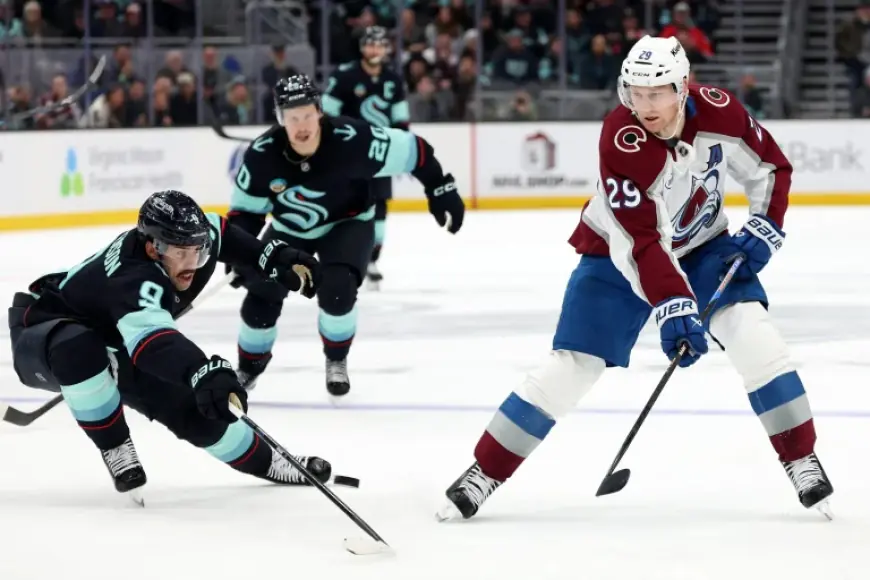
Avalanche vs kraken is the immediate pivot point for Colorado after a frustrating 4-3 loss to the Edmonton Oilers on Tuesday, with the club back on the road and aiming to start a new win streak. The same game also functions as a pressure gauge for Seattle, which is holding the second wild card spot in the West and trying to turn strong process signals into completed results.
Avalanche Vs Kraken at 7: 00 p. m. ET puts recent swings under a spotlight
The matchup is scheduled for 7: 00 p. m. ET, and it lands with both teams carrying distinct, context-backed storylines into the night. Colorado enters after a one-goal loss to Edmonton in which Nathan MacKinnon took a five minute major and a game misconduct for goaltender interference, while Ross Colton left early, leaving Colorado down to 10 forwards for later stages. Even then, Colorado was only down by a goal and could not capitalize, framing the game as one where execution lagged behind proximity to a comeback.
Seattle’s recent reference point is a loss to the Nashville Predators that still contained some of the Kraken’s strongest early-game indicators. Seattle produced one of the best starts to a game in franchise history, generated enough chances to plausibly have four goals in the opening period, and finished with 45 shots, the third most in team history. Yet the game also illustrated how quickly outcomes can tilt: a missed point-blank chance by Jacob Melanson from 15 feet, a nullified goal tied to a goaltender interference sequence involving Ryker Evans and Juuse Saros, and a stretch where Nashville tied it and “things went downhill from there. ”
Nathan MacKinnon, Ross Colton, and Seattle’s wild card race define the immediate drivers
The forces visible in the context are specific and actionable rather than abstract. For Colorado, discipline and lineup stability sit near the top of the list after Tuesday’s penalty-and-ejection to MacKinnon and Colton’s early exit. The forward groups and defensive pairs listed for Colorado underline how the club is arranging its pieces heading into Seattle, including Nazem Kadri between Nathan MacKinnon and Martin Necas, and a defense led by Devon Toews and Cale Makar.
For Seattle, urgency is baked into the standings description: the Kraken “currently hold” the second wild card spot in the West, with the Kings, the Sharks, and the Predators close behind, and about 20 games left in the regular season. That context turns every point into a lever on behavior, and it intersects with a second driver: finishing. The Nashville game account points directly at the gap between process and payoff, with Seattle scoring twice despite a first period that could have produced at least four goals.
Goaltending also remains a central driver. The Kraken’s Philipp Grubauer and Joey Daccord are described as key reasons Seattle stayed in a wild card position, including quantified goals-saved-above-average marks of 12. 03 for Grubauer and 11. 88 for Daccord. Still, the same context flags a recent shift since the Olympic break ended: Seattle has lost five of seven overall, all in regulation, and the two wins in that span are described as games where a Kraken goalie decisively “stole” goals that likely would have changed outcomes.
NHL 26 simulation details highlight a trend focus: special teams and conversion
One data point shaping the discourse is a video game simulation of Thursday’s matchup that projects a 4-2 Seattle win. As a forecast signal, it is not a real-world result, but the play-by-play texture inside the simulation aligns with themes already present elsewhere in the context: early pressure, special teams swings, and Colorado’s need to convert when opportunities arise.
In the simulation, Seattle scores 27 seconds into the first period when Jared McCann deflects an Adam Larsson point shot for a 1-0 lead, then extends it a little more than four minutes later on a Kaapo Kakko slot attempt that slips past Mackenzie Blackwood. Colorado answers through Gavin Brindley after Nicolas Roy forces a turnover behind the net and feeds the slot, but Seattle’s margin grows on a Jordan Eberle power-play redirect after a sequence of Colorado penalties. The simulated middle frame also includes Colorado receiving a power play when Chandler Stephenson is penalized for holding Brock Nelson, but producing only a single shot due to “sloppy puck management. ”
- Based on context data: Seattle urgency is tied to holding the West’s second wild card spot with close chasers (Kings, Sharks, Predators).
- Based on context data: Seattle’s process can be strong (45 shots vs Nashville; third most in team history) without matching finishing.
- Based on context data: Colorado’s recent game showed disruption (MacKinnon major and misconduct; Colton exit) yet remained within one goal late.
- Based on context data: Special teams and penalties appear as swing points in the simulation narrative.
If the current trajectory continues… Seattle’s path hinges on translating high shot volumes and strong starts into goals across a full 60 minutes, a specific need called out directly after the Nashville game. If that conversion gap persists while the standings remain tight around the second wild card spot, the pressure on execution in games like Avalanche vs kraken increases, because the context frames each point as more consequential with about 20 games left.
Should a key factor shift… Bobby McMann’s availability could change Seattle’s immediate lineup options if the necessary immigration paperwork is resolved within the next 24 hours, as of Wednesday’s practice. That scenario is explicitly conditional in the context, but it is also concrete: a newly added forward option would be arriving into a team conversation focused on finishing.
The next confirmed milestone is the 7: 00 p. m. ET puck drop, with Colorado trying to get back on track on the road and Seattle trying to protect its position in a tight West wild card race. What the context does not resolve is whether McMann will be cleared in time, and how Colorado’s group will respond in-game after Tuesday’s penalties and shortened bench. Still, the signals heading in are clear: early execution, special teams discipline, and finishing efficiency are the visible levers likely to define the night.