Byu Vs Houston: BYU faces rested No. 5 Houston in Big 12 quarterfinal test

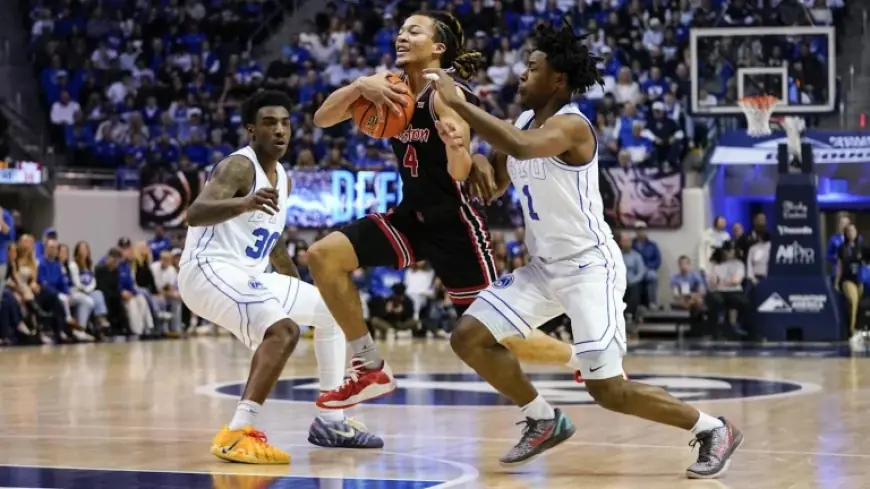
byu vs houston shifts from regular-season scouting to a schedule and execution problem as BYU enters the Big 12 Tournament quarterfinals playing a third game in three days at the T-Mobile Center in Kansas City. Houston, 26-5 and coming off its own three-game winning streak, opens its tournament with a matchup that tests whether BYU’s recent momentum can survive Houston’s physical identity and fresher legs.
BYU and Houston enter hot
BYU arrives after a sharp swing in form: three straight losses were followed by three straight wins in five days. That response has already changed the shape of its tournament, turning what began as an earlier-than-expected opening-round appearance into back-to-back Big 12 Tournament wins. One of those wins carried a specific emotional edge—BYU beat West Virginia after losing to the Mountaineers just 12 days earlier, then delivered a 68-48 result described as wire-to-wire control.
Houston’s recent arc mirrors that reset, even if the résumé looks steadier. The Cougars are 26-5, yet three of those five losses came in the last six games, including a three-game slide that preceded a three-game rebound. Houston’s turnaround included beating Colorado by 40, beating Baylor by 13 at home, and then securing a seven-point road win over Oklahoma State. The pattern suggests both teams are arriving with momentum, but BYU’s has been built inside the tournament environment, while Houston’s was built by stabilizing late in the regular season.
Thursday 7: 00 pm ET setup
The quarterfinal carries a built-in contrast: BYU’s rhythm versus Houston’s rest. The game tips off Thursday at 6: 00 CT (7: 00 pm ET) on ESPN2, with BYU playing for a third straight day and Houston playing its first game of the event. BYU’s path to this point has already required fast turnarounds, while Houston steps in after time to prepare for a single opponent.
That scheduling gap matters because both teams are described as coming off three-game winning streaks, but they got there differently. BYU has had to manage immediate carryover—minutes, legs, and adjustments—while also stepping up a level in competition. Houston, meanwhile, enters as the higher-ranked side in the matchup framing and as a team with a defined identity that opponents “can never overlook. ” For BYU, the practical question is whether tournament rhythm offsets cumulative fatigue when the opponent specializes in turning every possession into work.
Houston’s edge: turnovers and fouls
The on-court problem for BYU is not mysterious, and it is rooted in specific performance signals. Houston is described as “middle of the pack in shooting, ” but strong in controlling the turnover battle: it has the lowest turnover rate in the Big 12 and is second in defensive turnover percentage. That combination implies Houston can limit its own mistakes while also pressuring opponents into theirs, which compresses the margin for error for a team playing on short rest.
The first meeting offered a template for what BYU must clean up. Houston won in Provo 77-66 on February 7, even though BYU did several things well: it committed just 6 turnovers, held Houston to 7-20 shooting from three, and won 14 offensive rebounds to Houston’s 13. Yet two breakdowns swung the game—BYU shot 16-28 (57%) from the foul line, and Houston produced key offensive rebounds down the stretch to close it out. BYU also led 52-50 with about 12 minutes to go before Houston pulled away, a reminder that the margin can hinge on late details rather than early control.
For this rematch, the keys are framed as execution checkpoints rather than stylistic reinvention. BYU is positioned as needing at least three of four: get to the line and make free throws, keep turnovers close, keep the rebounding battle even, and get consistent isolation scoring from AJ Dybantsa to blunt Houston’s traps and turnover pressure. Houston’s foul profile—fouling more than any Big 12 team—cuts both ways. The figures point to an opportunity for BYU to manufacture points at the line, but only if it converts, after the 57% line from the first meeting became a decisive leak.
Personnel and role shifts also color the rematch. Richie Saunders “isn’t around” for BYU now, and the team is described as playing its best stretch after that injury. At the same time, Khadim Mboup, Dominique Diomande, and Alexsej Kostic have bigger roles than in the February matchup, with Mboup and Diomande highlighted for adding length and athleticism. The analytical layer here is straightforward: BYU’s route to narrowing the physical gap with Houston appears tied to role expansion from its frontcourt and rotation pieces, not simply a hot shooting night.
The next confirmed milestone is the tip itself—Thursday at 7: 00 pm ET—when BYU vs Houston moves from preview math to whether BYU can carry tournament momentum into a third consecutive day against a rested opponent. If BYU executes at the line and keeps the turnover and rebound battles close, the data suggests the game can stay in reach deep into the second half, where the February meeting turned on a handful of possessions and missed free throws.