Bryce Huff retirement from the 49ers points to a faster NFL exit cycle


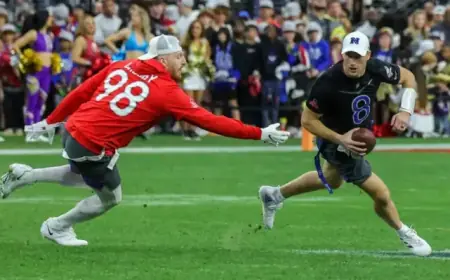
bryce huff has announced he is retiring rather than playing this upcoming season, ending a six-year NFL run while listed as a 49ers defensive end. The move lands as a surprise in the context, not least because it arrives with a contract year still on the table and after a full season of measurable production. The immediate direction is clear: San Francisco has to absorb a sudden depth change while the league watches another early-career exit.
Bryce Huff steps away after six NFL seasons, with a 49ers year on record
The confirmed development is straightforward: Bryce Huff announced his retirement on social media, with the announcement described as coming on a Thursday. One account frames the timing as “more to come, ” while another states he is retiring instead of playing the upcoming season. Both place him with the San Francisco 49ers as a defensive end at the point of the decision.
The context also supplies a performance baseline from his most recent season: in 2025, he appeared in 15 games for the 49ers and recorded 30 total tackles, six tackles for loss, four sacks, two forced fumbles, and a pass deflection. A separate line in the context cites “4 sacks in 8 games, ” paired with an opinion that he “was not a difference maker, ” but the hard data set attached to the 2025 season shows he played a larger sample of games and produced across multiple categories.
Contract status is part of the confirmed picture. The decision is characterized as surprising because he “isn’t even 28 yet” and was under contract for next year at a salary north of $17 million. That combination—youth, an active deal, and a recent season with 15 appearances—sets the stage for why this retirement is being treated as more than routine roster churn.
Jets, Eagles, and 49ers timeline shows contracts moving quickly around Bryce Huff
The forces visible in the context are mostly transactional. Bryce Huff is described as a former undrafted free agent who carved out a career with the Jets, Eagles, and 49ers. The timeline given starts with him signing with the Jets as an undrafted free agent out of Memphis following the 2020 NFL Draft, on a standard three-year UDFA deal. New York then re-signed him as a restricted free agent in 2023, another marker of teams managing cost and control on a pass rusher with a developing profile.
From there, the acceleration becomes clearer. He tested the market as an unrestricted free agent and signed a three-year, $51 million deal with the Eagles. Yet the context notes the Eagles traded him to the 49ers after just one year. That quick pivot—major multiyear money followed by a trade after a single season—signals how rapidly roles and valuations can shift, even for players who reach the high end of the pay scale.
Pay pressure is explicitly present as a driver. The context notes “buzz” that the 49ers would have at least approached Bryce Huff about a pay cut. That matters because it frames the retirement as a decision made in an environment where salary, expectations, and roster planning were already in motion, rather than a move detached from team economics.
49ers roster planning tightens as Bryce Huff exits with a contract year pending
The trajectory implied by the context points in two directions at once: an immediate team-level adjustment for San Francisco and a broader signal about the volatility of player availability, even with contracts in place. One summary in the context explicitly connects the decision to depth, noting it “sucks for depth, ” while also emphasizing relief that “his salary is off the books. ” Taken together, those phrases describe the practical trade-off teams face when a retirement hits: the roster hole appears instantly, while the budget impact can cut the other way.
For the 49ers, the timing carries added weight because the context frames Bryce Huff as retiring instead of playing the upcoming season, not after it. With his 2025 line including 15 games played and four sacks, the team is losing a player who was on the field regularly and contributed in multiple stat categories, even if outside commentary downplays his impact. For the Eagles, his arc reinforces a different signal: a three-year, $51 million deal can still lead to a trade after one year, and the player can still exit the league before the next season begins.
Based on context data:
- 2025 (49ers): 15 games, 30 tackles, 6 tackles for loss, 4 sacks, 2 forced fumbles, 1 pass deflection
- Alternate stat line cited: 4 sacks in 8 games
If pay-cut talks with the 49ers continue, retirements could arrive earlier
If pay-cut dynamics continue… the context suggests a scenario where early exits become a more visible endpoint when salary expectations collide with team planning. The key signal is explicit: there had been buzz that the 49ers would have at least approached Bryce Huff about a pay cut, and the retirement is presented as surprising in part because he was under contract for next year at a salary north of $17 million. If more players in similar situations face comparable pressure points—large salary figures alongside internal reassessments—teams could see more abrupt availability changes that do not follow the usual contract timeline.
Should Bryce Huff’s 2025 production set the reference point, team evaluation standards may tighten
Should the 2025 stat line become the reference point… the gap between measurable production and subjective impact could shape how teams talk about value. The context includes both a detailed 2025 production summary—15 games, 30 tackles, and four sacks—and a blunt assessment that he “was not a difference maker. ” If that tension persists in evaluations, it can push organizations to sharpen definitions of what they will pay for: not only sacks, but overall disruption, role fit, and depth utility, all implied by the way the retirement is framed as both a loss and a budget release.
The next confirmed milestone in the context is the promise of additional detail attached to the retirement announcement, described as “more to come. ” What the context does not resolve is the specific reason Bryce Huff chose retirement over playing the upcoming season, beyond the noted surprise and the mention of possible pay-cut conversations. For now, the visible direction is that a contract year and recent production did not prevent a sudden exit, forcing the 49ers to recalibrate depth planning immediately.