Nuremberg Movie Puts Russell Crowe Back in the Spotlight as WWII Drama Finds New Streaming Audience

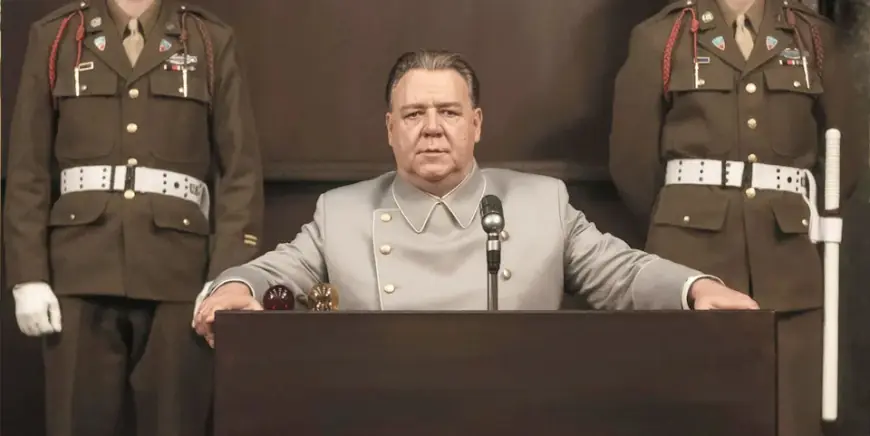
Nuremberg, the historical drama starring Russell Crowe as Hermann Göring, is drawing fresh attention in March 2026 after arriving on streaming, giving the actor one of his strongest recent showcase roles in a film built around the aftermath of World War II.
The movie centers on the Nuremberg trials, but it approaches the story less as a broad courtroom epic than as a psychological contest. Rami Malek plays U.S. Army psychiatrist Douglas Kelley, the man tasked with evaluating Nazi leaders as the Allies prepare to put them on trial. Crowe’s Göring becomes the film’s most unsettling presence, turning nearly every major exchange into a battle of manipulation, ego and moral pressure.
For viewers searching “Nuremberg movie” or “Russell Crowe,” that is the main reason the film has resurfaced in conversation. It is not just another war drama. It is a performance-driven story built around one of history’s most infamous defendants and the effort to understand, document and prosecute evil without excusing it.
What Nuremberg Is About
Directed and written by James Vanderbilt, Nuremberg is based on The Nazi and the Psychiatrist, Jack El-Hai’s nonfiction book about Kelley’s work with imprisoned Nazi officials after the war.
Rather than trying to dramatize every part of the trials equally, the film narrows its focus to the relationship between Kelley and Göring. That gives the movie a more intimate structure than its title might suggest. The courtroom and the political stakes remain central, but the dramatic engine is the psychological duel between a doctor trying to assess a war criminal and a defendant trying to control the room even after defeat.
That approach makes the film less about legal procedure alone and more about the dangerous normality of men responsible for catastrophe.
Russell Crowe’s Hermann Göring Is the Main Draw
Crowe plays Göring with a controlled menace that has become the biggest talking point around the film. He is not presented as a one-note monster. Instead, the performance leans into charisma, vanity, calculation and the unnerving confidence that made Göring such a powerful figure inside the Nazi regime.
That is what gives the role its tension. Crowe’s version of Göring is plainly guilty, but he remains verbally agile, socially manipulative and determined to shape how others see him. The performance works because it resists easy theatricality and instead lets the danger come through in smaller choices, especially in the conversations with Kelley.
For Crowe, it is the kind of role that fits his strengths: commanding, intelligent, forceful and difficult to ignore.
Rami Malek Anchors the Story From the Other Side
If Crowe supplies the film’s intimidation, Malek gives it its moral and emotional center. Kelley is not written as an action hero or a speech-making crusader. He is a professional trying to understand how men who helped organize mass murder could still present themselves as rational, coherent and even persuasive.
That tension gives the film its real weight. Kelley’s work is not just about deciding who is fit for trial. It is about confronting the possibility that monstrous crimes can be carried out by people who do not appear monstrous in any simple way.
The story uses that conflict to ask a harder question than many historical dramas do: not whether the Nazi leadership was evil, but what it means that evil could look so composed.
Why the Movie Is Trending Again
Nuremberg first reached theaters in late 2025, but it has found a new wave of attention after hitting streaming in March 2026. That kind of second life is common for prestige historical dramas, especially ones led by recognizable stars and built around major real-world events.
The renewed interest also reflects search behavior. Viewers who missed the theatrical run are now looking up the cast, the true story, the ending and Crowe’s performance. In that sense, the movie’s current moment is less about awards momentum and more about discoverability. It is reaching a broader audience now than it may have during its initial release.
That is often when a film like this gets its most straightforward test: not whether it plays well as an event title, but whether it holds attention once people can watch it at home.
What to Know Before Watching
The film runs close to two and a half hours and takes a serious, measured approach to its subject. It is not designed as a fast-moving war thriller. It is a dialogue-heavy historical drama with courtroom material, interrogation scenes and moral confrontation at its center.
That means expectations matter. Viewers looking for a sweeping battlefield story may find it more restrained than expected. Viewers interested in the psychology of the Nuremberg trials, the postwar push for justice and Russell Crowe in a deeply unsettling role are more likely to find exactly what they came for.
The strongest reason to watch remains the same one driving search interest now: Nuremberg gives Crowe a substantial, uncomfortable role in a film that treats one of the 20th century’s defining moments with gravity, focus and just enough psychological menace to linger after it ends.