Real Betis grind out a tight Athens night, signaling higher-stakes Europa League margins

Real betis walked into Athens for a Europa League round-of-16 first leg against Panathinaikos with the match level at 0-0 at halftime. The early shape of the night pointed toward a two-track end-of-season reality: European ties decided by small moments, and domestic objectives that hinge on an immediate response after recent league frustration.
Panathinaikos vs Real Betis in Athens: a 0-0 halftime baseline
The confirmed snapshot from the first leg came at the break: Panathinaikos and Betis were 0-0 at halftime at the Olympic Stadium of Athens. The first half was described as featuring greater control from the Spanish side, with Betis holding the ball and creating more danger, while the Greek team remained solid and organized defensively. That combination, possession without separation, established the immediate trend line for the tie: control alone may not be enough if the opponent keeps its defensive structure intact.
Match events later in the running account underscored how narrow the margins were becoming. There were multiple moments where a single touch could have turned the direction of the game: a close-range chance involving Fornals and a volley by Antony that was repelled by Lafont, and a separate defensive scare when a lateral free kick from Taborda left the ball loose in the Betis area without a Panathinaikos finisher able to apply the decisive touch. Even without a full match summary in the context, the sequence of chances shows a game moving from halftime control into a second phase where isolated episodes carried outsized weight.
Manu Fajardo sets Real Betis targets: hold fifth in LaLiga, push in Europa League
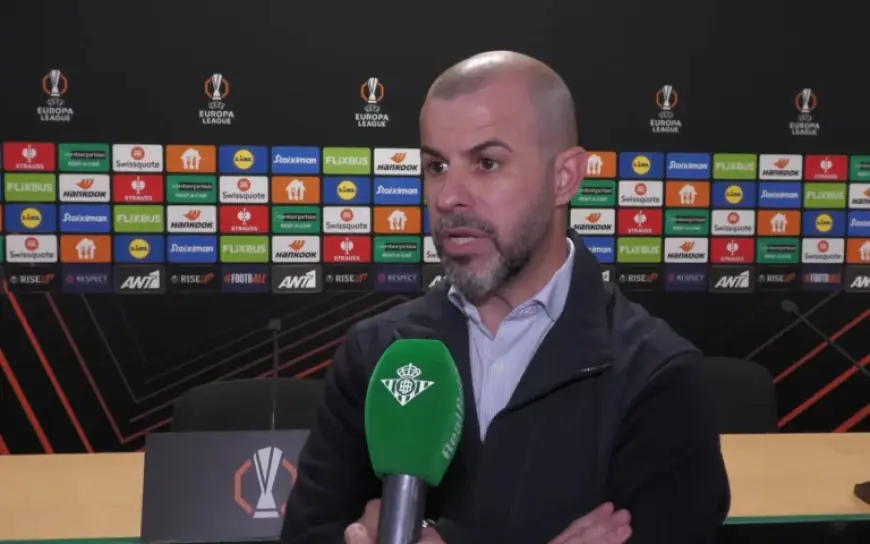
Before the Athens match, Manu Fajardo, the sporting director of Real Betis, framed the stakes in explicit terms. He pointed to the need for a reaction after “the last bad results, ” with the immediate domestic aim of at least consolidating fifth place in LaLiga. In the same breath, he described the team as being on the verge of reaching a Europa League quarterfinal for the first time in its history, adding urgency to a round-of-16 tie that could redefine the club’s season arc.
Fajardo’s central message was not subtle: the team has to “take one more step. ” He acknowledged that in recent league matches the side had been “a bit far” from its usual level in both phases of play, while still expressing confidence in the squad’s commitment and in the staff. He also anchored his argument in comparative context: this season the team has two more points than last season, despite taking only 2 out of 9 in the last three league games. That detail sketches a tension inside the current trajectory—overall consistency across the campaign, but a recent drop that threatens to complicate the run-in if it continues.
Injuries and in-game volatility around Pau Lopez, Lafont, and the red card moments
Fajardo also pointed to a concrete drag on planning: the team has barely been able to count on three key players—Isco, Lo Celso, and Amrabat—who are expected for the final stretch. He stressed it was not an excuse, but he described it as a reality that penalizes planning across the summer and winter market windows. As a trend signal, the message is straightforward: the final portion of the season may hinge on whether those players can be reintegrated in time to lift the level Fajardo said has been missing recently.
On the pitch in Athens, the live account offered further evidence of volatility shaping the tie. A second yellow card for Llorente reduced Betis to 10 men, matching a situation where the margin for error narrows sharply. A possible penalty sequence was also described: Swiderski’s shot was saved by Pau Lopez and Diego Llorente then struck the forward on the ankle, prompting a review for a potential Panathinaikos penalty with Marciniak going to the video review. Meanwhile, substitutions hinted at tactical adaptation under pressure: Bartra came on for Fornals, and Deossa replaced Altimira; Panathinaikos also made a double change, introducing Swiderski and Siopis for Tetteh and Cerin.
If the current trajectory continues… a match pattern like the 0-0 halftime baseline—Betis with more of the ball but facing a disciplined defensive block—raises the importance of single plays: set pieces like Taborda’s deliveries, one-off chances such as Antony’s volley, and disciplinary moments like Llorente’s second yellow. In that kind of game state, the tie can tilt on a limited number of high-leverage incidents rather than sustained dominance.
Should a specific factor shift… the late-season picture changes if the expected returns of Isco, Lo Celso, and Amrabat materialize in the “final stretch” Fajardo referenced. His comments tie the team’s recent dip in both phases of play to an overall season shaped by injuries and heavy match volume; getting those players back would be the most direct context-supported mechanism for the “one more step” he demanded, both to stabilize fifth place and to keep the Europa League run alive.
The next concrete signal in the context is procedural rather than rhetorical: the Athens match itself produced decisive checkpoints—video review involvement for a possible penalty and a red-card reduction to 10 men—that show how quickly the tie can swing. What the context does not resolve is the final score of the first leg or whether the anticipated player returns actually happen on the timeline Fajardo laid out, leaving the end-of-season direction dependent on confirmations still to come.