Ucf Vs Arizona: Big 12 quarterfinal set as scouting report flags bubble tension

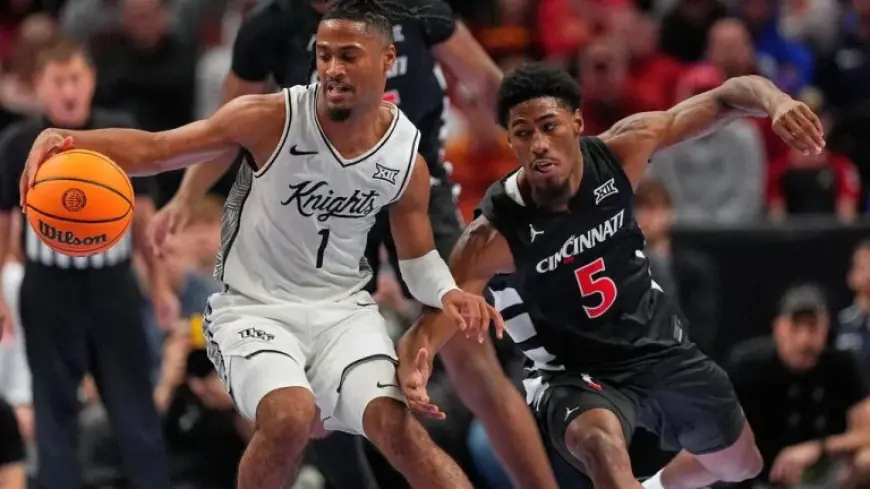
ucf vs arizona is scheduled as a Big 12 Tournament quarterfinal matchup between No. 1 seed Arizona (29-2) and No. 8 seed UCF (21-10). The surface storyline is simple: a top seed meeting a lower seed after UCF’s overtime escape against Cincinnati. Yet the documented framing around UCF pulls in two directions at once, describing a team on the NCAA Tournament bubble while also suggesting its latest win should make the result against Arizona largely irrelevant to its selection case.
Arizona, UCF, and a quarterfinal built on seeding and a one-point overtime win
Confirmed details set the bracket. Arizona earned the No. 1 seed in the Big 12 Tournament after going 16-2 to win the conference’s regular-season title. UCF finished 9-9 in league play, ended in a four-way tie for seventh, and landed the No. 8 seed through tiebreakers.
UCF reached the quarterfinal by beating Cincinnati 66-65 in overtime in a second-round game Wednesday. The matchup itself is set for the Big 12 Tournament quarterfinals at T-Mobile Center in Kansas City, with a listed start time of noon Thursday. The broadcast information in the record indicates the game will air on, with Arizona’s radio listing at 1290-AM.
On the court, the context includes a direct point of comparison from this season: Arizona beat UCF 84-77 in Orlando on Jan. 17. Arizona’s Motiejus Krivas had 17 points and 12 rebounds, while Jaden Bradley scored 23 points and hit 9 of 10 free throws taken in the final 77 seconds. For UCF, the same set of notes indicates Koa Peat was limited to four points while dealing with foul trouble, while Brayden Burries scored 18 on 8-for-14 shooting and Tobe Awaka added 10 points and nine rebounds.
UCF’s NCAA Tournament “bubble” label versus “expected bid regardless” language
The investigative tension sits inside two confirmed statements that do not neatly align. One part of the record describes UCF as putting itself “on the NCAA Tournament bubble” after ending the regular season with a downturn. Another part states UCF’s overtime win over Cincinnati “is expected to earn them an NCAA Tournament bid regardless of Thursday’s game. ”
Both characterizations are tied to the same documented arc. UCF started Big 12 play 6-3, a stretch that included a win over Kansas and a “close call” with Arizona. Then the Knights “dropped six of nine” to close the regular season, a slide that nearly cost them a first-round bye in the conference tournament. They lost at home to Baylor and Oklahoma State and then lost at West Virginia on March 9 to end the regular season.
Still, the record also says UCF “skidded into the No. 8 Big 12 seed thanks to tiebreakers, ” then beat Cincinnati. That win is the factual pivot: it is explicitly cited as a reason the team’s NCAA Tournament outlook may be insulated from the result against Arizona. The context does not confirm what specific selection criteria or committee evaluation led to that “expected” outcome, and it does not confirm whether UCF’s status changed before or after the Cincinnati game. What remains unclear is how the same profile can be framed as both “bubble” and “regardless” without additional documentation in the record about who is making the forecast and on what basis.
Tommy Lloyd, Jaden Bradley, and the on-court profile that underlies the framing
Arizona enters with both results and internal talking points that also shape how the game is being sold. The record notes Arizona coach Tommy Lloyd discussed why Jaden Bradley “deserved to be Big 12 Player of the Year, ” alongside thoughts on other Arizona award winners. That is a documented position from inside Arizona, but the context does not confirm the award outcome or what other awards were referenced.
For UCF, the record lays out performance and efficiency markers that help explain why “bubble” language may persist even alongside an “expected bid” claim. UCF is described as having a balanced offense with four players averaging in double figures and using the same five starters as in the game against Arizona. Yet UCF’s team profile is uneven: it ranks 39th in overall offensive efficiency but 105th in defensive efficiency.
Three-point shooting also comes with a built-in qualifier. UCF shoots 36. 8% from three, but three-pointers make up only 34. 4% of its field goal attempts. The context frames individual form as a possible swing factor as well: guards Themus Fulks and Riley Kugel “entered the Big 12 Tournament on a hot note, ” with Kugel averaging 20. 0 points over his previous five games while hitting 9 of 18 three-pointers. The same passage then states Kugel averaged 18. 8 points over the same five games, a numerical mismatch the context does not reconcile. Kugel scored 15 against Cincinnati on Wednesday, while Stillwell posted his eighth double-double with 17 points and 15 rebounds.
Fulks is described as averaging 6. 8 assists entering the tournament, ranking second in the Big 12 and 10th nationally. He scored four points against Cincinnati but had seven assists. The context also states he scored 30 points on 9-for-14 shooting against Arizona and had three games of 22 or more points in his last six, underscoring that the “balanced” label does not preclude a single-guard takeover.
Arizona’s advantage in the series is also explicit: the teams had not met before Arizona joined the Big 12 last season, but Arizona is now 2-0 against UCF, including an 88-80 win last season at McKale and the 84-77 win in Orlando this season. The context does not confirm whether “close call” refers to the 84-77 result or another game state within it.
The next piece of evidence that would resolve the central gap is not a prediction but a verifiable outcome: how UCF’s selection outlook is treated after Thursday’s game. If UCF is confirmed to receive an NCAA Tournament bid regardless of the ucf vs arizona result, it would establish that the Cincinnati win alone carried decisive weight within the framing presented here.