Big Ten Network bracket talk puts Indiana and Iowa on edge

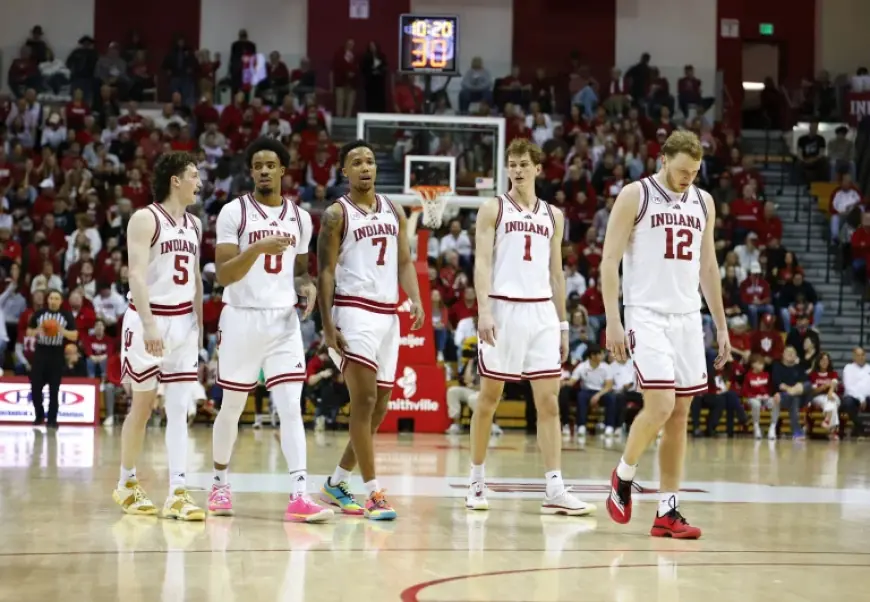
For Indiana, the bubble is not an abstract concept this week; it is a single game that has to be found and won. As the big ten network conversation turns to matchups and paths, the Big Ten Tournament opens with teams staring at their own thin margins—some chasing seeding, others chasing survival—before the event shifts to Chicago for its March 10-15 run at the United Center.
Indiana Hoosiers and one win that changes the bubble math
Indiana enters the Big Ten Tournament with an unusually clear requirement laid out in front of it: at a minimum, the Hoosiers need to win one game to even be considered for the NCAA Tournament. The bracket road begins in the second round, where Indiana will play the winner of a first-round matchup between 15-seed Northwestern and 18-seed Penn State.
From there, the stakes rise quickly. The next step would be a meeting with arch-rival Purdue, the 7-seed. The framing around Indiana is blunt: an upset of Purdue would improve the Hoosiers’ position, and stacking that with another win—against Minnesota, Rutgers, UCLA, or Michigan State—would “do wonders, ” even while that multi-win run is described as highly unlikely.
The bubble label is not just rhetorical. ’s Joe Lunardi had Indiana as the first team out of the field as of Monday night, leaving the Hoosiers in the kind of spot where the bracket has to be read almost like a checklist: one win to keep the conversation alive, more wins to change it.
Iowa Hawkeyes, UCLA Bruins, and the fight to escape the 8/9 line
For Iowa, the tension sits in a different place. The Hawkeyes have lost six of their last eight, yet they are still described as firmly in the NCAA field. What hangs over them is seeding. Bracket Matrix has Iowa as the top-rated 9-seed, and in a year described as having four 1-seeds that “look like superstars, ” getting out of an 8/9 game is framed as paramount.
Iowa’s path in the Big Ten Tournament starts with the winner of 16-seed Oregon versus 17-seed Maryland in the second round. Win there, and the next step is Ohio State. If Iowa wins twice, the reward is a rematch with Michigan—an opponent that could function as a lever. A victory over the Wolverines “just might be enough” to move Iowa off the 8/9 line.
UCLA is slotted into the same seeding anxiety. The Bruins are described as squarely on the 8/9 line, with Lunardi listing them as an 8-seed in the West Region—one that would potentially put them into a second-round game against 1-seed Arizona after a first-round meeting with 9-seed Texas A& M. The route to something better runs through the Big Ten Tournament. UCLA is the 6-seed and has a double-bye. The Bruins will play the winner of 11-seed Minnesota and 14-seed Rutgers, and a win there would set up a quarterfinal with Michigan State.
The assessment is specific: beating Minnesota or Rutgers likely would not move UCLA off the 8-seed line, but beating Michigan State could. In bracket terms, that single result becomes the hinge between staying in the same neighborhood and finding a different street entirely.
Chicago’s United Center, Michigan’s title memory, and what the bracket asks next
The 2026 Big Ten men’s basketball tournament will be played March 10-15 at the United Center in Chicago. For Michigan, that setting carries an immediate historical marker: the Wolverines won the 2025 tournament, beating Wisconsin 59-53 in the championship game as the No. 3 seed over the No. 5 seed. That result makes Michigan the defending champion as a new bracket begins to fill in.
Michigan State holds the largest share of Big Ten tournament titles, with six, and the Spartans last won the event in 2019. Those numbers sit over the present week like a reminder that programs arrive in March with different kinds of pressure: some have banners to defend, others have droughts to end, and some have a narrow doorway to squeeze through.
Even the overall Big Ten NCAA picture is framed as unusually defined. The field projection described for the conference sits at nine likely teams with a chance to add a 10th, paired with the warning that it could slide to eight if “disaster” hits and bids are stolen by other leagues. That is where the big ten network style of bracket talk lands hardest—on the teams near the cut line, where an early loss can change the conversation faster than any season-long resume building.
Ohio State, for example, is presented as a team whose recent month has shifted its status. At the end of February, the Buckeyes were narrowly outside the NCAA Tournament picture. Since March began, they picked up wins over Purdue, Penn State, and Indiana, moving them to around the 10-seed line for most bracketologists. Yet their safety is described as conditional: one win in the Big Ten Tournament is “likely enough” to guarantee it, while the risk grows if bid thieves emerge elsewhere.
The tournament, then, holds different missions at once. Michigan arrives as the most recent champion. Michigan State sits as the most decorated by titles. Iowa and UCLA chase a seed line that could dictate a second-round opponent. Indiana tries to secure the one win that keeps its season in the NCAA conversation. The bracket is a map, but it is also a set of instructions, and for teams living close to the margins, those instructions start with the next game and do not get any simpler from there.