Max Homa faces TPC Sawgrass tweaks as agronomy work intensifies

max homa arrives at TPC Sawgrass as The Players Championship setup tilts toward a tougher start: players have described “a bit more fire” in the greens and fairways, while the rough has been allowed to grow through the championship after a final mow on Sunday. The combination concentrates pressure on accuracy and reshapes the calculus on pivotal holes, especially the short par-4 12th.
Lucas Andrews’ TPC Sawgrass setup
Course preparation is being led by Lucas Andrews, who took over as director of agronomy last fall after 17 years on staff at TPC Sawgrass. Andrews described the approach as consistent with annual targets rather than a new mandate to “challenge the pros, ” pointing instead to Northeast Florida weather as the catalyst that allowed the team to reach its preferred championship position.
That weather window has translated into two concrete playing characteristics noted by players in the days leading up to the tournament: firmer turf and thicker rough. Scottie Scheffler said Tuesday that the greens are “a little bit firmer than they have been the last couple years, ” adding that they were “definitely firm to start the week, ” while also flagging that the forecast could still influence how conditions evolve.
The pattern suggests the early-week setup is designed to reward clean positioning rather than brute recovery, because firmness tends to narrow the margin between a controlled shot and a ball that runs into trouble. Andrews’ decision to mow the rough one last time on Sunday and then let it grow through the championship underscores that emphasis on precision, especially when paired with turf that releases more than it has in recent years.
Justin Rose on thicker rough
Players have already felt the practical impact of the rough increase at ground level, with balls “disappearing in multiple areas. ” Justin Rose said he had heard the rough was “4 1/2 inches, ” framing it as a conscious choice to go “a tiny bit longer” this year. Rose tied the change directly to strategy: the course remains “first and foremost” about getting the ball in the fairway, but the longer rough can raise the penalty when that first job is missed.
For max homa and the rest of the field, that framing matters because it points to a subtle but significant shift: strategy may not change on paper, but outcomes can. The figures point to a more binary week—either play from the fairway with options into firm greens, or accept that thicker rough can remove spin, control, and confidence even before a player reaches the putting surface.
Yet Andrews’ comments also indicate the setup is not a one-note attempt to punish. His description of targeting “championship-caliber” conditions every year suggests the current playing bite is as much the product of timing and weather cooperation as it is an intentional escalation. That distinction is important for understanding the next variable: how quickly conditions could pivot if the forecasted cooler weather and rain arrive.
12th hole and the 220-person crew
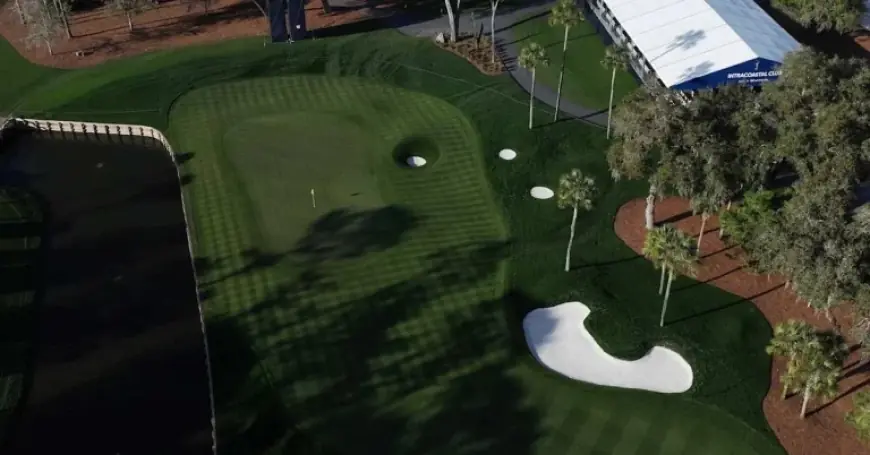
No hole better captures how these agronomic decisions can ripple into scoring than the short par-4 12th at TPC Sawgrass. Listed at 365 yards, it can also be shortened dramatically through an array of tee boxes, with tournament officials able to set it as short as 270 yards. The risk-reward equation is defined by water lining the raised green along the entire left side, while dense trees protect the right side parallel to the putting surface.
Historically, the hole has often functioned as a conventional two-shot par 4, with players choosing less than driver and laying up short of the trees on the right to leave a short pitch. The article notes that Pete Dye held a firm stance against the drivable par-4 concept, and that Sawgrass’ 12th originally reflected that preference with mogul-style bunkers guarding against overly ambitious tee shots. A later overhaul in 2011, when Steve Wenzloff was brought in, shifted the hole into its current role as a reachable option, changing how often players consider taking on the green from the tee.
Behind the scenes, the labor to present that decision point at championship standards is being carried by a 220-person agronomy team of full-time staff and volunteers. Industry vendors are also supporting the crew with catered meals, a swag bag, guest speakers, and a golf simulator intended to make an intense week more manageable. John Deere’s Chase Tew described shadowing the crew and seeing “the decision-making it takes to execute their plan, ” including workers “walking with buckets, filling every divot. ”
The most immediate operational question is weather. Cooler conditions and rain are expected on Thursday, a forecast that could soften the “firm to start the week” setup described by Scheffler and alter how aggressively players attack the 12th, where firmness can increase both opportunity and danger around a raised green bordered by water. If Thursday’s expected rain holds, the data suggests the course could play less bouncy and slightly more receptive, but the longer rough would still keep fairways at the center of the week’s scoring equation.