Singapore tourism marketing shifts toward playful, culture-led short-stay travel

singapore is being positioned through two parallel signals: a practical, two-day layover itinerary that urges visitors to leave the airport and a new Singapore Tourism Board (STB) push to present the city as a “springboard for play” for Hong Kong audiences. Together, they point toward a travel narrative that favors short, high-density experiences built around food, heritage sites, shopping, and contemporary culture.
Singapore Tourism Board brings “We don’t wait for fun” to ComplexCon Hong Kong
STB has partnered with ComplexCon for the first time, introducing a series of travel promotions aimed at Hong Kong audiences in collaboration with Singaporean artist tobyato and eCommerce platform ShopBack. The campaign, titled “We don’t wait for fun, ” targets early-career travellers aged 25 to 39—and beyond—using a framing that invites people to “rediscover Singapore from a fresh perspective. ”
In the context provided, the core mechanism is cultural translation: the initiative spotlights intersections where “heritage meets street culture” and where “familiar icons are continuously reimagined. ” At ComplexCon, STB’s presence includes a three-metre-tall “Sneaker Stone Dragon” art installation and a dedicated booth designed to highlight “unexpected and memorable spots. ” The installation is described as inspired by Dragon’s Teeth Gate, an ancient navigational landmark that once guided sailors to the island’s shores, and is reinterpreted as a modern symbol of creativity and movement.
tobyato’s role signals a deliberate blend of legacy imagery and modern aesthetics. The context describes a reimagining of traditional stone lions through street art and sneaker cues like laces and stitching, alongside motifs drawn from Singaporean icons and heritage. Visitors are also offered limited-edition keepsakes created exclusively for ComplexCon, including art toys, keychains, sports jerseys, socks, and stickers. The booth’s experience design mixes “nostalgic gameplay” with “high-energy, interactive experiences, ” including the classic childhood game Goli Shoot, described as a playground favorite across kampongs and schoolyards for generations.
Urvija Banerji’s two-day layover guide spotlights dense, walkable experiences
In a separate signal of what is being emphasized in short-stay travel, Urvija Banerji ’15 recommends a two-day layover approach that begins with a direct behavioral push: do not wait near the airport, and “pass immigration” to see the city-state. The framing acknowledges popular imagery of “infinity pools on skyscrapers” and “futuristic parks, ” then pivots to a Singapore presented as a place with “a rich history of intercultural exchange, ” a “relaxed pace of life, ” and “some of the best food in the world. ”
The itinerary described is built around a sequence of concentrated stops that require little narrative setup beyond proximity and variety. It starts with coffee at Calligraph Coffee, then moves into Chinatown with the Chinatown Heritage Centre, which is described as featuring a reproduction of a 1950s shophouse interior. Two religious sites appear as complementary anchors: Sri Mariamman Temple, described as centuries old and open to visitors of all faiths with a colorful facade, and the Buddha Tooth Relic Temple, described as a newer addition with striking red pagodas and a tooth relic.
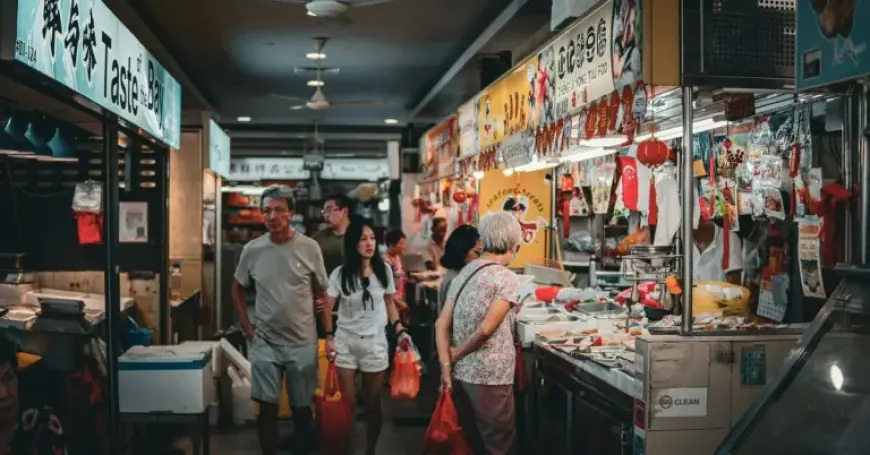
Food is treated as both a destination and a system. The guide sends travelers to Tiong Bahru Market, explaining the ground-floor wet market for fresh meat and fish and an open-air hawker center upstairs. The context ties this to the Michelin Guide’s arrival in Singapore in the 2010s, noting that hawker stalls began receiving stars or Bib Gourmands, and that a Bib Gourmand went to Hong Heng Sotong Prawn Mee at Tiong Bahru. The guide explicitly lists dishes a visitor might choose—roti prata, Hainanese curry rice, pandan-flavored chendol—and includes a travel-reassurance note: the government enforces strict standards at these outdoor food venues.
From there, shopping is presented as a “national pastime, ” anchored by Takashimaya, its basement food hall for edible souvenirs, and Kinokuniya as a bookstore destination. The day’s late segment shifts to a Singapore River cruise at Boat Quay, with the guide noting locals ride regularly despite its “tourist trap” reputation, and highlighting views of Marina Bay, the skyline, and the Merlion statue. The evening endpoint is Long Bar at the historic Raffles Hotel, linked to the Singapore Sling’s invention in 1915 and a quirky detail: peanut shells are encouraged on the floor even though littering elsewhere may draw hefty fines.
Singapore’s visible direction: curated “unexpected” stops and rewards through 30 April 2026
Read together, the context shows a direction of travel that favors curated, high-impact experiences packaged for both short layovers and younger leisure segments. On one side, the layover guide is essentially a compressed map of high-salience stops: a single neighborhood (Chinatown) yields multiple distinct attractions, and a single market (Tiong Bahru) yields both a wet market and a hawker center. On the other side, STB’s activation leans on an “unexpected fun” frame, using a large-scale installation and interactive booth to push the idea that Singapore is not “predictable or functional, ” but reimagined through street culture, heritage motifs, and gameplay.
Another visible force is the extension beyond a one-off event into a longer promotional runway. STB’s partnership with ShopBack is set to roll out “surprise experiences and rewards” for Hong Kong travellers exploring the Lion City, running from now until 30 April 2026. The context describes this as leveraging Singapore’s “smart connectivity” for seamless planning and travel, and as a way to bridge “discovery and decision-making, ” rewarding travellers not only for where they go but how they choose to experience Singapore.
If the ComplexCon-style activation continues… the context suggests Singapore’s pitch to Hong Kong audiences will keep foregrounding limited-edition cultural touchpoints and interactive design—art installations, exclusive keepsakes, and nostalgic games—to turn heritage references into a contemporary “gateway” experience tied to travel promotions.
Should the layover-style itinerary framing expand… the context implies that more messaging could emphasize leaving the airport for compact, walk-friendly sequences that combine coffee, museums, temples, hawker food, shopping, and riverfront sightseeing—an approach that treats a couple of days as enough time for a structured “sampling” of icons and everyday life.
The next confirmed milestone in the context is the ShopBack-linked run of surprise experiences and rewards continuing until 30 April 2026. What the context does not resolve is how success will be measured for the ComplexCon partnership, or how strongly these campaigns will shift actual visitor behavior beyond the events and itineraries described.