Toxic Commando reviews frame a grind-heavy Carpenter experiment

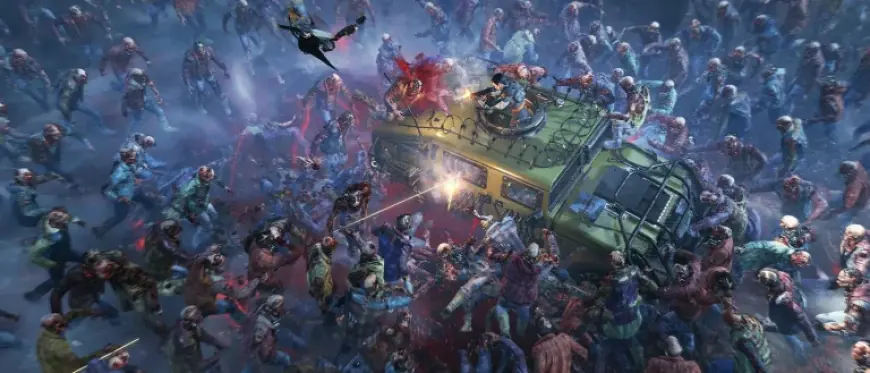
Early coverage of toxic commando points to a co-op horde shooter that leans hard into John Carpenter’s signature mood—synth-driven tension, foggy roads, and reluctant anti-heroes—while also asking players to accept a progression grind that can feel punishing. Together, the readouts suggest the game’s identity hinges on whether its atmosphere and curated set pieces outweigh repetition, especially as expectations build toward its arrival in March 2026.
John Carpenter’s Toxic Commando tone
The most consistent takeaway is how deliberately John Carpenter’s Toxic Commando wraps its action in Carpenter-inspired presentation. A pulsing synth soundtrack runs under the firefights, and a “Cinema Ambience” graphics mode is described as shifting color toward Carpenter-style palettes. Even when the game shifts into “full zombie-splattering chaos, ” the coverage emphasizes that the mood holds: fog, empty roads, and lingering shots of distant movement work as connective tissue between loud set pieces.
Cinematics appear to do heavy lifting. Between horde sequences, the camera reportedly lingers on quiet spaces—roads, hillsides, and shapes in the fog—before the swarm arrives. The pattern suggests the game is trying to manufacture dread as a gameplay ingredient rather than a cutscene garnish, with a visual rhythm that slows the player down just enough to anticipate the next wave instead of simply reacting to it.
Saber Interactive’s horde-shooter loop
Beneath that mood, the structure is framed as familiar to the co-op horde shooter subgenre. Toxic Commando is explicitly placed alongside games such as Left 4 Dead, Warhammer 40, 000: Darktide, and Saber Interactive’s own World War Z, setting expectations that the real engine is replayability. One write-up describes a lean, functional story that largely “services the grind, ” acting as connective tissue for the next goal, the next quest, and swarm survival.
The setup described is “pure Carpenter pulp”: a group of smugglers chasing payday collides with a supernatural catastrophe tied to an entity called the Sludge God. The characters are framed as bickering, mocking, and treating an apocalypse as an inconvenience. That characterization is credited with giving missions personality, with dialogue that is sharp enough to make players want to hear the next exchange. Yet the same coverage also notes that story threads—fractures teased between characters—do not pay off, reinforcing the idea that narrative flavor is present, but progression remains the main course.
Systems details underscore what the loop is intended to reward. Toxic Commando is described as having four classes, dozens of weapons, and a prestige system that unlocks special camos. Replaying missions on higher difficulties yields more XP and Sludgite, identified as the resource used to upgrade weapons. The figures point to an experience calibrated less around a one-and-done campaign and more around repeated runs that steadily feed upgrades, cosmetics, and class experimentation.
March 2026 game length expectations
Timing and value are where the current coverage creates the clearest pressure point. March 2026 is identified as the arrival window for John Carpenter’s Toxic Commando, and one estimate pegs completion at between eight and 10 hours on Normal difficulty, with variation based on playstyle and exploration choices. Missions are described as featuring more open areas, likened to a compact open world, where players can either beeline objectives or sweep points of interest.
That runtime is presented as potentially “short” to some players, but it is also positioned as typical for a horde shooter designed around replay. Three Acts and nine missions are cited, implying a finite main path that is meant to be revisited rather than simply finished. Still, the grind emphasis flagged elsewhere—described as punishing at times—suggests the outcome will depend on whether players view repetition as rewarding progression or as padding around a thin narrative spine.
What remains open is how consistently the game can maintain its Carpenter-flavored tension across repeated runs of the same nine missions. If the mood-setting cinematics and “Cinema Ambience” presentation keep paying off even on replays, the data suggests toxic commando could feel like a distinct spin within a crowded subgenre; if they fade into the background during the upgrade chase, the grind becomes the defining feature players remember when weighing its length against its replay demands.