Nanophotonic Waveguide Revolutionizes Chip-to-World Beam Scanning

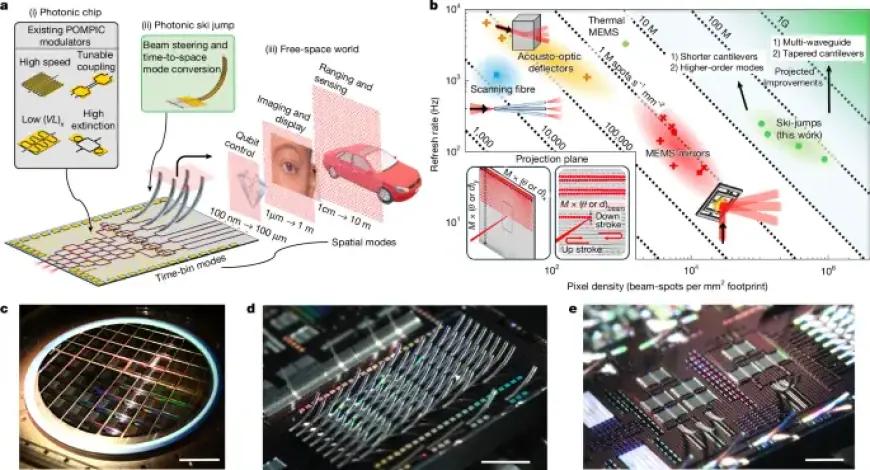
Recent advancements in nanophotonic waveguide technologies are transforming the field of beam scanning, particularly for automotive LiDAR systems. These innovations aim to enhance both the efficiency and effectiveness of laser beam steering processes.
Understanding Nanophotonic Waveguides
Nanophotonic waveguides are fundamental in directing light at extremely small scales. Their ability to manipulate light with high precision makes them ideal for applications demanding accuracy, such as LiDAR technology. This system is increasingly relevant in autonomous vehicles, where precise scanning is critical for navigation and safety.
Key Technological Breakthroughs
- Microcantilever-Integrated Photonic Circuits: Research by Sharif Azadeh et al. in 2023 introduced a novel microcantilever system that facilitates broadband laser beam scanning, enhancing the versatility of beam steering.
- High-Q MEMS Resonators: The work conducted by Hofmann et al. investigated MEMS resonators, which are integral for high-quality laser beam displays.
- Optical Phased Arrays: Poulton et al. demonstrated a coherent LiDAR system utilizing an 8,192-element optical phased array, showcasing significant advancements in scanning capabilities.
Recent Studies and Applications
Several recent publications offer insights into the effectiveness and future of nanophotonic waveguide applications:
- Li et al. presented a frequency-angular resolving LiDAR, marking a critical step towards more efficient scanning mechanisms.
- Zhang et al. explored large-scale microelectromechanical systems (MEMS) in LiDAR, revealing new possibilities in integrating silicon photonics with advanced scanning technology.
- Farmakidis et al. discussed the challenges and opportunities of integrated photonic neuromorphic computing, highlighting the intersection of photonics and computing.
Future Directions
The future of nanophotonic waveguides looks promising, especially as research continues to evolve. The integration of nanotechnology into autonomous systems will enhance device capabilities across various sectors, primarily in robotics and automotive applications. Ongoing exploration in chip-scale applications is pivotal for scaling these technologies effectively.
In conclusion, the ongoing advancements in nanophotonic waveguide technology are poised to revolutionize beam scanning for automotive LiDAR, representing a leap forward in both safety and innovation in autonomous vehicles.