Djokovic sees a path for Alcaraz to chase a record start

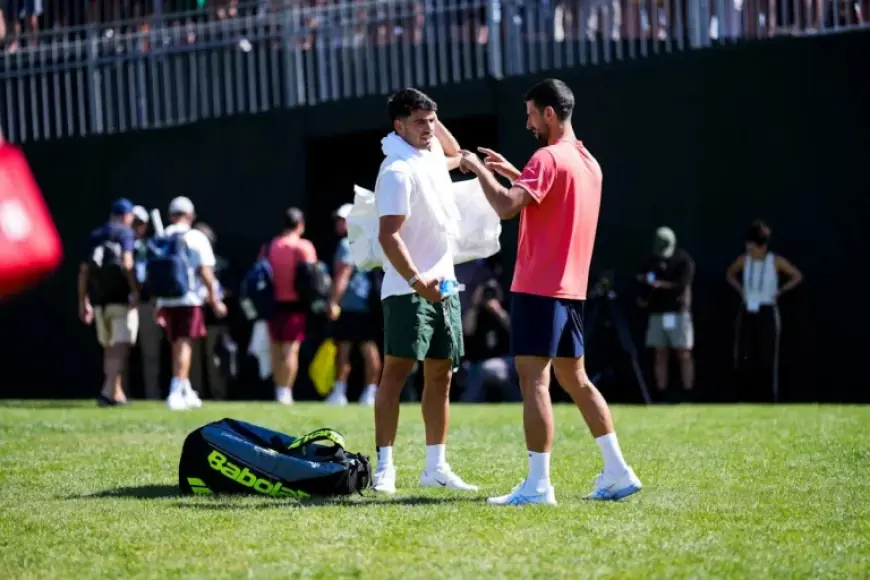
Carlos Alcaraz heard the number first, then felt what it meant: 41 straight wins to open a season. In Indian Wells, djokovic’s unbeaten run to begin 2011 resurfaced as a measuring stick for the world No. 1’s perfect start to 2026. After his own second-round win in the desert, djokovic did something rare for a record holder: he pointed to a successor and said it could be done.
Indian Wells puts Carlos Alcaraz next to Djokovic’s 2011 standard
When Novak Djokovic’s 41-match winning streak to begin 2011 came up in Tennis Paradise, Alcaraz didn’t treat it like a museum piece. He spoke about the way the number changes shape when you try to reach it. “You don’t realize how difficult it is until you’re chasing that, ” he said on the eve of the tournament, walking through the math of what it takes to keep stacking wins. Alcaraz described the moment when a target that sounds manageable becomes a stretch of “four or five more tournaments, the biggest tournaments in the world. ”
Then the tournament supplied the evidence of where Alcaraz stands right now. The world No. 1 improved to 13-0 in 2026 when he swept past Grigor Dimitrov 6-2, 6-3 in 69 minutes at Stadium 1. The context around that unbeaten start is plain in the record chase: he still has a long way to go, and even a third-round victory over Arthur Rinderknech in Monday’s action would only move him to 14 wins on the season.
Yet Alcaraz has already won the Australian Open and Qatar Open in 2026, and his win over Dimitrov in Indian Wells pushed him into the role of tournament title favourite. That is the kind of present-tense momentum that turns old streaks into active goals, and places each next match under a slightly different pressure.
Djokovic’s Majchrzak win resets his own season in the desert
While Alcaraz’s streak drew attention, Djokovic’s Saturday night had its own stakes. He beat Kamil Majchrzak 4-6, 6-1, 6-2 in the second round, and afterward he talked about what it felt like to return after time away from competition. Djokovic said he had not played since the Australian Open, and he framed the match as a test of managing the first minutes back in an “official match. ”
“Five weeks with no official match, I knew that the first match in such a long time will be a little bit tricky, ” Djokovic said. The details he chose mattered: losing the first set, resetting “right away in the second, ” and finding his “‘A’ game when it was most needed, ” especially at the beginning of the third. He also pointed to the conditions, describing the match as played in blustery weather, and said he was happy with how he “hung in there. ”
That win carried him forward into a familiar kind of setting for him: the next round in Indian Wells, another opponent across the net, the work continuing. The desert tournament also brought a small, human-scale reminder of longevity and influence. Majchrzak idolized Djokovic, as did Djokovic’s next opponent, Aleksandar Kovacevic. It is not a stat, but it is a quiet fact that follows a 38-year-old into the later stages of a career built on accumulation.
Why Djokovic thinks Alcaraz can match the 41-match start
Djokovic did not speak about Alcaraz’s streak as a fairy tale. He spoke about the tools and the toll. “He can do it, ” Djokovic said, pointing first to the components: Alcaraz’s game, his adaptability to different surfaces, and “level of fitness and recovery” that Djokovic said Alcaraz has shown and matured over the years. Then he narrowed it to a single condition: “He needs to keep his body healthy. ”
Djokovic also described the internal challenge of sustaining a run once it starts. He referenced not only 2011, but other seasons where he opened with extended unbeaten stretches: 26-0 to begin 2020 and 28-0 in 2016 if discounting a retirement loss to Feliciano Lopez. Winning “40-plus matches, ” he said, is demanding. Yet he also explained why streaks can feed themselves: when you are winning so much, “you don’t want to let go of that wave, ” because confidence rises and each match can feel stronger—until the first loss shakes it.
The record that Alcaraz is chasing has a precise ending. Djokovic’s 2011 run stopped at the French Open, in what was described as a Davis Cup-like atmosphere, when Roger Federer beat him in four sets. That detail is part of why 41 still lands with force: it is not just the length, but the moment it ended, and the stage required to stop it.
Djokovic has watched Alcaraz’s rise from close range. He was on the other side of the net when Alcaraz, 22, became the youngest man to complete his Grand Slam collection at this year’s Australian Open. Djokovic said Alcaraz has done “historic things” for such a young age, and added, “I wish him many more victories. ”
In Indian Wells, the record holder moved on with his own tournament after beating Majchrzak, and the record chaser carried a 13-0 start deeper into 2026. For now, djokovic’s number remains intact at 41—no longer just a memory from 2011, but a live target Alcaraz has begun to count, tournament by tournament.