Rockets Vs Nuggets betting preview touts trends, but team details don’t align

The Denver Nuggets host the Houston Rockets at 10: 00 p. m. ET at Ball Arena in Denver, a matchup framed as a late-season heavyweight bout. Yet the public-facing coverage of rockets vs nuggets shows a split record: one preview leans heavily on betting markets and star-driven trends, while another centers on situational fatigue and team-style claims that do not fully line up with the same game framing.
Ball Arena and set the stage for rockets vs nuggets
Confirmed details about the event itself are straightforward. The game is set for Wednesday, March 11, with tip-off scheduled for 10: 00 p. m. ET from Ball Arena in Denver, and it is slated to air on. One preview describes it as the fourth and final meeting of the season between Denver and Houston, with Houston listed as 1-2 straight up against Denver and both losses coming by three points.
The same coverage also frames both teams as close to full strength, while anticipating that “offense won’t be in short supply. ” It points to Denver’s league-leading frequency of game totals going over, noting the Nuggets have gone over in 41 of 65 games and are 16-14 to the over at home, while Houston is listed at 18-16 to the over on the road.
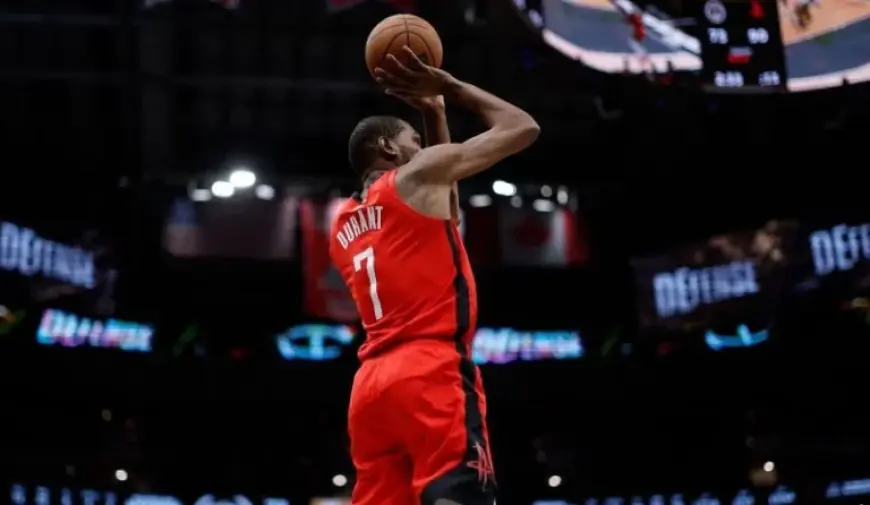
On the individual side, the betting angle narrows to a single prop recommendation: Kevin Durant over 24. 5 points (-112). The argument offered is split between home and road splits and recent road form: 24. 1 points per game at home versus 27. 9 points per game outside of Houston, plus a six-game road stretch averaging 31. 7 points with 25 or more points in five of those six games. The same preview states Durant scored at least 25 points in 21 of 31 road games, and reached 25 or more in each of his two games at Ball Arena this season.
Kevin Durant in a Rockets-Nuggets preview raises a documented mismatch
The clearest tension in the record is internal to the game framing itself. The betting preview repeatedly anchors its “Rockets vs Nuggets” case on Kevin Durant’s performance, treating him as central to Houston’s ability to “keep his team competitive on the road. ” A separate game preview, however, builds its matchup expectations around Denver’s offense and identifies Nikola Jokic and Jamal Murray as the creators when “they need buckets, ” without referencing Durant at all.
The context does not confirm why Durant is the focal point of a Houston vs Denver preview, nor does it establish how he fits into the rosters being discussed. What is confirmed is that the betting preview attributes multiple performance splits to Durant and ties them to Houston’s outlook, while the other preview describes Houston’s challenges through team habits and situational scheduling. That split leaves a practical gap for readers trying to reconcile the two lenses: one treats a single scorer’s road profile as the headline driver, the other treats structural factors as the deciding force.
There is also a second, more subtle mismatch in how certainty is presented. The betting preview states both teams are “close to full strength, ” but the other preview says the Nuggets have dealt with “their fair share of injuries this season, ” without specifying who is in or out for this particular game. Those statements are not mutually exclusive, but they do not answer the same question. One describes season-long experience; the other implies near-term availability. The context does not confirm which specific injuries are relevant for Wednesday night, or whether they affect the offensive and defensive claims being made.
Nikola Jokic, Jamal Murray, and the trend-heavy case for points
When the facts are viewed together, a documented pattern emerges: both previews support a high-scoring environment, but they arrive there in different ways and with different levels of specificity. The betting preview supplies numeric totals trends and ATS records. It states Denver is 4-6 against the spread over its last 10 games, 14-16 ATS at home, and 10-12 as the home favorite. It also states Houston has covered six of seven games as the road underdog.
Meanwhile, the game preview frames Denver as having the league’s most efficient offense and supplies style descriptors: fewer three-point attempts, frequent trips to the line, and the highest three-point percentage in the league at 39%. It adds that Denver’s defense has “taken a step back, ” and claims Denver does not force many turnovers, but capitalizes when it does and rebounds well defensively. It also presents a threshold claim about Houston’s ball security: if Houston turns the ball over more than a dozen times, it “won’t have much of a chance, ” while also asserting “which they will. ”
Those claims point in the same direction, yet they also spotlight an evidence imbalance. The betting preview quantifies outcomes and splits; the game preview relies more on narrative certainty about likely turnovers, a “sluggish start, ” and an expectation Houston could be down double digits early. The context does not confirm any measured turnover rates for Houston, any first-quarter scoring splits, or any specific national-television results, even though the game preview describes national TV and a back-to-back as ongoing “bugaboos” for the Rockets.
One more documented detail adds to the situational contrast: the game preview says Denver did not play yesterday and is coming off a hard-fought loss against the Oklahoma City Thunder, while Houston is described as on a back-to-back. The betting preview does not address rest, schedule, or the Thunder result, even as it projects plentiful scoring and near-full-strength lineups.
The immediate record leaves one central issue unresolved: whether the public-facing arguments for this game rest on comparable, verifiable premises. If the identity and role of Kevin Durant in the rockets vs nuggets framing is confirmed within the same set of matchup facts used elsewhere in the coverage, it would establish that the betting-led preview and the situational preview are describing the same on-court reality rather than parallel narratives built from different assumptions.