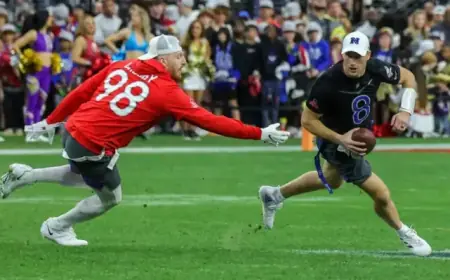
Sam Antonacci’s on-base skill set is forcing the White Sox to notice

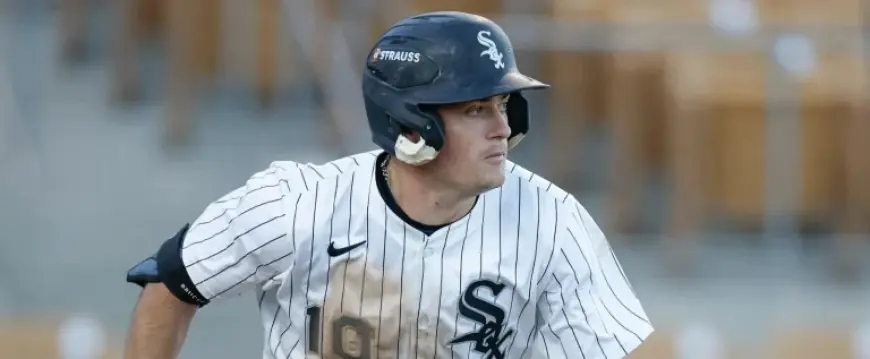
sam antonacci has stacked attention-grabbing moments across spring training in Arizona and the World Baseball Classic in Houston, pairing immediate power with an unusually consistent ability to reach base. The through-line is not just a couple of homers; it is a profile built around getting on base in multiple ways, including a “strange” one that has already produced standout numbers at several levels.
Sam Antonacci’s two-run homer trail
The loudest early signals came in the form of nearly mirrored home runs. The 23-year-old infielder opened his spring with a 417-foot two-run homer over the right-field wall in Chicago’s Cactus League opener against a crosstown rival. Eight days later, he again put the Sox on the board first against the Guardians with a nearly identical two-run blast. Two similar swings in a short window matter because they hint at repeatable approach and contact quality rather than a single isolated highlight.
Across six games in Arizona, Antonacci totaled 4 hits, 4 RBIs, 3 walks, and 3 stolen bags, while also providing “dependable defensive play. ” The pattern suggests the White Sox are getting a compact sample of a broader toolkit: not just damage on contact, but also plate discipline and baserunning contributions that create additional pathways to runs.
That blend becomes more meaningful because it aligns with how offensive value is framed in the modern game inside the available context: teams and fans care how often a player gets on base, and then how much damage he causes once there. In that lens, the spring stat line is less about the exact number of games and more about the variety of ways he impacted them.
Team Italy, Houston, and instant spotlight
From Arizona, Antonacci moved into a bigger stage by joining Team Italy in Houston for the World Baseball Classic, described as “the biggest spotlight of his young career. ” Italy’s 3-0 start included a Tuesday night win over Team USA framed as a “borderline historic upset, ” and the context ties Antonacci directly to that surge: his “fingerprints have been all over the hot start. ”
His contributions were not limited to one type of play. In a win over Great Britain, Antonacci “went all the way around the bases” on an “electric little league home run. ” A game later, he hit a two-run homer in the second inning against Team USA. The figures point to a player whose impact is showing up in multiple game states—power when the moment calls for it, and aggressive baserunning when a defense opens a door.
One described sequence against Team USA underlines that decision-making. With Italy already up 8-0 in the sixth inning, Antonacci reached base on a fielder’s choice, then moved along a throwing error and a sacrifice fly by teammate Dante Nori. On a breaking ball from Brad Keller that hit the dirt and briefly got away from catcher Will Smith, Antonacci “made a break for home plate and slid” to extend the lead to 9-0. The pattern suggests his value is not only in outcomes like homers, but also in recognizing the exact moment a small mistake can be turned into a run.
Hit-by-pitches and the White Sox fit
The most unusual part of the sam antonacci story, though, is neither the 417-foot spring homer nor the World Baseball Classic highlight reel. It is his demonstrated tendency to get hit by pitches at a rate that stands out even when compared with major-league history cited in the context. In one season at Coastal Carolina before being drafted by the White Sox in the fifth round, Antonacci was hit by a pitch 27 times in 61 games. In his first full professional season in the minor leagues, he played 116 games and was hit by a pitch 35 times.
Those totals are placed against specific major-league benchmarks: the last MLB player to be hit by a pitch 35 times in a single season was Don Baylor with the 1986 Boston Red Sox, a figure accumulated over 160 regular-season games. Ron Hunt was hit by 50 pitches in one season with the 1971 Montreal Expos (152 games), and the context states those are the only two instances in the modern era in which an MLB player has been hit by at least 35 pitches in a season. Antonacci matched that 35-hit-by-pitch threshold in just 116 minor-league contests.
That matters because the context explicitly pushes back on the idea that this is mere luck. It argues hit-by-pitch rates can be more sustainable than many assume, noting that “the guys who get drilled tend to keep getting drilled, ” and citing Hunt leading Major League Baseball in hit-by-pitches six consecutive seasons and Baylor leading the league seven times in his career. The pattern suggests that if Antonacci’s approach, stance, or pitch recognition reliably puts him in position to take first base, the White Sox could eventually gain an on-base lever that does not rely solely on batting average or even walks.
Recent results in the 2025 Arizona Fall League further anchor the point: Antonacci was hit by four pitches in 19 games, and alongside 15 walks, his on-base percentage sat at. 505 in the AFL. In the value framework laid out in the context—get on base, then do damage—the simplest reading is that Antonacci has already shown he can manufacture access to the bases repeatedly, even when pitchers avoid giving him something to hit.
The context leaves one key question unresolved: how quickly, and in what role, the White Sox might tap that on-base skill “at some point this season. ” If Antonacci’s mix of walks, hits, and hit-by-pitches continues to translate under higher-pressure competition, the data suggests his path to helping Chicago may be less about one tool and more about a consistent ability to start rallies by reaching first base by any means.