Michigan Hockey opens Big Ten quarterfinal as single-elimination era begins

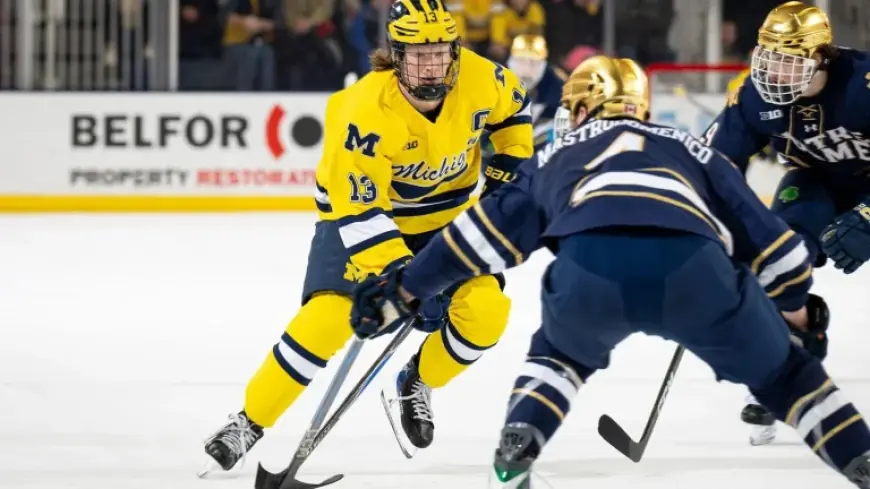
michigan hockey will begin the 2026 postseason at home on Wednesday, March 11, hosting Notre Dame in a Big Ten Tournament quarterfinal at Yost Ice Arena at 7: 00 p. m. ET. The game also serves as an early test of the conference’s new, tighter postseason structure, with single-elimination rounds replacing the earlier best-of-three opening round and Michigan’s quarterfinal now set as one game.
March 11 at Yost Ice Arena puts Michigan Hockey in a one-game quarterfinal
The University of Michigan enters the Big Ten Tournament as the No. 1-ranked team and the No. 2 seed, carrying a 26-7-1 overall record and a 17-16-1 mark in Big Ten play into Wednesday’s quarterfinal. Notre Dame arrives as the No. 7 seed at 9-22-5 overall and 5-17-2 in conference play. The matchup will be streamed on B1G+.
Notre Dame framed the contest as the start of “a new season” and emphasized the format shift: each round of the tournament will be single elimination, rather than the best-of-three opening round used previously. Michigan’s athletics preview also underscored the change at the quarterfinal stage, calling it “one game rather than a three-set series, ” a direct adjustment that raises the stakes of Wednesday night’s puck drop.
The teams’ history is extensive, with Michigan holding a 97-71-6 edge in the all-time series and having won 12 of the last 13 meetings. Notre Dame’s accounting lists the series at 77 wins, 96 losses, and six ties for the Irish. Either way, both sides characterize the rivalry as long-running, and Wednesday marks the 176th all-time clash between the programs in Notre Dame’s preview.
Notre Dame and Michigan bring contrasting recent signals into Ann Arbor
On paper, Michigan’s regular-season results against Notre Dame supply the clearest directional signal. The Wolverines went 4-0 against the Fighting Irish this season, collecting 11 of 12 possible points in the series. That run included 5-3 and 2-1 overtime wins in South Bend in the fall, followed by 5-2 and 7-4 victories at Yost Ice Arena in early January.
Yet the context also flags volatility on both benches. The fall series in South Bend coincided with a season-ending injury to Michigan defenseman Henry Mews, while the early January set at Yost included an injury to Michigan goaltender Jack Ivankovic. Michigan’s current status in net remains tied to Ivankovic’s numbers: a 2. 15 goals-against average, a. 922 save percentage, and a 20-7-1 record.
Notre Dame, meanwhile, arrives with a different kind of momentum marker: three straight overtime victories that set program history for consecutive extra-time wins. The Irish won 4-3 against then No. 5/5 Penn State, followed by two overtime wins at Ohio State (5-4 and 4-3). In the Friday game at Ohio State, Notre Dame tied it with 0. 1 seconds left in regulation on a shot by junior defenseman Paul Fischer before freshman Pano Fimis ended it in overtime at the 3: 16 mark of three-on-three play.
That combination—Michigan’s four straight wins in the season series and Notre Dame’s recent overtime resilience—creates a clean, context-driven tension for a single-elimination setting where one bounce ends the season.
T. J. Hughes, Will Horcoff, and special teams shape the visible trajectory
Michigan’s profile entering Wednesday is defined as much by special teams as by ranking. The Wolverines have the No. 1 power play in the country, converting 29. 8 percent of chances (36-for-121), and they have not allowed a short-handed goal all season. Notre Dame’s power play also grades as a strength in the provided context, ranking fifth at 27. 5 percent (30-for-109). With both units producing, the trend line inside this matchup points toward special teams carrying outsized weight in a one-game format.
Personnel notes in the context reinforce that directional pull. Senior T. J. Hughes has 18 career points against Notre Dame (seven goals, 11 assists) in 16 games and leads Michigan this season with 47 points (18 goals, 29 assists). Junior Garrett Schifsky has nine points against the Irish in 12 games, and junior Nick Moldenhauer has eight points in 12 career meetings. In Michigan’s most recent on-ice action, an exhibition against Simon Fraser at Yost Ice Arena after a bye week, Hughes posted five points (two goals, three assists) while Jayden Perron had a goal and three assists; Hunter Hady, Michael Hage, and Schifsky each recorded two points, and all three goaltenders played a period.
Hage sits two points behind Hughes with 33 assists and 12 goals. Will Horcoff leads Michigan with 22 goals and has seven game-winning tallies within his 35 points (22 goals, 13 assists). Those numbers, paired with Michigan’s sustained No. 1 standing in the national polls for a second consecutive week, support a clear near-term direction: Michigan’s offense and top-end execution remain the foundation of its postseason entry point.
If the single-elimination format continues to compress margins… Wednesday’s quarterfinal offers an immediate indicator of how the Big Ten’s revised structure changes the path for teams at both ends of the seeding line. Michigan has prior tournament success against Notre Dame, including a best-of-three quarterfinal sweep in 2024 and a semifinal win in 2022, and Michigan is 10-0 all-time as the No. 2 seed while winning the tournament title each time (2016, 2022, 2023). Still, a one-game quarterfinal reduces the runway for a favorite to absorb a slow start or a hot opposing goalie.
Should Notre Dame’s overtime form translate into another tight finish… the Irish have already shown they can extend games and find single moments to swing outcomes, from Fischer’s 0. 1-second equalizer to Fimis’ overtime winner at 3: 16. That kind of late-game resilience aligns with what single elimination rewards most, even against a team that went 4-0 in the season series.
The next confirmed milestone is the puck drop on Wednesday, March 11 at 7: 00 p. m. ET at Yost Ice Arena, with streaming on B1G+. What the context does not resolve is who will seize the special-teams edge in a matchup where both power plays are operating at high percentages, a gap that could decide whether michigan hockey turns its regular-season dominance into a clean postseason start.