Mojave Desert trail closures target tortoise habitat, but enforcement remains unclear

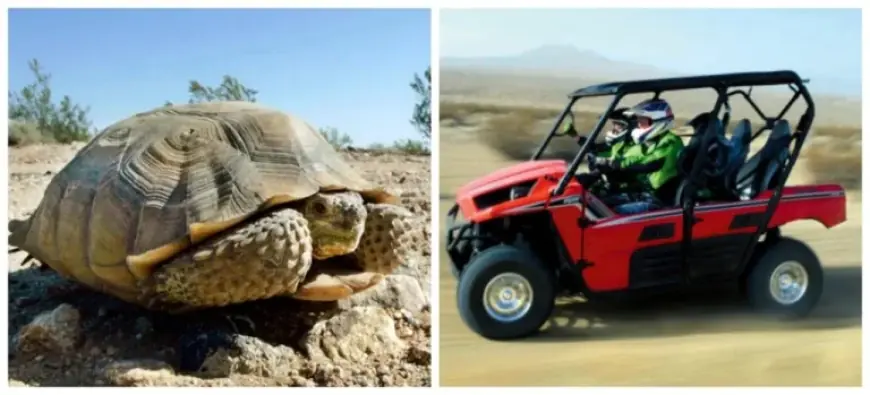
A federal judge has ordered roughly 2, 200 miles of off-road routes in the mojave desert to be closed to public off-highway vehicle recreation in areas designated as critical habitat for the threatened desert tortoise and the Lane Mountain milk-vetch. Yet the record also points to an immediate practical gap: the order requires closures and clear marking, while the available context does not confirm how the Bureau of Land Management will enforce them across such a large area.
Judge Susan Illston’s order and the Bureau of Land Management’s required actions
Confirmed details in the context show United States District Judge Susan Illston directing the Bureau of Land Management to close all off-highway vehicle routes inside designated critical habitat for the desert tortoise and the Lane Mountain milk-vetch. The order also calls for the routes to be “clearly” marked as closed, using “appropriate signage and fencing as needed. ” Still, the order is not a blanket shutdown of access across the region: it explicitly states that designated county roads and highways must remain open, along with routes needed for established easements, administrative access, emergency access, and other permitted uses, while excluding public off-highway vehicle recreational use.
The closures sit inside a broader planning framework that the context documents. In 2019, the Bureau of Land Management approved 6, 000 miles of off-road trails through the West Mojave Route Network Project, covering public lands in San Bernardino, Riverside, Kern and Inyo counties. The described geography stretches from Joshua Tree National Park and Twentynine Palms to Calico, the mountains north of Barstow, and to Ridgecrest near Trona. A year after the approval, six environmental groups sued, asserting the Bureau of Land Management did not properly consider impacts to threatened species in the area.
Illston’s reasoning, as quoted in the context from a nine-page order dated Jan. 23, frames off-highway vehicle use as “a significant ongoing cause of harm” to the desert tortoise and states that closures are beneficial to tortoise survival. The context also describes the Lane Mountain milk-vetch as a legume found only north of Barstow, and identifies that region as the plant’s only known home.
Mojave Desert access rules and an enforcement gap the context does not resolve
The central tension is not whether closures were ordered; the context confirms they were. The gap lies in implementation. One account in the context states it is still unclear how the Bureau of Land Management plans to enforce route closures given the size of the area Illston ordered to be closed. Another set of details complicates enforcement further: Ed LaRue, a Desert Tortoise Council board member and former Bureau of Land Management biologist, describes a pattern in which riders drive parallel to routes, using them as landmarks rather than staying on them. In that description, designated routes do not reliably confine activity; they can also provide access for people “not willing to stay on them. ”
Together, these facts create a documented implementation question. The order requires closures plus visible marking through signage and fencing “as needed, ” but the context does not confirm the standards that will determine what is “needed, ” or the operational plan for monitoring compliance. Even where routes are formally closed, the same context contains the claim that some users go off-trail anyway, raising the open question of whether closure lines alone will change behavior without additional measures. The context does not confirm what those measures would be, who would carry them out, or what resources would be used.
Also unclear is how the carve-outs will work in practice. The order keeps open county roads, highways, and certain access routes for easements, administrative purposes, emergencies, and other permitted uses. The context does not confirm how those open routes will be distinguished from closed ones on the ground, beyond the general directive to mark closures with signage and fencing as needed.
Environmental groups, off-road enthusiasts, and what the record leaves unanswered
Stakeholder reactions in the context split sharply, and that split is itself part of what the record reveals. Environmental advocates frame the closures as necessary to stop continuing harm. LaRue describes biodiversity loss in the area and argues that staying strictly on existing routes has not been realistic in practice. Joan Taylor, chair of Sierra Club’s California Nevada Desert Committee, argues that it is possible to balance healthy habitats with outdoor recreation, but says protections need enforcement, and points to “more than 271, 000 acres” available for off-highway vehicle users to enjoy. Another environmental perspective appears through Lisa Belenky, an attorney for the Center for Biological Diversity, who characterizes the recreational activity as “dominating these lands and literally ruining them. ”
Off-road enthusiasts, in contrast, characterize the order as overreach and dispute responsibility for the tortoise’s decline. The context includes a complaint that the West Mojave plan took nearly a decade of public meetings, environmental review, and compromise, and that a judge can undo that work. Ben Burr, executive director of the Blue Ribbon Coalition, is quoted calling the ruling an overreach and saying the judge “went a little too far. ” The context also states the group turned to the U. S. Department of Justice to appeal Illston’s decision and circulated a petition opposing it.
The record also shows the debate extends beyond recreation. One account describes the dispute as reflecting a long-running conflict over desert use including recreation, grazing, mining, and military activity. Businesses tied to tourism in places such as Lucerne Valley, Calico, and Randsburg are described as concerned about impacts from the closures. Yet the context does not confirm any specific economic losses, nor does it confirm how many visitors or events will be displaced.
On the science, the context documents multiple estimates and a timeline of concern, but does not reconcile them. The U. S. Fish and Wildlife Service is cited as stating Mojave desert adult tortoise populations dropped by almost 50% between 2004 and 2014, with more than 67, 000 killed during that period. Another biologist, Kristin Berry of the U. S. Geological Survey, is quoted saying the species’ numbers have dropped by 96% in some monitored areas since the 1970s. Separately, one account attributes population decline to multiple factors, including predators, nearby military bases, drought, and climate change. These facts support the confirmed point that the tortoise’s decline is central to the dispute, while leaving open how much of that decline the closures can address by themselves.
The next concrete benchmark in the context is a deadline: Illston’s ruling gives the Bureau of Land Management until 2029 to develop new off-road vehicle routes in the Mojave area. If the Bureau of Land Management’s enforcement plan is confirmed and aligned with the order’s marking requirements, it would establish how the 2, 200-mile closure will operate in practice while the agency works toward that 2029 route revision.