Blackhawks Honor Troy Murray and Link Tribute to First Home Overtime Win

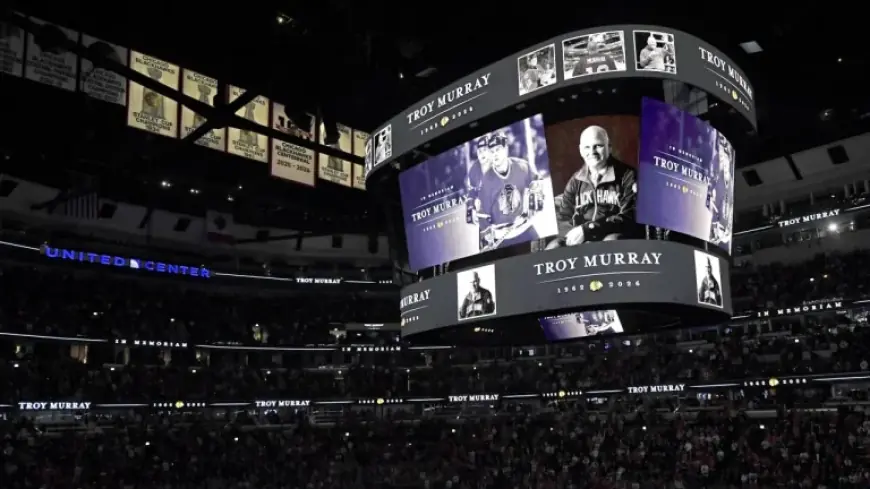
The Blackhawks held a videoboard tribute and a moment of silence for Troy Murray before their first home game since his death. This article examines the contrast between public commemoration on the ice and a more intimate memorial inside the Hawks’ radio booth, and what the available record shows about how those gestures intersected with the team’s 3-2 overtime win.
Blackhawks pregame tribute, game result, and Troy Murray’s passing
Confirmed: The team played a video on the United Center videoboard and observed a moment of silence in honor of Troy Murray before the game against the Mammoth. The game in question was the Blackhawks’ first home appearance after Murray’s death, and the Hawks won 3-2 in overtime. Confirmed: Murray died Saturday at age 63 after fighting cancer since 2021. These facts establish the timeline: a widely visible tribute preceded a home-ice game that ended in an overtime victory.
Frank Nazar, Andre Burakovsky and Joel Quenneville on Troy Murray
Documented: Frank Nazar, who scored the overtime winner, said Murray’s memory added importance to the game, stating, “He’s definitely up there watching and guiding us. ” Andre Burakovsky described relief after scoring and looked to the rafters following his goal, and he and Nazar both expressed a desire to make up for missed chances. Documented: Joel Quenneville remembered Murray and recounted driving back from airports with him during a Cup run when Quenneville was an assistant coach on that Colorado team. The record also documents Murray’s long association with the franchise as a longtime player and broadcaster, his role as color commentator for the Hawks’ three title runs in the 2010s, and that he earned a player Stanley Cup in 1996 with Colorado, appearing in eight playoff games.
Radio booth memorial for Troy Murray versus the public ceremony
Confirmed: Inside the Hawks’ radio booth, two bouquets of flowers appeared on the front desk and a MURRAY 19 Hawks jersey was slung over a chair next to analyst Steve Konroyd. That private or semi-private memorial contrasts with the public videoboard tribute and the moment of silence held for the full arena before the game. The two settings—a stadium-wide ceremony and a personal, workplace memorial—are both documented in the record.
Documented pattern: The record shows both public and private forms of remembrance happening at the same event. Public commemoration took place on the videoboard and in the scheduled moment of silence, while the team also left personal tokens—flowers and a jersey—in Murray’s former workspace. Players’ remarks and visible reactions during the game linked those remembrances to the on-ice experience: Nazar tied Murray’s memory to the game’s importance, and Burakovsky looked to the rafters after scoring.
Open question: The context does not confirm whether the tributes—either the videoboard moment of silence or the radio booth memorial—changed how the Blackhawks prepared for or approached the game on a tactical level. The record documents emotional connection and visible memorials, but it does not establish a causal pathway from tribute to specific decisions such as lineup changes, tactical adjustments, or altered pregame routines.
What would resolve it: If the Blackhawks confirm they altered pregame preparation, lineup choices, or strategy specifically because the game was the first home appearance since Troy Murray’s death, it would establish a direct link between the memorial gestures and tangible changes in how the team approached that game. For now, the documented facts show a clear pattern of public and private remembrance and players framing the win as meaningful in Murray’s honor, but they stop short of proving that the tributes produced measurable changes to team preparation or tactics.