Byu Vs West Virginia Prediction: Conflicting signals around BYU’s rematch urgency

BYU faces No. 7 seed West Virginia in the Big 12 Tournament after beating Kansas State, setting up a rematch 11 days after a 79-71 loss in Morgantown. Yet the byu vs west virginia prediction landscape inside the available preview material pulls in different directions: one account frames BYU as the likely winner on a model edge and improved health, while another emphasizes BYU’s recent defensive leakage and doubts West Virginia can keep pace.
BYU, West Virginia, and the 79-71 game that now frames the rematch
Confirmed fact: BYU enters this matchup fresh off a Kansas State win in which it posted a Big 12 Tournament record 105 points, led by a 40-point performance from AJ Dybantsa. The opponent is West Virginia, identified as the No. 7 seed, and the game arrives 11 days after West Virginia beat BYU 79-71 on February 28.
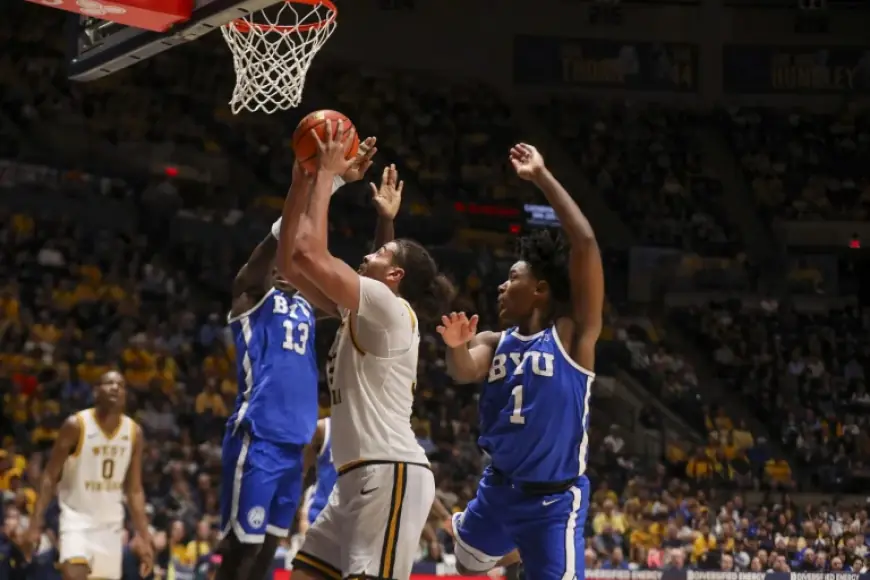
Documented detail from that first meeting shows why the rematch resists a single clean narrative. West Virginia limited Dybantsa to 20 points by crowding him in the paint, while manufacturing offense through second chances: it collected 18 offensive rebounds, despite being described as not normally strong in offensive rebounding. BYU trailed by 14 at halftime, rallied to within three in the final couple of minutes, and then saw turnovers and West Virginia’s second-chance points decide the result.
Individual matchups also shaped that outcome. West Virginia forward Brenen Lorient scored 18 points and grabbed seven offensive rebounds. Guard Rob Wright scored 23 points, and Alexsej Kostic added 12 off the bench. BYU, meanwhile, held West Virginia leading scorer Honor Huff to 3-for-10 shooting from three, but Huff’s made threes came at pivotal moments and he went 6-for-7 at the foul line. The context also describes Huff’s profile as central to the rematch: he shoots as many threes as any player in the country, making him a focal point for BYU’s defense.
Byu Vs West Virginia Prediction splits on defense, pace, and what repeats
A key tension emerges when the context is read side by side: the same recent evidence gets used to argue opposite directions about what should happen next. One set of material points to a model projection favoring BYU, listing a KenPom projection of BYU 75, West Virginia 69 with a 69% win probability. It also frames BYU’s motivation as “revenge” for the February 28 result, and notes BYU’s NCAA Tournament positioning, calling the matchup a Quad 2 game that could “beef up the resume” as BYU looks to snag a 6 seed.
Another account leans on a different axis: defensive performance and game flow. It describes BYU’s defense as “brutal” over the last baker’s dozen, allowing north of 84 points per game, and notes BYU gave up 79 to what it calls a poor West Virginia offense in the first meeting 11 days earlier. At the same time, it says West Virginia should be able to get good looks, but doubts the Mountaineers can convert consistently for forty minutes.
Those claims do not neatly align, and the context does not confirm which variable will dominate: BYU’s ability to adjust from being out-rebounded, West Virginia’s ability to generate the same second-chance volume, or BYU’s ability to solve the shot-quality problem implied by allowing “good looks. ” The context also adds a stylistic contrast: West Virginia runs the slowest tempo in the Big 12, while Kansas State is described as the fastest, suggesting BYU is moving from one extreme opponent style to the other after the Kansas State game.
AJ Dybantsa, Khadim Mboup, and Honor Huff: the evidence points to hinge factors
Confirmed fact: West Virginia’s first win came with unusual offensive rebounding volume and a constrained Dybantsa scoring line. The rematch discussion in the context points to personnel and health as the fulcrum for whether those elements repeat. BYU center Khadim Mboup had a leg injury in the first game and recorded two rebounds in 11 minutes. The preview material states he is more healthy now and “playing his best ball of the season, ” coming off a 14 point rebound performance versus Kansas State, with the expectation that his presence can help even out the rebounding battle.
That sets up the clearest documented gap between what happened and what one side expects to change. If West Virginia’s 18 offensive rebounds were the decisive swing, then a healthier Mboup could plausibly disrupt that pathway. Still, the context does not confirm whether Mboup’s improved condition will translate into rebounding control against Lorient, who already produced seven offensive boards in the earlier meeting.
On West Virginia’s side, the preview notes Wright is expected to play, while also stating it will be worth monitoring whether a lip laceration impacts him. That introduces another open question the context does not resolve: West Virginia relied on Wright’s 23 points in the first game, so any limitation could shift where points come from, particularly if BYU focuses on Huff, described as a high-volume three-point shooter on a team labeled the Big 12’s worst three-point shooting group but with the conference’s second-highest three-point attempt rate after Texas Tech.
In the end, the byu vs west virginia prediction debate inside the context narrows to two competing explanations for the first game: whether it was fundamentally about repeatable matchup edges for West Virginia (tempo control, second chances, and paint crowding on Dybantsa), or about variables that may swing (Mboup’s health, turnover avoidance late, and which team sustains offense across halves). The context states West Virginia sits on the outskirts of the bubble and needs a win to keep its NCAA Tournament hopes alive, while BYU is positioned as playing for seeding improvement, leaving both sides with documented urgency but different kinds of stakes.
The context does not confirm a scheduled ET tip time for this game, only that it was set for 6 p. m. CT. If a rematch shows West Virginia again winning the offensive-rebounding battle at the same scale while limiting Dybantsa’s paint touches, it would establish that the February 28 result reflected a repeatable formula rather than a one-off outcome shaped by injury and late-game turnovers.