Tyrus Wheat reunion with Cowboys points to special teams-first roster building

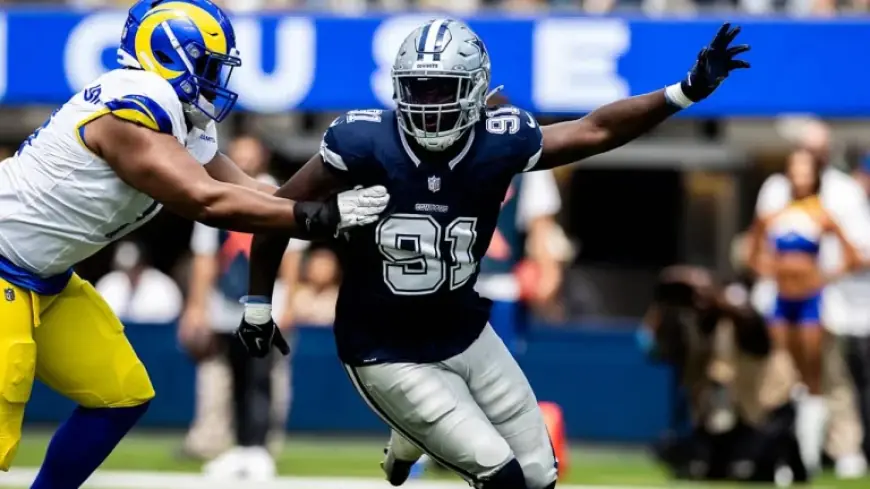
The Dallas Cowboys have agreed to terms to bring back tyrus wheat, returning him to the team that first signed him as an undrafted free agent in 2023. The move, timed for processing when the new league year opens, signals a direction the Cowboys have repeatedly leaned into during this free-agency stretch: stacking depth pieces who can contribute on special teams while the roster is reshaped for the 2026 season.
Tyrus Wheat returns to Dallas with recent Lions production on his resume
The Cowboys’ plan to bring back OLB tyrus wheat comes after a short but productive stop with the Detroit Lions. In two seasons with Dallas, Wheat played in 20 games and recorded 17 tackles and half a sack. Last season with the Lions, he appeared in 15 games and posted career highs with 15 tackles and 1. 5 sacks, while also adding a forced fumble and a pass breakup.
Context around his Lions role also points to why Dallas would value him as more than a one-dimensional add. In Detroit, Wheat’s biggest impact came on special teams, where he played 215 total snaps. Detroit’s decision not to place a restricted tender on him effectively opened a path for him to reach free agency, and Dallas moved quickly to align a return as the league calendar turns.
The timing is explicit: Wednesday marks the start of the new league year, with 4: 00 p. m. ET described as the moment when deals can be formally processed. That places the Cowboys’ agreement with Wheat in the cluster of moves waiting for official clearance.
Dallas Cowboys free-agency activity shows a depth-and-processable-deals pattern
Wheat’s return sits alongside several other agreements and roster mechanisms that, together, form a visible pattern. Dallas has made five external additions in free agency up to the point when Wheat was described as a potential sixth addition, and the broader list of moves includes both contract work and one-year deals that can be processed when the league year opens.
Based on context data, the Cowboys’ recent, confirmed or described actions include:
- Agreed to terms to bring back OLB Tyrus Wheat.
- Restructured WR Jonathan Mingo’s contract heading into the 2026 season.
- Agreed to terms on a one-year deal with QB Sam Howell.
- Agreed to terms on a one-year deal with defensive tackle Otito Ogbonnia.
- Added P. J. Locke, described as upgrading special teams and reuniting him with Christian Parker.
- Agreed to terms with Jalen Thompson after making a deal for Rashan Gary.
On the cap side, the Cowboys were described as “continuing to work their space in the salary cap, ” with one specific mechanism named: a contract restructure for Jonathan Mingo heading into the 2026 season. Mingo is heading into the final year of his rookie deal and has spent the last year and a half with the Cowboys. In 14 games, he has caught six passes for 71 yards. Context also ties that to an earlier acquisition cost: at the trade deadline in 2025, the Cowboys traded a fourth-round pick to the Panthers for Mingo and a seventh-round pick.
Even the ancillary roster moves fit the same “processable” shape: the Cowboys agreed to one-year terms with Howell and Ogbonnia, and also placed the second-round tender on kicker Brandon Aubrey and offensive lineman T. J. Bass.
Detroit Lions’ tender choice and Dallas’ timing point to a special teams market
Wheat’s path back to Dallas doubles as a signal about how teams are valuing special teams snaps in this portion of the calendar. In Detroit, Wheat was described as a special teams stalwart, and the Lions not placing a restricted tender on him was framed as a move that “could spell the end of his tenure in Detroit. ” That decision also carried a football consequence in the same context: it “could leave the team with a big hole on special teams. ”
For Dallas, the context explicitly connects Wheat to special teams help. That aligns with another move on the Cowboys’ list, where adding P. J. Locke was described as both a reunion with Christian Parker and an upgrade on special teams. Put together, the confirmed details point toward a roster-building trajectory that emphasizes special teams roles as a parallel track to bigger-name additions and trades.
If this special-teams-and-depth trajectory continues… Dallas’ early free-agency approach suggests more agreements that prioritize coverage units and flexible defensive roles, similar to how Wheat’s value was framed through both his defensive production (1. 5 sacks, forced fumble, pass breakup last season) and his heavy special teams usage (215 snaps). The context already places Wheat alongside multiple deals and additions designed to be processed as the new league year opens, reinforcing the pattern.
Should Detroit’s edge depth issues intensify… the Lions’ decision not to tender Wheat could look less like a minor administrative choice and more like part of a broader edge reshaping, especially with the context noting only three defensive ends under contract: Aidan Hutchinson, Josh Paschal, and Ahmed Hassanein. The same context also notes Paschal’s contract tolling under a specific CBA provision tied to missing the entirety of the 2025 season with an injury, and it references another edge rusher, Al-Quadin Muhammad, as slated to hit free agency as well.
The next confirmed milestone is the opening of the new league year on Wednesday, when 4: 00 p. m. ET is described as the time when deals can be formally processed. What the context does not resolve is the precise role Dallas plans for Wheat on defense beyond the special teams emphasis, or how the Lions will fill the special teams and edge snaps his departure could leave behind. For now, the clearest signal is procedural and practical: Dallas is lining up additions to be processed immediately as the league calendar turns.