Josh Allen contract restructure creates $12 million cap space, leaving conflicting cap claims

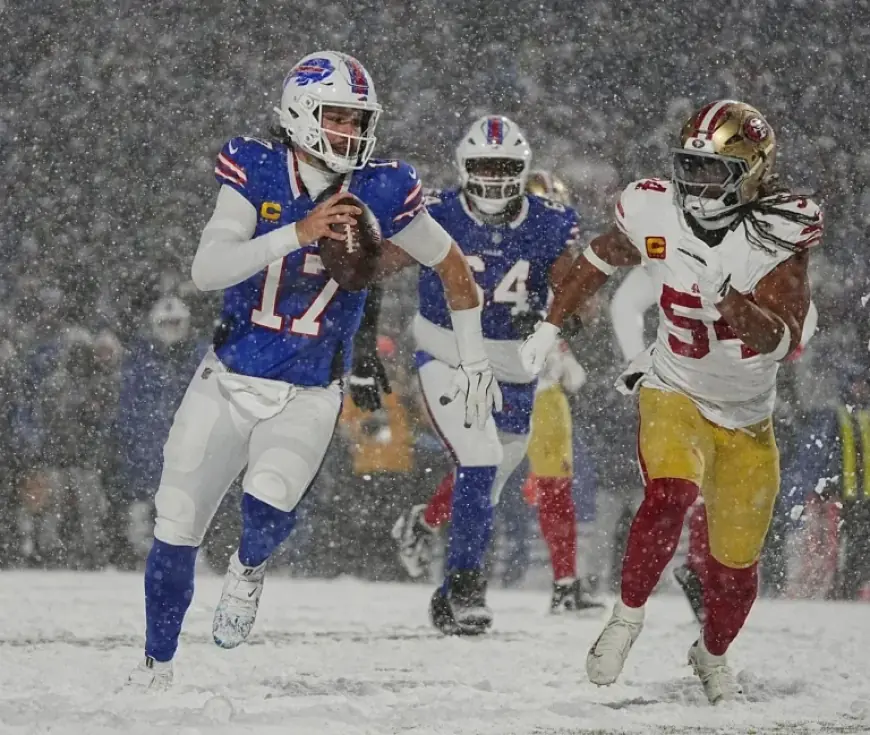
josh allen’s contract has been restructured by the Buffalo Bills in a move designed to open cap space ahead of the new league year. The confirmed outcome is a $12 million gain against the cap, but the public record in the provided context also contains a separate, now-disputed figure that framed the restructure as part of a much larger cap-space creation. The gap between those numbers is the unresolved tension.
Buffalo Bills and Josh Allen restructure: the confirmed $12 million cap result
The clearest documented fact across the context is that Buffalo reworked the quarterback’s contract to free up $12 million against the cap. The move is described as procedural and timed with the new league year arriving Wednesday afternoon, with the stated purpose of creating room on the books.
The same context also fixes several reference points around the contract itself. Josh Allen and the Bills agreed to a six-year, $330 million extension last March, placing him under contract through 2030. Another detail in the context describes Allen as previously set to count for roughly $56. 39 million of cap space in 2026, a figure that helps explain why even a single restructure can meaningfully change Buffalo’s flexibility in future accounting years.
Performance information is also included, though it does not explain the cap mechanics. In 2025, Allen completed 69. 3 percent of his throws for 3, 668 yards with 25 touchdowns and 10 interceptions, and he rushed for 579 yards with 14 touchdowns. Those statistics confirm the team’s reliance on him, but they do not resolve the financial questions raised by diverging cap-space claims elsewhere in the context.
Field Yates correction and the lingering $40 million figure
The context contains a second, contradictory thread: a claim that the Bills created $40 million in room connected to this contract action, followed by an explicit correction that the $40 million number was incorrect. The corrected figure returns the discussion to the $12 million restructure result, but the existence of both numbers in the record creates an evidentiary gap for readers trying to understand what changed and what did not.
One part of the context states that the restructure created an additional $12 million in cap space, then adds that a previous statement about $40 million in room was wrong. That is a confirmed correction, but the context does not confirm what specifically produced the earlier $40 million figure, whether it reflected a different transaction, a misunderstanding of multiple moves bundled together, or a simple misstatement.
That distinction matters because another portion of the context frames the offseason in terms of cap clearing across multiple actions, not only a quarterback restructure. The document describes other roster and contract decisions, including restructures involving Spencer Brown and Ed Oliver, a pay cut for Tyler Bass, and additional transactions such as trading Taron Johnson to the Las Vegas Raiders and cutting Curtis Samuel, Taylor Rapp, and Dane Jackson. Yet, the context does not confirm how much cap space those collective moves created, leaving the corrected $12 million figure standing alone as the only clearly quantified result tied to Josh Allen.
Offseason flexibility claims: D. J. Moore, Maxx Crosby, Trey Hendrickson, and what remains unverified
A documented pattern across the context is that the Bills’ cap actions are repeatedly described as a means to pursue additional roster moves. One account links the corrected $12 million figure to offseason budgeting, including getting under the cap and creating room to take on wide receiver D. J. Moore’s contract from the Bears. Another describes the team making “key moves” and finalizing deals with players already on the roster, including a four-year, $52 million agreement with Connor McGovern and a three-year extension for Dawson Knox.
Still, the context does not confirm that the Bills have acquired D. J. Moore or that any specific cap-room target is attached to him beyond the assertion that space was needed to take on his contract. The context also does not confirm the timing of that potential transaction relative to the restructure, or whether the $12 million alone would be sufficient to complete it.
The same is true for the more speculative roster angles introduced alongside cap discussion. One account describes a failed trade framework involving Maxx Crosby: the Las Vegas Raiders reached an agreement to trade Crosby to the Baltimore Ravens on Friday for first-round picks in 2026 and 2027, but Baltimore pulled out Tuesday night because Crosby did not pass his physical. That narrative is presented as a reason Crosby could, in theory, return to the market, with an added note that different teams can handle physicals differently. Yet the context does not confirm any negotiation between Buffalo and Las Vegas, any intent by Buffalo to pursue Crosby, or any medical outcome that would make such a move feasible.
Another name appears in the same cap-flexibility framing: free agent pass rusher Trey Hendrickson, described as someone who might command around $25 million per season. The context ties that potential cost directly to the idea of Josh Allen freeing up $12 million through a restructure. What remains unclear is whether Buffalo is actually pursuing Hendrickson, or whether the number functions mainly as an illustration of how quickly cap space can be consumed.
The central tension, then, is not whether Buffalo acted; it did. The tension is whether the restructure should be understood as a discrete $12 million adjustment or as part of a broader cap strategy that some statements initially quantified at $40 million, then walked back.
The next clarifying evidence point is straightforward within the context’s own boundaries: if the only confirmed figure attached to the quarterback move remains $12 million, it would establish that earlier $40 million framing did not describe this restructure’s direct effect, even if other cap actions occurred elsewhere on the roster.