Elana Meyers Taylor’s long-awaited gold rewrites Winter Games history

elana meyers taylor finally captured Olympic gold on Monday in Cortina, winning the women’s monobob in 3: 57. 93 and edging Germany’s Laura Nolte by four-hundredths of a second. The result not only completed a five-Winter-Olympics pursuit, it also stacked new historical markers onto one race—age, medal totals, and representation—making the victory bigger than a single podium moment.
Elana Meyers Taylor wins by 0. 04
The defining fact of the final heat was the margin: four-hundredths of a second separated elana meyers taylor from Nolte, in what was described as the closest women’s bobsled finish in Olympic history. Nolte entered the final heat leading by 0. 15 seconds, then lost 0. 19 seconds of ground, a swing that turned a near-lock into silver. The figures point to how monobob can punish even small errors over a multi-heat format: a narrow advantage can disappear fast, and a single late run can reorder the medals.
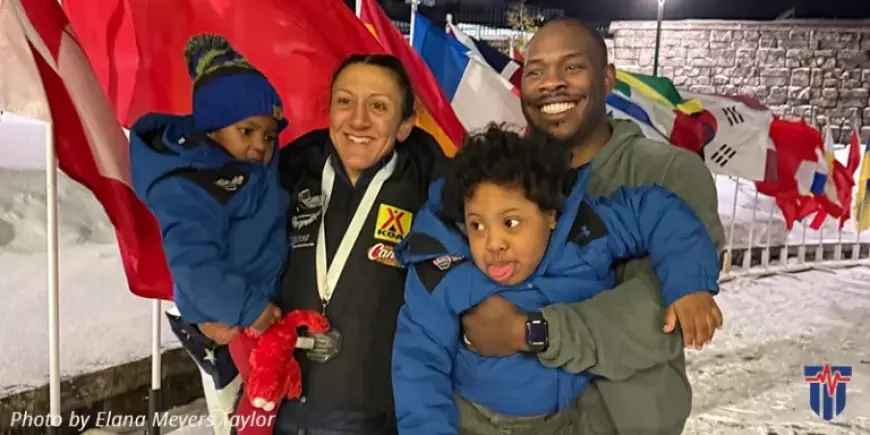
Meyers Taylor’s win also came with a personal scene at the center of the celebration. She celebrated with her sons Nico, 5, who has Down syndrome, and Noah, 3; both are deaf. In a post-win interview, she framed the moment through their presence and sacrifice, saying it “meant everything, ” and noting they had traveled across Europe since November 1. The pattern suggests her preparation and competition schedule were intertwined with parenting logistics, turning what is usually treated as a purely athletic timeline into a family-led endurance test.
Meyers Taylor’s own words also set the tone for how she viewed the achievement. “I thought it was impossible, ” she said. “I didn’t need it, but I wanted it. ” That mix—acknowledging a career already defined by medals while still chasing the one missing result—helps explain why this gold resonated beyond a standard victory lap. It was not a breakout; it was a capstone.
Cortina gold caps five Olympics
Monday’s monobob gold completed a pursuit that stretched across five Winter Olympics and multiple roles within bobsled. Meyers Taylor first won bronze in the two-woman competition in 2010 as a pusher for Erin Pac. She later became a pilot, earning silver with Lauryn Williams at the 2014 Sochi Games and another silver four years later with Lauren Gibbs in Pyeongchang. She claimed bronze with Sylvia Hoffman at the 2022 Beijing Games, where she also won silver in monobob in the event’s Olympic debut. The accumulation matters because it shows longevity across changing partners, event formats, and responsibilities—evidence of adaptability rather than one-era dominance.
At 41, she was also described as the oldest American woman to earn a medal at the Winter Games. Her gold counted as her sixth career medal, tying her with former speedskating star Bonnie Blair for the most by an American woman in Winter Olympic history. It also extended her record for the most medals by any black woman ever at the Winter Games. The figures point to a rare convergence: a single race both adds to an already elite medal count and shifts multiple “most” lists at once, which is why the win reads like an inflection point in the record book, not just a personal milestone.
Her reaction to being tied with Blair captured the scale of that change. “To have my name up there with Bonnie Blair, it doesn’t even make sense to me, ” she said. Still, the record tie is now a concrete benchmark, one that will frame every future U. S. Winter Games conversation about women’s medal totals, not only in bobsled but across sports.
Humphries, Nolte define the field
The podium in Cortina also clarified the competitive landscape around Meyers Taylor. Nolte’s silver came after leading into the final heat, a detail that underscores how close the race remained until the end. Compatriot Kaillie Humphries took bronze; she was described as a 40-year-old mother to a 1-year-old son, Aulden, and as the monobob gold medalist from four years earlier. Her presence in the medals alongside Meyers Taylor reinforced a theme Humphries articulated directly: “You get a lot of people that like to write you off as soon as you reach 40, ” she said, arguing that both she and Meyers Taylor show that narrative does not hold.
Humphries also pushed back on another assumption—post-pregnancy performance—saying, “As soon as you become a mom, your body’s not the same, and you can never get that high performance back, ” before adding that their results showed otherwise. The pattern suggests Monday’s outcome will be read by many athletes less as an isolated bobsled result and more as evidence that elite outcomes at 40-plus are not theoretical, particularly when two medalists embody that reality on the same day.
Meyers Taylor’s background details add another layer to why her win stands out. She grew up in Douglasville, Ga., outside of Atlanta. Yet, the larger takeaway from her own comments is not geography; it is priority. She said parenting her two sons with disabilities gave her “patience” and “the drive to keep going, ” and she drew a sharp comparison between athletic hardship and family responsibility: even her worst days in bobsled, she said, were better than the worst days as a parent. That framing suggests the gold medal is being positioned as a byproduct of a broader life structure, not the sole measure of success.
One specific point remains open from the available details: beyond the Monday monobob result in Cortina, no next confirmed competition date or event for Meyers Taylor was provided. If her comments about family-driven motivation hold, the data suggests her future athletic decisions will continue to be evaluated through the same lens she described—medals matter, but the central constant is returning home as “still mom to them. ”