Earthquakes Today: 2.3-Magnitude Quake Near Sleepy Hollow Reveals Wider Reach

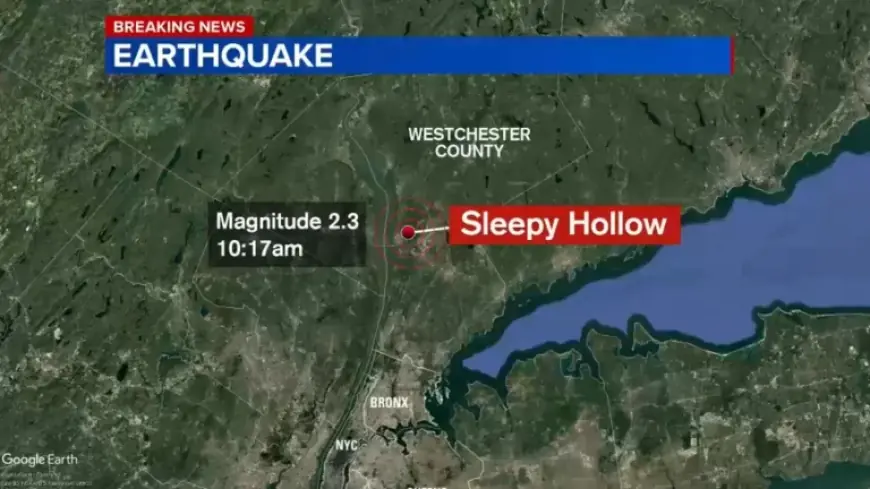
A small 2. 3-magnitude earthquake struck about half a mile west of Sleepy Hollow at 10: 17 am ET, centered roughly 4 miles deep and felt across a broad area of Westchester County though it caused no reported damage. The temblor — confirmed by the U. S. Geological Survey and described by residents as a pair of loud booms that lasted roughly seven seconds — prompted precautionary site surveys at the former Indian Point location and drew criticism from Westchester County Executive Ken Jenkins about hosting a nuclear plant.
Earthquakes Today in Sleepy Hollow
Residents in Sleepy Hollow described two loud explosions followed by noticeable shaking, and eyewitnesses said the event lasted about seven seconds; a student in the village recalled the motion starting slow then picking up. Reports of earthquakes today stretched from the Bronx to Putnam County, and Channel 7 Eyewitness News chief meteorologist Lee Goldberg noted observers as far north as Mount Kisco, about 13 miles from Sleepy Hollow, felt the tremor. The pattern suggests that even low-magnitude events in this area can produce widespread perceptible shaking because local witnesses and media consolidated reports across dozens of miles.
Ramapo Fault Zone explains reach
Experts described Sleepy Hollow as part of the Ramapo Fault Zone, with movement possibly propagating the Dobbs Ferry Fault, and noted the quake could have been tectonic, a strike-slip event, or a so-called frost quake tied to recent snow melt and wild temperature swings. Scientists pointed out that the East Coast crust is relatively rigid, which can carry seismic energy farther than on the West Coast; that rigidity was cited as a reason the temblor was felt in a broad swath of New Jersey and New York. The pattern suggests the geology of the Northeast amplifies the felt area for small events, so pinpointing the mechanism matters for assessing local seismic risk.
Indian Point surveys and Jenkins
Westchester’s Department of Emergency Services received no reports of damage, and officials at the former Indian Point site conducted precautionary surveys after the tremor; Westchester County Executive Ken Jenkins said the event underlines why a nuclear power plant does not belong in Westchester County. For now, those local checks were precautionary and found no immediate safety issues at the former plant, but the public reaction and Jenkins’s statement indicate political sensitivities tied to seismic activity in the Hudson Valley. The figures point to how even a minor event can revive policy debates about infrastructure siting when a county executive cites safety concerns.
The specific cause of the Sleepy Hollow temblor—whether a tectonic quake on the Ramapo Fault the Dobbs Ferry Fault, a strike-slip event, or a frost quake related to recent snow melt and temperature swings—remains unconfirmed and requires further study to resolve that open question.