Jarred Vanderbilt steps into a larger Lakers role as depth is tested

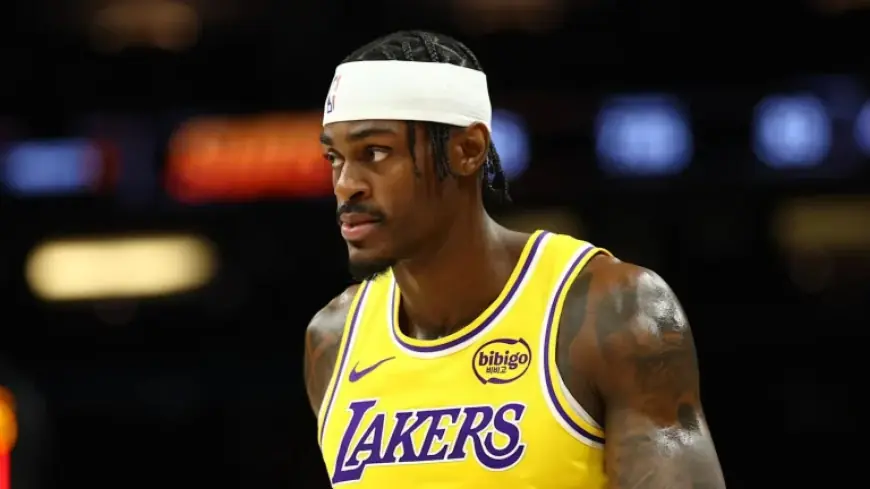
jarred vanderbilt has moved back into the Los Angeles Lakers’ spotlight after center Deandre Ayton went down with an apparent knee injury, exposing the team’s limited depth at center. The early signal is a rotation stress test: the Lakers appear to need Vanderbilt’s defensive impact to cover for what Ayton’s absence removes offensively, even as Vanderbilt’s own offense remains a documented concern.
Deandre Ayton’s apparent knee injury puts the Los Angeles Lakers rotation under pressure
Ayton’s apparent knee injury has quickly brought the Lakers’ roster balance into focus. The context frames Ayton as divisive, but also as an offensive presence the team misses “down low, ” and it describes a lack of ideal depth at center as “unavoidable. ” That combination matters because it narrows the Lakers’ options for patching minutes and production at the position while Ayton is out.
Rather than treating the injury as a single-player problem, the current development points to a broader rotation question: which players can reshape game-to-game lineups when a center who provides interior offense is unavailable. In that environment, the Lakers’ need becomes less about replicating Ayton’s profile and more about finding a workable mix that can “situationally win games, ” a phrase the context directly ties to what Vanderbilt can provide.
Jarred Vanderbilt’s defense-and-offense split is the defining force in his expanded minutes
The context describes Vanderbilt as the Lakers’ “ultimate X-Factor” and notes he is being challenged to prove he can “transform the rotation” during Ayton’s absence. The driver behind that challenge is the sharp contrast between Vanderbilt and Ayton: where Ayton is portrayed as talented and productive offensively but inconsistent defensively, Vanderbilt is portrayed as a versatile and overwhelming defensive presence whose offense is a recurring limitation.
Those boundaries are quantified in the details provided. Vanderbilt is a career 29. 4 percent shooter from beyond the arc, and he is at 30. 5 percent in 2025-26. The context also says he is producing 9. 5 points per 36 minutes. Taken together, those numbers establish why the Lakers’ bet on him cannot simply be “play him more” without consequence; it must be tied to defensive utility, lineup flexibility, and the ability to create advantages that do not require him to carry scoring.
Still, the same context also grounds the immediate case for giving him a bigger role: Vanderbilt can pick players up at multiple positions, and the Lakers can lean on that “elite defensive quality” during and after Ayton’s injury absence. In other words, the team’s current direction is not an expectation that Vanderbilt will suddenly become a high-efficiency scorer, but rather that his defensive value can outweigh his offensive limitations in the right matchups and lineups.
Jarred Vanderbilt’s 21-minute game on Mar. 6 hints at how the Lakers may proceed
Los Angeles played its first game since Ayton’s injury on Friday, Mar. 6, and Vanderbilt received 21 minutes. The context emphasizes that this was his highest minute total in just over a month, and only his fifth game with at least 20 minutes since mid-January. That minute pattern is a concrete signal of where things stand now: Vanderbilt’s usage had been more limited, and Ayton’s injury has already coincided with a notable increase.
In that Mar. 6 game, Vanderbilt “capitalized on the opportunity” by dominating the glass and creating for teammates, and he finished with a plus-minus of +12 in an 11-point win over the Indiana Pacers. Even without a full stat line, that summary points to the shape of impact the Lakers are seeking: not just stops, but extra possessions, connective playmaking, and lineup stability that can show up in on-court results.
- Based on context data: Vanderbilt played 21 minutes on Mar. 6, his highest total in just over a month.
- Based on context data: It was his fifth game with at least 20 minutes since mid-January.
- Based on context data: He posted a +12 plus-minus in an 11-point win over the Indiana Pacers.
If Ayton’s absence continues… the visible trajectory suggests Vanderbilt stays in a more prominent rotation slot, because the Lakers’ center depth is described as lacking and his Mar. 6 minutes already jumped immediately after the injury. In that scenario, the team’s best path inside the context is to keep extracting defensive value and situational advantages, while living with the reality that his three-point shooting profile and per-36 scoring do not currently signal an offensive breakthrough.
Should Vanderbilt’s offensive issues persist at the levels described… the Lakers’ reliance on him would likely remain matchup-dependent, with his role hinging on whether his defense, rebounding, and creation continue to tilt lineups positively. What the context does not resolve is the timeline for Ayton’s return, or how long the Lakers must lean on this arrangement before a different rotation solution becomes necessary. For now, the next concrete signal is whether Vanderbilt’s post-Mar. 6 minute spike becomes a repeatable pattern while Ayton remains out.