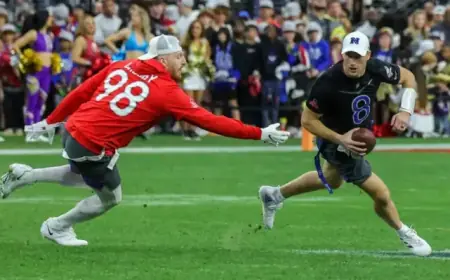
Lamelo Ball: 20-5-5 Production vs. Free-Throw Shortfall Reveals Hornets Imbalance

Charlotte Hornets guard LaMelo Ball appears in two contrasting lights this season: a member of an elite 20-5-5 games club and a player who has recorded 0 free-throw attempts in 16 games. This comparison asks which portrait — high-volume all-around production or a striking failure to get to the line — better explains his impact on the Hornets’ offense.
LaMelo Ball’s Free-Throw Shortfall and Related Metrics
LaMelo Ball has logged zero free-throw attempts in a game 16 times this season, including in a recent loss where he attempted 0 FTA. He ranks 96th in the league in free throws attempted per game and is seventh on the Hornets in that category, behind both Coby White and Collin Sexton during their respective tenures. Ball also ranks 35th in drives per game. He attempts 9. 7 three-pointers versus 7. 3 two-point attempts per game, a split tied to his difficulty finishing through contact and a lower rate of drawing contact than some peers.
Lamelo Ball and the 100 20-5-5 Games Club
At the same time, Lamelo Ball has reached a rare milestone: he has 100 games with at least 20 points, five rebounds and five assists, the most in Hornets history and only the eighth player in NBA history to reach that mark before turning 25. In the Hornets’ loss to the Phoenix Suns, Ball produced 22 points, seven rebounds and six assists while shooting 9-of-19 from the field in 33 minutes. That game marked back-to-back 20-point performances for him since the All-Star break and included four made three-pointers.
Direct Comparison: Efficiency, Contact, and Production for the Hornets
Set against the same evaluative criteria — ability to influence scoring, ability to draw and convert contact, and contribution to wins — the two portraits diverge. On production, Ball’s 100 games of 20-5-5 and the recent 22-7-6 line show consistent scoring, rebounding and playmaking. On contact and free-throw generation, the 16 games with 0 FTA, a 96th-place FTA rank, and a preference for threes over twos show a shortfall that limits points from the line.
| Metric | Value from Context |
|---|---|
| Games with 0 FTA | 16 this season |
| League rank — FTA per game | 96th |
| Drives per game rank | 35th |
| Three attempts vs two attempts | 9. 7 threes vs 7. 3 twos per game |
| 20-5-5 games before age 25 | 100 games; 8th player to reach mark |
| Recent single-game line vs Suns | 22 points, 7 rebounds, 6 assists, 9/19 FG, 4 threes, 33 minutes |
Analysis: the production metrics establish Ball as a rare, all-around contributor for the Hornets, but the free-throw and contact metrics reveal a recurring limitation that reduces his points-per-possession ceiling. Players who draw more contact convert additional easy points at the line; Ball’s combination of lower free-throw attempts and a higher share of three-point attempts suggests his offense relies more on jump shooting than on getting to the line.
What the Divergence Reveals About the Hornets’ Offensive Profile
By holding these two portraits side by side, a structural reason emerges: Ball’s role and shot profile push him into perimeter creation and long-range attempts, which lift raw scoring and all-around stat lines but suppress free-throw opportunities. The context notes other guards with fewer drives get more whistles, and several role players receive friendlier officiating than Ball. That comparison indicates refereeing patterns and finishing-at-the-rim effectiveness interact to limit his free-throw totals despite frequent drives.
Finding: The comparison establishes that LaMelo Ball is simultaneously an elite all-around scorer and playmaker for the Hornets and a player whose low free-throw generation represents a concrete constraint on his scoring profile. The next confirmed data point that will test this finding is the remainder of the 2025-26 NBA regular season, during which Ball still has time to add to his tally of 20-5-5 games and to alter his free-throw attempt pattern. If Ball maintains his current drive rate but continues to rank low in free-throw attempts, the comparison suggests his scoring will remain skewed toward threes and exclude the consistent advantage of free-throw scoring, limiting the Hornets’ margin in tight games and in their push for the NBA Playoffs.