David Byrne brings choreographed joy to UK arenas and castles

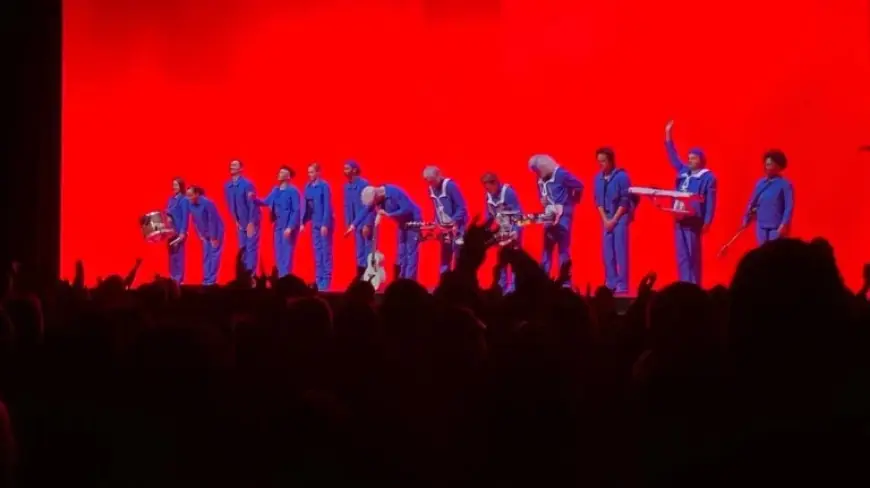
david byrne is drawing unusually consistent reactions across the UK leg of his Who Is the Sky? tour: audiences and reviewers describe a show that treats a concert like a fully staged production, with dancers who sing, percussionists who dance, and towering screens that steer the mood song by song. In Cardiff, the staging is framed as a reminder of “joy in movement”; in Glasgow, it is described as meticulously planned, with no encore and a tightly controlled flow.
David Byrne’s Cardiff production
At Utilita Arena in Cardiff, the show is built around a large ensemble in matching blue suits and a set list that leans into “elastic bass and polyrhythms, ” moving from Talking Heads songs such as Slippery People to newer material including What Is the Reason for It?, described as a brass-driven track from Byrne’s recent LP Who Is the Sky?. The visual design functions as more than decoration: huge concave screens sit at the rear of the stage, shifting scenes from a cityscape during Strange Overtones to saturated color contrasts during Once in a Lifetime. The pattern suggests the production is meant to be read as a single work, not a sequence of songs, with each track assigned its own visual logic.
Cardiff’s review also pins a specific thematic edge to specific moments. During Life During Wartime, footage from ICE raids appears in the arena, and the “insularity of the pandemic” returns as a motif, notably when the screens recreate Byrne’s home for My Apartment Is My Friend. Yet the show’s response is framed as communal rather than confrontational: “noise, laughter and community, ” with the audience gradually pulled to its feet during This Must Be the Place (Naive Melody), turning “something lithe and delicate into a collective shout along. ” Byrne’s onstage line—“Love and kindness are a form of resistance”—lands here as an explicit statement of intent rather than a throwaway aside.
Cardiff Castle and July 26
A separate Cardiff account focuses less on the arena as a venue and more on repeatability—how the same staging can be reimagined as a summer event. After attending the spring show, the writer says a second, outdoor date at the castle was announced at the start of the year and points to July 26 as the next key milestone, while also acknowledging uncertainty about whether the set and presentation will “follow the same path” outdoors. Still, the description emphasizes that the core ingredients travel well: “stylish and vibrant” visuals, vivid colors and “starry skies” on the screens, plus an ensemble that “stand front and centre as one” in matching electric blue.
The Cardiff account also adds concrete set and performance details that underline how the tour balances eras. Newer material includes Everybody Laughs, which is described as launching an energy spike from the 74-year-old performer. Talking Heads staples named include Psycho Killer and Once in a Lifetime, while (Nothing But) Flowers is singled out for its “semi-hopeful” feel and danceable pull. The figures point to a deliberate architecture: the show relies on the familiarity of “bonafide” classics while using newer tracks and the visual system to keep the night from becoming a nostalgia exercise.
Glasgow Armadillo sets the rules
In Glasgow at the Armadillo, the show is described as the kickoff of the UK leg of the Who Is the Sky? tour, and it is defined by constraint as much as spectacle: there is support and “no encore, ” just Byrne and a cadre of musicians and singers. Talking Heads material appears beside solo work, with Heaven named as the opener and My Apartment Is My Friend cited as an example of solo material that sits comfortably in the set. The staging again receives as much attention as the songs, with screens and displays “tie[ing] in perfectly with the music, ” and every movement described as choreographed and perfectly planned. The pattern suggests that the tour’s “proper show” reputation depends on discipline—blocking, timing, and a shared physical language—rather than spontaneity alone.
Glasgow’s review also introduces friction that helps explain why the show reads as theatrical. On-stage banter “didn’t always land, ” with anecdotes that made Byrne drift from “cool uncle” energy toward something more discombobulated. The set’s omissions matter, too: Road to Nowhere is explicitly named as not performed, even as the overall experience is still characterized as “breathtaking” and “a stunning experience. ” Before the performance, a voice note from Byrne encouraged the audience to dance if they wanted to, and many did—an instruction that fits the tour’s broader message of participation, whether in a seated arena where crowds rise in waves or in an indoor hall where dancing becomes an endurance test.
The next confirmed dates in the schedule are in London: David Byrne plays Eventim Apollo on March 3, 4 and 15, 16, with UK touring in between. If the Cardiff Castle July 26 show keeps the same tightly choreographed structure described in Cardiff and Glasgow, the evidence suggests the production’s central bet will hold: that a concert can feel like collective movement without needing an encore to manufacture catharsis.