Neighbors Hbo and the disputes that refuse to stay next door

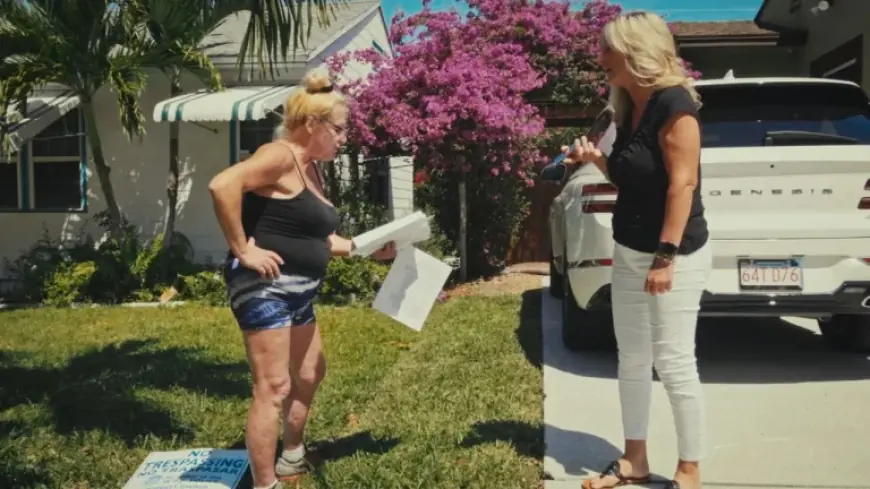
In West Palm Beach, two women named Melissa and Victoria argue over a comically small patch of grass that each says is on her property. Neighbors hbo places a camera close enough to show how a boundary line can redraw a relationship. The series tracks disputes that begin as local irritations and harden into years-long standoffs, with the creators framing them as a window into American life after Covid.
Melissa and Victoria in West Palm Beach, filmed as former friends turn rivals
Melissa and Victoria once shared something simpler than a property line: they used to be friends. Now, in West Palm Beach, the show presents them as rivals, connected mainly by the fact that both agreed to be filmed. The argument centers on a small strip of grass, a detail that lands with a kind of precision because it is so ordinary. The series’ interest is not in extraordinary settings or faraway stakes; it is in the way domestic space becomes the stage for conflict that follows people home.
That focus on the mundane is deliberate. The show is described as methodical about everyday details, treating them as the place where revealing portraits can surface. Still, the conflicts themselves are not fleeting. The series follows disputes between homeowners that, in many cases, have grown into debilitating feuds that stretch on for years, long after friends and family have tired of hearing about them.
Dylan Redford and Harrison Fishman bring cameras into conflicts to reach an endpoint
Neighbors hbo is a documentary series on HBO created by Dylan Redford and Harrison Fishman, who also directed all six episodes. Their starting premise was straightforward: bring cameras into a local community where two or more people are in the middle of a dispute, then follow both sides toward some kind of endpoint. As they pursued that premise, their work expanded across communities around the country, guided by casting director Harleigh Shaw.
Redford and Fishman have said the task of getting people to participate could be easier than it sounds. Redford described a recurring dynamic: the people in these conflicts often find that friends and family have reached their limit, telling them to stop talking about the neighbor and to let it go. The show arrives at the moment when that social pressure has failed, when the dispute has outlasted the informal mechanisms that might have cooled it down.
The series ranges across several locations, presenting arguments that differ in subject but rhyme in intensity. In Kokomo, Indiana, a man named Darrell rages at his neighbor Trever, who has started a makeshift farm, livestock included, in his grandmother’s yard. On the Florida Panhandle, oceanfront-property owners squabble with the public over beach access. In Palm Bay, Florida, a storyline centers on Johnny, a former male dancer, and Andy, described as a grizzled Vietnam vet, who feud over lawn maintenance.
Covid, online conflict, and 1. 6 million viewers for HBO Max’s debut
As Fishman and Redford developed the series, they tied its rise to a period when home felt less like a refuge and more like the center of everything. Fishman said Covid inflamed the way people interact, especially around space. Redford described a shift that came with isolation and constant phone use during 2020 and 2021, when watching real-life arguments online became one of the few accessible forms of consumption for many Americans. For them, the stakes of internet conflict began to feel bigger and more real, shaping the idea of following neighbor conflicts in a sustained way.
The show’s reception suggests that the premise traveled beyond any single street. It launched as HBO Max’s biggest unscripted debut ever, with 1. 6 million viewers tuning in. An executive-producer team includes Josh Safdie, Eli Bush, and Ronald Bronstein, and the series is described as combining immersive filmmaking with twists rooted in human behavior. The creators have framed what emerges as more than neighbor-on-neighbor friction: larger themes about society after Covid, the meaning of home ownership today, and American identity.
Within the episodes, the camera sometimes captures claims that veer into conspiracy, and the show can force a viewer to change allegiances as details unfold. In the Palm Bay storyline, Johnny comes to appear fully paranoid, convinced he is living in a “Truman Show” situation in which neighbors watch his every move. He says he has not seen any of his family since 2012 and insists he cannot leave his house during the day. He adds that he has a step-aunt in the neighborhood, and he says he does not even know if she is still alive.
Back in West Palm Beach, the frame narrows again to that strip of grass and two women who once called each other friends. The series does not need a courtroom or a grand speech to show what changes when a dispute becomes a daily structure. For now, Neighbors hbo keeps returning to the same basic fact: a home comes with a neighbor, and for some people, that closeness becomes the longest-running conflict they cannot escape.