Bub Carrington moves into the starting unit as Wizards weigh his trajectory

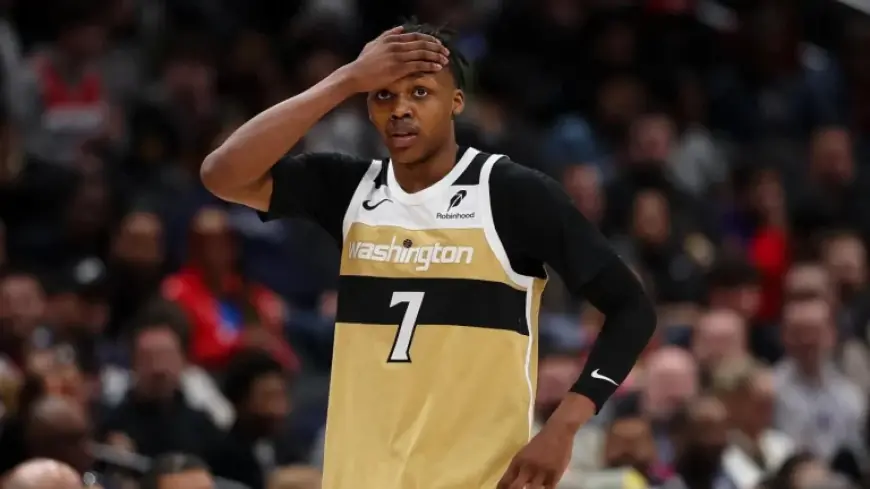
bub carrington will start Tuesday’s game against the Heat, a concrete rotation decision that puts him back with the first unit. The move also sharpens a broader question already forming around his second season: whether a larger role can stabilize his uneven production, or whether Washington eventually treats him as a trade or reduced-usage candidate.
Bub Carrington starting Tuesday vs. the Heat: what is confirmed now
The immediate development is clear: Carrington will start Tuesday against the Heat. The stated reason is also specific: Trae Young is sidelined with a knee issue, and that absence opens a spot that returns Carrington to the first unit.
Context on how he has performed in that role this season provides the cleanest baseline for what this start could represent. As a starter in 32 games, Carrington has averaged 11. 6 points, 5. 1 assists, and 3. 8 rebounds in 30. 3 minutes per game. Those numbers outline a guard who can carry a meaningful workload when his minutes rise, especially in playmaking volume, and Tuesday sets up another data point within that same usage band.
Yet, even with a defined starter sample, the context does not specify how long Young will remain sidelined, or whether this is a one-game adjustment. For now, the confirmed part of the story is the assignment itself: Carrington is in, and the rotation change is driven by injury availability rather than a stated strategic overhaul.
Trae Young’s absence and Washington’s roster pressure are the visible drivers
Two forces are apparent in the context. The first is immediate and transactional: Young’s knee injury creates a direct opening for Carrington to start. That kind of opportunity tends to elevate not just minutes but decision-making responsibilities, which matters because Carrington’s profile in the context is heavily tied to playmaking and role definition.
The second force is longer-range and organizational: the context frames Washington as approaching a “new era, ” with Young and Anthony Davis described as a new All-Star duo and General Manager Will Dawkins characterized as aggressive in seeking deals to improve the roster or obtain draft capital. In that environment, a young guard’s week-to-week role can quickly become an evaluation tool, and a single start can be read as part of a broader sorting process even if it originates from an injury replacement.
That roster pressure is amplified by two additional signals contained in the context. First, Carrington’s role is described as being in question due to the addition of Young and the possibility of a top-three pick in the 2026 NBA Draft. Second, Carrington is placed in a comparative frame: his draftmates Alex Sarr and Kyshawn George are described as showing more of a production jump, and rookies are said to be standing out compared to him. Those comparisons set the backdrop for why a starting opportunity is more than a box-score note; it intersects with a larger internal ranking of who is trending upward.
Deni Avdija comparisons and mixed indicators define Bub Carrington’s direction
The context explicitly raises a parallel: whether Bub Carrington could face a similar fate to Deni Avdija. Avdija is described as having been traded to maximize value after a career season in 2023-24, and the comparison is not presented as identical circumstances. Instead, it highlights the risk Washington faces when deciding whether to move a player based on potential versus proven production.
In Carrington’s case, the trajectory described is uneven rather than linear. He is said to have made no major “sophomore jump” outside of improved three-point shooting. The context quantifies that mixed picture: his field goal percentage is down this season, while his three-point shooting is six percent better. Meanwhile, he is averaging the same 9. 8 points per game, his assists have increased to 4. 5, and he is averaging over two turnovers per game. That combination supports why his season is characterized as inconsistent and why his “stats tell a rather confusing story. ”
This is where Tuesday’s start functions as a trend signal rather than a conclusion. The context already sketches a fork between paths: Washington could try to capitalize on his potential in a trade, or keep him but reduce him into a rotational usage player rather than a 25-plus-minute role. Being placed back into the first unit because of Young’s absence does not settle that fork, but it does create another chance for Carrington to show he can handle starter-level minutes with fewer of the inconsistencies highlighted.
If the first-unit run continues, Bub Carrington’s evaluation window widens
If Trae Young’s absence continues… Carrington’s return to the first unit could extend beyond a single night, and the context suggests what would matter most in that stretch. His starter averages this season (11. 6 points, 5. 1 assists, 3. 8 rebounds in 30. 3 minutes) indicate he can produce in volume, but the broader season snapshot flags efficiency and decision-making tension: a lower field goal percentage, improved three-point shooting by six percent, 4. 5 assists, and over two turnovers per game.
In that conditional scenario, the trendline Washington would be watching is not simply points per game. It would be whether Carrington can translate starter minutes into steadier playmaking and scoring consistency, because the context frames his inconsistency as the main obstacle to clearly defining his value.
Should Will Dawkins prioritize deals, Bub Carrington becomes a clearer pivot point
Should the front office pursue deals for roster improvement or draft capital… Carrington’s status as a player who “could be moved” becomes more immediate. The context frames the dilemma directly: trade him and capitalize on his potential, or keep him and shift him toward a smaller rotational role. It also outlines why another team could be interested: he has shown flashes as a bench scoring option, has versatility as a guard, and offers playmaking that could fit a sixth-man type role running an offense.
The Avdija reference adds a cautionary undertone within the context itself: moving a player before he fully hits his stride can carry regret. Still, the context does not provide any confirmed negotiation, timeline, or concrete offers involving Carrington. What it does show is the logic structure around him: a new core described as arriving quickly, uneven second-year indicators, and an aggressive decision-maker in Will Dawkins.
The next confirmed milestone in the context is Tuesday’s game against the Heat, with Bub Carrington starting due to Trae Young’s knee injury. What the context does not resolve is how long the starting opportunity lasts, or whether Washington’s internal direction favors a trade path or a reduced role. For now, the clearest signal is that a short-term lineup change is colliding with longer-term uncertainty about where Carrington fits as the roster priorities sharpen.