Consumers Energy storm outlooks converge, but warnings split across Michigan regions

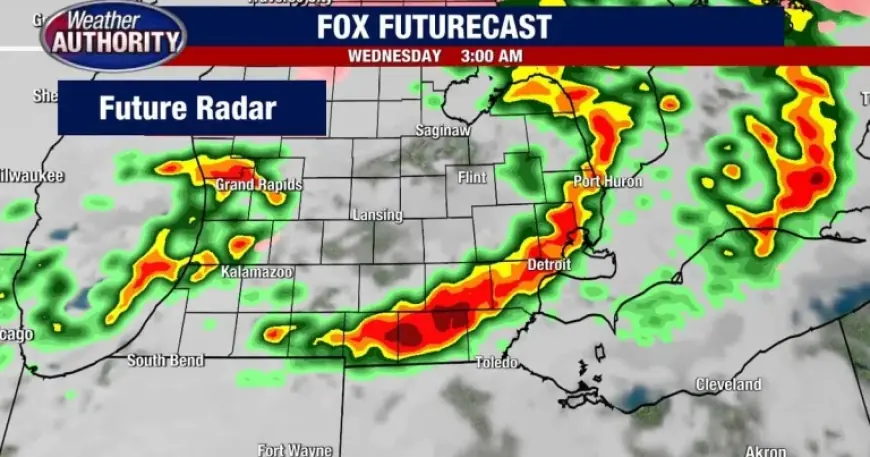
consumers energy customers across Michigan are heading into a night where forecasters agree on one central fact: strong storms are possible after dark. Yet the record in the latest forecasts shows a second, less visible reality. Official risk levels, watch areas, and the most emphasized hazards vary by region, creating a patchwork of guidance that can be hard to translate into a single, statewide sense of urgency.
Metro Detroit: Christina Burkhart details hail, heavy rain, and overnight timing
A forecast centered on Southeast Michigan places Metro Detroit under Marginal and Slight risks for severe weather tonight, described as levels 1 and 2 out of 5. The forecast acknowledges the risk as “lesser” while still emphasizing that strong storms remain possible, with a clear operational message: stay weather aware overnight and ensure alerts can wake people up.
In that same forecast, storms are expected to develop and move in around 10: 00 p. m. ET. Two hazards are explicitly listed as possible as storms move through overnight into Wednesday morning: locally heavy downpours with rainfall totals by Wednesday afternoon of 1 to 2 inches, and large hail of 1 inch or greater in diameter. The forecast also introduces a temperature-driven complication farther north. For the northern Thumb and Bay region, it states temperatures will be cold enough that freezing rain is possible, with those locations potentially seeing 0. 1 inch of ice accumulation by Wednesday morning.
The forecast then pivots from the overnight severe-weather window to the back side of the system: the main rain looks to move out by midday Wednesday as temperatures fall, scattered wintry mix is possible Wednesday night into Thursday, and Thursday morning wind chills will be in the teens.
Genessee, Lapeer, and St. Clair: Rich Luterman cites a watch until 3: 00 a. m. ET
A separate update frames the threat as severe weather rolling through northern Indiana and Illinois just south of Chicago Tuesday night, with Southeast Michigan under a hazardous weather outlook. It also documents a more formal escalation for part of the region: Genessee County, Lapeer, and St. Clair counties are under a severe thunderstorm watch until 3: 00 a. m. ET, with storms carrying 60 mile-per-hour winds and hail up to an inch in diameter.
For Metro Detroit specifically, the forecast narrows the most active period to a window that starts later than the 10: 00 p. m. arrival described elsewhere: 11: 00 p. m. to 5: 00 a. m. ET. That difference is not presented as a dispute, but it is a documented gap in how the night is framed. One forecast highlights storms developing around 10: 00 p. m. ET, while another spotlights an 11: 00 p. m. to 5: 00 a. m. ET window as the period when activity “appears” most likely.
Beyond watches and timing, the same update points to the broader Midwest impact, describing severe weather in northern Indiana with videos of funnel clouds and suspected tornadoes circulating on social media. It also notes a colder pattern arriving Thursday and lays out a multi-day outlook, including a low of 46 Tuesday night with late-night thunderstorms, a high of 63 Wednesday with rain, and a high of 43 Thursday with colder conditions.
Berrien and Kalamazoo watches: Storm Prediction Center outlook escalates hail and tornado language
Farther west and southwest, the watch landscape becomes more complex. A tornado watch is stated as being in effect for far southwest Michigan, covering four counties along the Indiana border: Berrien, Branch, Cass, and St. Joseph. A separate severe thunderstorm watch is stated as being in effect across a wider area from Iowa into part of Michigan, including seven counties in southwest and west-central Lower Michigan: Allegan, Barry, Kalamazoo, Kent, Muskegon, Ottawa, and Van Buren.
This update goes beyond the one-inch hail referenced in the Southeast Michigan forecasts. It describes expectations of very large hail, with tools that forecast “large to very large hail” up to a maximum size of three inches in diameter, described as baseball-sized. The text adds that hail that large, if it occurs, would cause extreme damage to vehicles or houses, and it urges people to park cars in garages and pole barns for the rest of the night.
It also highlights an atmospheric setup described as unusual for severe thunderstorms: a window where storms are expected to expand and intensify between 8: 00 p. m. and 10: 00 p. m., with severe potential continuing to 1: 00 a. m. ET. The timing is labeled “very odd” because severe storms are described as usually most severe in the afternoon up to about 8: 00 p. m. In this case, a strong jet core is described as moving into position to expand thunderstorms. The storms are characterized as “elevated thunderstorms, ” with cold air beneath warmer, more unstable air aloft, a structure described as making it tougher for a circulation to reach the ground.
Still, the same text states there are enough ingredients not to rule out tornadoes, and it notes that the Storm Prediction Center still has the chance of an EF2 or EF3 tornado from I-94 southward, especially in the southwest corner of Lower Michigan.
Taken together, the confirmed facts point to a clear pattern: storm risk is broadly shared across the state tonight, but the intensity language, watch types, and the headline hazards diverge by location. Southeast Michigan forecasts emphasize hail around one inch, heavy rain totals by Wednesday afternoon, and a defined overnight window. Southwest Michigan watch language escalates to potential tornadoes and baseball-sized hail, with an additional focus on the unusual nighttime timing and storm structure.
What remains unclear is how residents who sit outside the named watch counties, but inside broader risk categories, should reconcile the different thresholds being communicated. The context does not confirm whether additional counties will be added to any watch, or whether the timing windows will narrow as storms evolve.
The next concrete evidence point is operational rather than interpretive: the watch expirations and the overnight windows already specified in the forecasts. If storms intensify in the areas under the tornado watch or severe thunderstorm watch during the stated windows, it would establish that the higher-end hazards described for southwest and west-central Michigan are not confined to earlier, daytime storms.