Cameron Payne’s expanded role signals a short-term test for Sixers offense

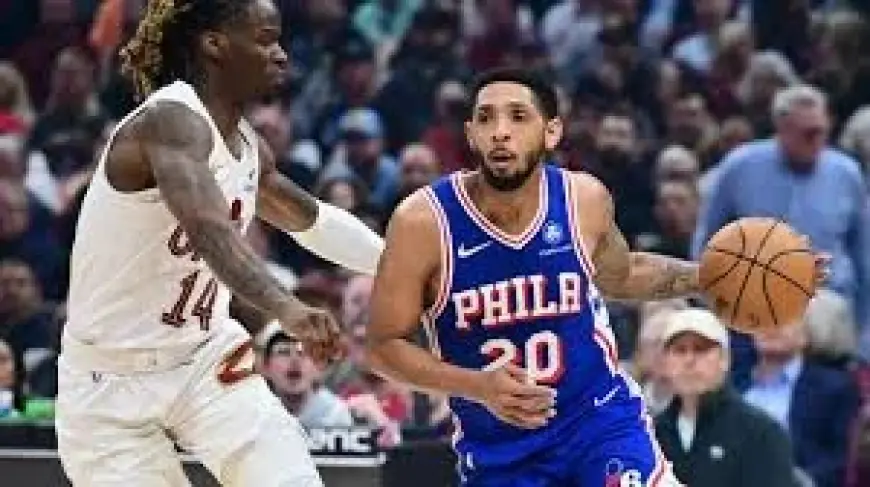
cameron payne turned in a 12-point night in Philadelphia’s 115-100 loss to the Cavaliers on Monday, pairing his scoring with six rebounds and four assists. The performance also points toward a near-term direction: with multiple regular scorers unavailable, the Sixers are testing whether Payne can provide workable offense when his role grows.
Cameron Payne’s Cavaliers line shows volume, not efficiency
Cameron Payne finished with 12 points on 4-of-12 shooting, including 2-of-7 from three-point range, and went 2-of-2 at the free-throw line. Alongside the scoring, he added six rebounds and four assists, a stat line that reflects a wider workload than a typical low-usage night.
That mix of production and inefficiency matters because it frames the current state clearly. The shot volume was there, but the conversion rate was uneven, especially from deep. In a game the Sixers lost by 15 points, that gap between opportunity and finishing becomes part of the immediate evaluation of what this role expansion can realistically deliver.
Tyrese Maxey, Joel Embiid, and VJ Edgecombe absences are driving the experiment
The context of the night is as important as the box score. Philadelphia played without Tyrese Maxey, Joel Embiid, and VJ Edgecombe, leaving the team shorthanded and creating a larger scoring and playmaking burden for the remaining rotation. Within that setup, Cameron Payne ended up third on the team in scoring, an indicator that the Sixers’ offensive hierarchy looked materially different than it would at full strength.
This is the clearest force visible in the current development: availability. When multiple primary options sit, the team needs someone to absorb possessions, take shots, and keep the offense moving. Payne’s combination of 12 points, four assists, and six rebounds suggests he was asked to do more than simply spot up, even as the shooting line shows the limits of that approach over a single game.
The Sixers’ near-term trajectory depends on whether Cameron Payne can stabilize offense
The direction signaled by Monday’s loss is not complicated: if the Sixers continue to face games without key scorers, they will keep looking for functional offense from role players in bigger minutes. Payne’s outing supplies both evidence of capability and a warning flag. He produced across categories and took enough attempts to matter, yet he needed 12 shots to reach 12 points and missed five of seven three-point tries.
If the current absences continue… Cameron Payne’s workload is likely to stay elevated simply because the shorthanded rotation requires it, and the Sixers may keep using him as a startable option in that larger role. In that scenario, the trend to watch is whether his scoring comes with steadier efficiency than the 4-of-12 shooting shown against Cleveland, because shot volume alone did not close the gap in a 115-100 defeat.
Should Tyrese Maxey, Joel Embiid, and VJ Edgecombe return… the context suggests Payne would be less central, shifting from a bigger-role option to a more situational one. The difference between being third on the team in scoring and being a supplemental piece is the core swing factor for how the Sixers would deploy him, and it would also change how his 12-point, six-rebound, four-assist profile is interpreted.
The next concrete signal in the context is the team’s continued handling of games while missing key players, because Monday’s shorthanded setup is the direct reason Payne’s role expanded. What the context does not resolve is how long the absences for Maxey, Embiid, and Edgecombe will last, leaving the timeline for this experiment undefined while the Sixers search for enough offense in the meantime.