Baltimore Ravens trade for Maxx Crosby and rewrite their roster blueprint

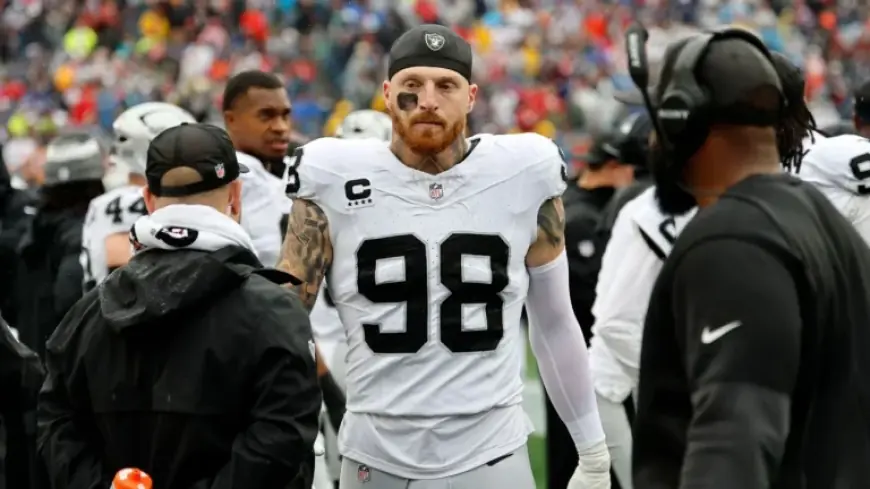
The baltimore ravens are set to acquire five-time Pro Bowl defensive end Maxx Crosby from the Las Vegas Raiders for first-round picks in 2026 and 2027, a deal contingent on Crosby passing a physical that cannot happen until the start of the new league year Wednesday. The move breaks from Baltimore’s long-standing draft-first posture and immediately targets the team’s most visible weakness after a disappointing 2025.
Baltimore Ravens pay two firsts
Baltimore’s agreement to send away first-round picks in 2026 and 2027 represents more than a blockbuster acquisition; it is an explicit decision to convert future flexibility into present certainty. It is also a franchise precedent: in the Ravens’ 31-year existence, they have never used a first-round pick to trade for a veteran player. Before this, the highest pick Baltimore had surrendered in a trade was a second-rounder for middle linebacker Roquan Smith in November 2022.
That choice lands differently because of what the Ravens are giving up and what they are signaling. Baltimore had the No. 14 pick in this year’s draft, but the Crosby deal instead pushes their biggest investment into proven production rather than another attempt to develop it. The pattern suggests the front office is prioritizing a known defensive disruptor over the longer arc of first-round development, a meaningful pivot for a franchise that has historically guarded top draft capital.
The competitive context inside the negotiations underscores the urgency. The Ravens beat out other bidders, including the Dallas Cowboys, who were willing to offer a first- and a second-round pick for Crosby. Matching or exceeding that kind of offer required Baltimore to accept a steeper price, and the two-first structure reflects both Crosby’s value and the market pressure created by multiple interested teams.
Maxx Crosby targets Baltimore’s sack drought
Crosby, 28, arrives as a direct response to a pass rush that stalled in 2025. Baltimore finished last season with 30 sacks, its fewest total in 15 years. It was also the first time since the Ravens’ inaugural 1996 campaign that the team didn’t have an edge rusher with more than 4. 5 sacks. Those two numbers, taken together, describe not just a down year but a unit lacking a credible week-to-week finisher.
Crosby’s profile addresses that specific gap. Since entering the NFL in 2019, he has 360 quarterback pressures, which stands 29 more than the next-closest player. He has also produced four double-digit sack seasons in his seven-year career. The figures point to a player who creates disruption consistently, even before sacks show up, and that consistency is what Baltimore’s 2025 line did not deliver.
His résumé also resets how opponents will have to game-plan Baltimore. Over the same span when Crosby piled up those double-digit sack seasons, the Ravens have had two edge rushers reach 10 or more sacks: Kyle Van Noy (12. 5 in 2024) and Odafe Oweh (10 in 2024). Crosby does not simply add depth; he becomes the focal point of the pass rush, the type of presence Baltimore has not had in his prime since Terrell Suggs, the franchise’s all-time sacks leader who played in Baltimore from 2003 to 2018.
Jesse Minter inherits a new centerpiece
The trade also functions as an organizational reset after a season that forced dramatic change. The Ravens finished 8-9 in 2025, missed the playoffs, and fired longtime coach John Harbaugh. The front office’s pursuit of a “game changer” like Crosby, as described in the context of trying to reach the Super Bowl for the first time since the 2012 season, frames the move as a deliberate attempt to accelerate the timeline rather than patiently rebuild.
For new coach Jesse Minter, who will call plays on defense, Crosby offers a clear foundation to build around immediately. Yet the deal’s contingency—Crosby must pass a physical, and that can’t occur until the start of the new league year Wednesday—introduces a brief, defined window where the acquisition is agreed to but not finalized. That matters because roster planning, draft positioning, and defensive installation all hinge on whether Crosby is officially cleared to join the team.
On the Raiders’ side, the deal marks a turning point after public expectations that Crosby would remain. Owner Mark Davis, general manager John Spytek, and new coach Klint Kubiak said last month they anticipated Crosby staying with the club in 2026. Still, the relationship “had run its course, ” and a longer view of Crosby’s tenure provides the friction points: one postseason appearance (a loss in the 2021 season), five losing seasons, five head coaches, and four general managers, along with instability that included nine different players starting at quarterback during that span.
A separate account describes a meeting two months ago in which Davis went to Crosby’s house, and the two spoke for hours about Crosby’s issues with the state of affairs in Las Vegas before agreeing they might need different futures. It also notes Crosby often said he was “a Raider for life, ” and that he did not wipe Raiders photos from his Instagram page or publicly demand a trade, details that helped Las Vegas maintain leverage while it searched for a buyer. The pattern suggests this exit was not a sudden rupture but a negotiated acknowledgement that the Raiders’ direction and Crosby’s prime were no longer aligned.
The next confirmed step is procedural: the trade remains contingent on Crosby passing a physical, which cannot take place until the start of the new league year Wednesday. If that clearance holds, the data suggests the baltimore ravens have chosen immediate pass-rush disruption—anchored by Crosby’s 360 pressures since 2019—over the longer runway of two future first-round picks, a clear statement about how they plan to respond to 2025’s collapse.