Kankakee Illinois expansion by CSL points to a fuller domestic plasma supply chain

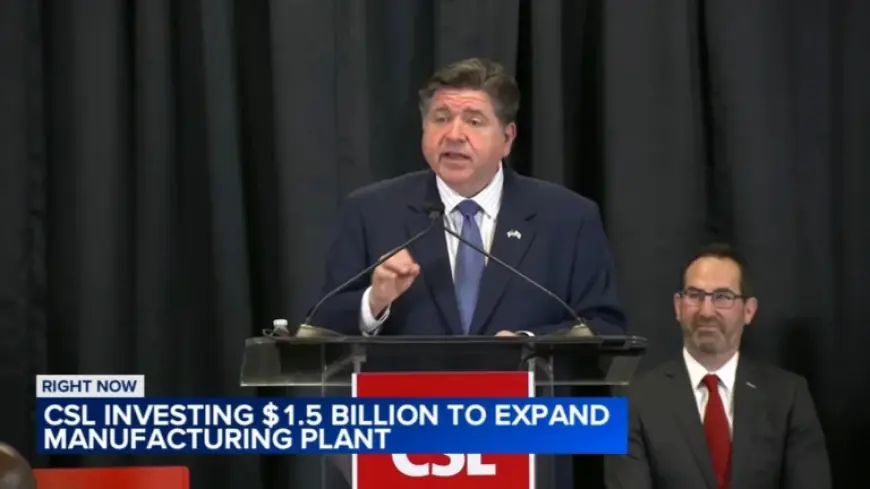
CSL has announced a major expansion tied to its Kankakee-area manufacturing campus in Bradley, with a nearly $1. 5 billion investment planned through 2031 and 300 new full-time jobs alongside more than 1, 200 existing positions. For kankakee illinois, the confirmed move signals a direction of travel: more of the plasma-therapy manufacturing chain is being pulled into a single U. S. -based hub, backed by state incentives and multi-year planning.
CSL Behring’s Bradley site sets a 2031 investment and hiring marker
CSL Behring, a subsidiary of CSL, said the expansion at its Kankakee manufacturing facility will bring end-to-end plasma processing into the U. S. The plan calls for investment of nearly $1. 5 billion by 2031, creating 300 new high-skilled jobs while retaining more than 1, 200 existing full-time employees. Beyond the permanent hiring, the buildout is also expected to require around 800 construction and related local jobs to support the expansion.
The state described the project as one of the largest life sciences investments in Illinois history, and the company framed it as a shift toward completing more steps of its manufacturing process domestically. The Illinois announcement centered on construction of a new manufacturing facility at the company’s Kankakee campus and emphasized that the project brings the full process, from plasma collection through filling and packing, entirely to the U. S.
The expansion also adds a concrete timeline to recent activity around the site. State Sen. Patrick Joyce, D-Essex, pointed back to 2023, when he said he stood at the north end of the CSL property for the opening of a plasma donation center. That reference anchors the current push as a continuation of capacity-building already visible on the ground near kankakee illinois.
Gov. JB Pritzker and Illinois EDGE incentives align with CSL’s scale-up
Gov. JB Pritzker credited the state’s Economic Development for a Growing Economy, or EDGE, tax credit program as an incentive for CSL’s continued investment in Illinois. The EDGE program has been administered by the Illinois Department of Commerce and Economic Opportunity since 1999, and it received a significant overhaul in 2017. In 2024, the General Assembly added a new tier intended to attract large-scale projects, a relevant signal given the size of CSL’s planned investment.
Within the structure described by the state, projects that qualify for EDGE credits can receive tax credits for new hires and retained jobs, with extra savings for operating in underserved areas. The program also offers a credit for 10% of new employee training costs. Taken together, those components map directly onto the job figures attached to CSL’s announcement: 300 new full-time positions and retention of more than 1, 200 roles at the site.
Pritzker said the expansion had been in discussion for 2 to 3 years, with acceleration over the last 12 months. He also described coordination between the company and local government to understand what infrastructure would be needed to support the expansion. The context does not specify which infrastructure elements are involved, but it does confirm that planning has moved beyond internal facility design into wider local coordination.
Privigen and Hizentra plans point toward deeper U. S. end-to-end production
The company produces plasma therapies used in treating rare diseases and immunodeficiencies, and the expansion is positioned as a manufacturing step-change rather than a simple footprint increase. Illinois said the new manufacturing facility is intended to increase production capacity for the company’s top immunoglobulin therapies, Privigen and Hizentra. For the first time, the project would bring the company’s full manufacturing process from plasma collection through filling and packing entirely to the U. S., while positioning the Illinois facility to supply 100% of its U. S. demand for immunoglobulin therapies.
Company executives also pointed to manufacturing efficiency as a key driver. CSL’s leadership said the site expansion incorporates new manufacturing processes and technology, with the goal of increasing protein yield from each gram of plasma collected. That detail matters because plasma cannot be synthesized like other manufactured pharmaceuticals: it must be collected from healthy donors, then tested and purified through a complex and highly regulated process before it can be used to treat patients.
The underlying demand pressure described in the context is personal as well as operational. Treating a single patient for a year can require plasma from hundreds or thousands of individual donations. The Immune Deficiency Foundation’s president and CEO, Jorey Berry, described the fear of infection in the community and noted that shortages can cause anxiety for those who rely on consistent access to therapies. Those statements connect the investment’s trajectory to a central constraint: supply depends on collections, processing capacity, and sustained manufacturing throughput.
If the 2031 buildout stays on track, CSL’s Kankakee campus consolidates more steps
If the planned investment through 2031 continues on the timeline CSL laid out, the visible trajectory is further consolidation of plasma-derived therapy manufacturing steps at the Kankakee campus. The context’s clearest signal is the stated intent to complete the process in the U. S., from collection through filling and packing, alongside job growth and a new facility described as state-of-the-art.
Based on context data.
- Investment: nearly $1. 5 billion by 2031
- Jobs: 300 new full-time roles; more than 1, 200 retained
- Construction: around 800 construction and related local jobs
- Manufacturing scope: plasma collection through filling and packing in the U. S.
- Products named: Privigen and Hizentra immunoglobulin therapies
Should that consolidation occur as described, the campus would be positioned to supply 100% of U. S. demand for those immunoglobulin therapies, a benchmark Illinois highlighted as part of the announcement.
Should plasma supply constraints persist, efficiency and collection capacity stay central
Should shortages in plasma-derived therapies persist, the context suggests the pressure will remain on two linked levers named explicitly in the announcement: the availability of plasma donations and the efficiency of processing each gram collected. CSL’s stated goal of increasing protein yield from each gram of plasma collected points to a response aimed at getting more output from the same constrained input, while the emphasis on end-to-end processing underscores an effort to reduce friction across handoffs.
The next confirmed milestone in the context is the long-horizon commitment itself: CSL’s investment plan runs through 2031, and state leaders have tied it to EDGE incentives and multi-year discussions that accelerated over the last 12 months. What the context does not resolve is the specific infrastructure needs identified with local government, or the detailed build schedule for the new facility. For now, the direction is clear within the confirmed facts: kankakee illinois sits at the center of a plan to expand capacity, add jobs, and bring more of the plasma-therapy production chain into the U. S.