Kankakee development signals a dual track for safety and life sciences growth

kankakee is confronting two very different, confirmed developments at the same time: a small residential electrical fire that caused about $5, 000 in damage, and a long-dated, $1. 5 billion manufacturing expansion plan tied to plasma-derived therapies. Together, they signal a direction in which day-to-day public safety readiness runs alongside a multi-year push to deepen domestic plasma processing and expand specialized employment.
Kankakee Fire Department response on South Washington Avenue shows a familiar risk
An electrical fire in a wall on Tuesday caused about $5, 000 in damage to a residence in the 900 block of South Washington Avenue. The Kankakee Fire Department responded at about 5: 45 a. m. ET to what it described as a very small structure fire, then stayed on scene for about an hour to confirm the fire was extinguished within the walls.
The cause was ruled electrical in nature, specifically a failure of wiring. No residents were displaced and there were no injuries. Assistance came from the Bourbonnais and Bradley fire departments, a detail that points to operational reliance on neighboring departments when a call requires additional hands, even when the incident is described as small.
For now, the confirmed signal is not a spike in frequency, since the context describes a single incident. Still, the details underscore the kind of risk that can be easy to miss until it is inside a wall: wiring failure, limited visible flames, and a need for extended confirmation that the fire is out.
CSL Behring’s Bradley expansion ties Kankakee manufacturing to end-to-end plasma processing
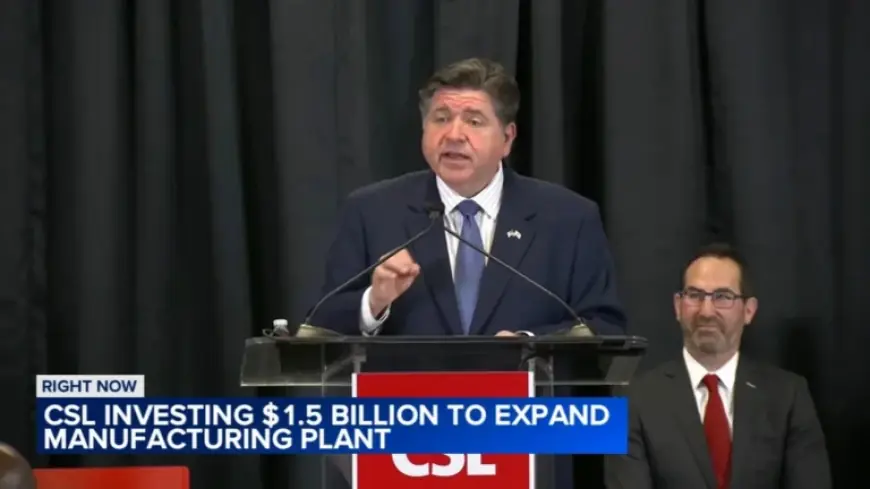
In Bradley, Ill., Australian biopharmaceutical company CSL announced Monday a major expansion at its Kankakee manufacturing facility. CSL Behring, a subsidiary of CSL, said it will invest $1. 5 billion into the site expansion by 2031. The plan adds 300 new high-skilled jobs to its existing 1, 200 full-time employees, plus around 800 construction and related local jobs needed to support the build-out.
State announcements described the project as constructing a new manufacturing facility at the company’s Kankakee campus, creating 300 new full-time jobs while retaining more than 1, 200 existing positions. The expansion is designed to increase production capacity for immunoglobulin therapies Privigen and Hizentra. A central feature is process consolidation: for the first time, the company’s full manufacturing process, from plasma collection through filling and packing, would be entirely in the U. S., while positioning the Illinois facility to supply 100% of its U. S. demand for immunoglobulin therapies.
The context also describes why the supply chain matters operationally. Plasma cannot be synthesized like other manufactured pharmaceuticals; it must be collected from healthy donors, tested, and purified through a complex and highly regulated process before it can be used to treat patients. The company notes that treating a single patient for a year can require plasma from hundreds or thousands of individual donations. Within that constraint, CSL executives said new processes and technology are meant to increase protein yield from each gram of plasma collected.
Illinois EDGE incentives and a 2–3 year runway suggest how projects like CSL’s get built
The expansion was not framed as an overnight decision. Gov. JB Pritzker said the project had been in discussion for 2–3 years, with acceleration over the last 12 months. Those conversations included coordination between the company and local government to understand what infrastructure would be needed to support the expansion.
The state positioned incentives as part of the push. Pritzker credited the Economic Development for a Growing Economy, or EDGE, tax credit program as an incentive for CSL’s continued investment in Illinois. The context notes the program has been administered since 1999, received a significant overhaul in 2017, and added a new tier in 2024 to attract large-scale projects. Qualifying projects can receive tax credits for new hires and retained jobs, with extra savings for operating in underserved areas, plus a credit for 10% on new employee training costs.
Placed next to the residential fire response in kankakee, the trajectories look different but complementary: emergency services responding to a wiring failure at 5: 45 a. m. ET on one hand, and a policy-assisted, infrastructure-dependent manufacturing build that runs through 2031 on the other. Both depend on coordinated capacity: mutual aid for fire response, and multi-party coordination for a complex industrial project.
If CSL’s 2031 investment schedule continues, Kankakee County’s job mix may tilt further toward specialized manufacturing
If CSL’s investment timeline through 2031 continues, the most visible near-term direction is a layered employment ramp: 300 new high-skilled jobs added to 1, 200 existing full-time employees, plus around 800 construction and related local jobs supporting the expansion. The context also points to a manufacturing shift, with end-to-end plasma processing located in the U. S. for the first time in this company’s chain, and an Illinois facility positioned to supply 100% of U. S. demand for certain immunoglobulin therapies.
Based on context data:
- $1. 5 billion investment planned by 2031
- 300 new full-time high-skilled jobs
- More than 1, 200 jobs retained (and 1, 200 existing full-time employees referenced)
- Around 800 construction and related local jobs
- Discussion period: 2–3 years, accelerating over the last 12 months
That direction also carries a practical constraint the context makes explicit: plasma must be collected, tested, and purified, and a single patient’s annual needs can draw from hundreds or thousands of donations. Expansion plans that depend on plasma inputs necessarily keep donor-driven supply in the foreground, even as manufacturing capacity grows.
Should wiring-failure incidents recur, Kankakee Fire Department mutual aid patterns could become more routine
Should wiring-failure incidents recur, the Tuesday call offers a small but clear signal about how responses could look: dispatch at about 5: 45 a. m. ET, an extended on-scene period of about an hour to confirm extinguishment inside walls, and assistance from nearby Bourbonnais and Bradley fire departments. The context does not quantify additional fires, so it does not support a claim of rising frequency. Yet, it does show the operational reality that even “very small” structure fires can demand careful verification and inter-department support.
The next confirmed milestones in the context are already defined: CSL’s $1. 5 billion expansion is planned through 2031, and state officials describe it as bringing plasma collection through filling and packing into the U. S. What the context does not resolve is the detailed infrastructure scope implied by the coordination discussions, or how quickly hiring and construction jobs materialize within that 2031 window. Still, the present signals are concrete: kankakee is managing immediate safety risks while anchoring a long-horizon manufacturing bet tied to plasma-based medicines.