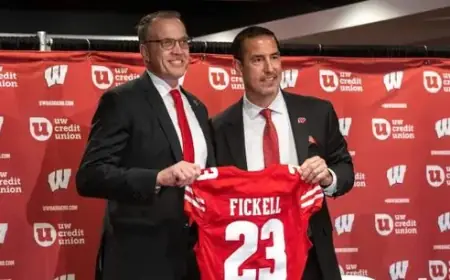
Luke Fortner vs. Cade Mays: what Carolina’s center pivot reveals


Carolina is set to sign veteran center luke fortner on a one-year deal worth up to $4. 75MM, while center Cade Mays has already left for Detroit on a three-year contract. Put side by side, the two transactions answer a practical roster question: is Carolina responding to an immediate void with a short-term plug, or choosing a longer runway at the position?
Luke Fortner: a one-year bet shaped by recent performance
Carolina’s plan centers on adding luke fortner as a direct response to a vacancy on the interior offensive line. The contract is described as a one-year deal that can pay up to $4. 75MM, a structure that reads as a limited-term commitment while still leaving room for upside compensation.
Fortner’s most recent season offers the clearest snapshot of what Carolina is buying. In his lone year in New Orleans, he returned to a starting role, starting 10 games while appearing in all 17. Pro Football Focus labeled it the best showing of his career, ranking him 17th among 37 qualifying centers, and crediting him with three sacks allowed and 11 pressures allowed. That profile positions him as a player with identifiable recent tape at center, rather than a projection at the spot.
Still, the contrast inside Fortner’s last two seasons is part of the story. In 2024, he played only 13 offensive snaps across 17 games. After that campaign, Jacksonville moved on by trading him to the Saints for defensive tackle Khalen Saunders. Carolina is, in effect, leaning on what he did in New Orleans rather than what happened at the end of his Jacksonville tenure.
Cade Mays and Austin Corbett: a longer deal exits as a hole opens
Mays’ departure sets the urgency. He joined Detroit on a three-year deal, and with center/guard Austin Corbett also described as unsigned, Carolina faced what was framed as a major hole along the offensive line. The timing creates a before-and-after comparison inside Carolina’s own depth chart: where there was at least a recognizable option in Mays, the position suddenly needed a new plan.
That is where the difference in contract length matters. Carolina’s incoming move is one year, while the outgoing player secured three years elsewhere. Those structures do not, by themselves, declare which player is better. Yet they do show different levels of commitment between the team that just added Mays and the team that is now replacing him.
Corbett’s unsigned status also adds a second layer to the same problem. With one player leaving on a multi-year deal and another still not under contract, Carolina’s decision to pursue a one-year signing can be read as prioritizing immediate lineup functionality, even if it leaves future planning to later roster decisions.
Carolina’s comparison point: short-term fix versus multi-year continuity
Viewed together, Fortner’s arrival and Mays’ exit clarify Carolina’s current approach: fill the vacancy quickly and keep flexibility. Detroit’s three-year deal for Mays is built for continuity; Carolina’s one-year agreement with Fortner is built for responsiveness. Neither is automatically superior, but they point to different priorities under the same basic criterion: stabilizing the center position.
| Comparable point | Luke Fortner (incoming) | Cade Mays (outgoing) |
|---|---|---|
| Team outcome | Panthers set to sign | Left for Lions |
| Contract length | One year | Three years |
| Contract value detail | Up to $4. 75MM | Not specified beyond length |
| Most recent season usage noted | 10 starts in 17 appearances (New Orleans) | Not specified |
| Most recent performance markers provided | Ranked 17th of 37; 3 sacks and 11 pressures allowed | Not specified |
The competition angle reinforces the same theme. Fortner is described as being “penciled in” for the starting job entering training camp, but not handed it without challenge; potential competition could come from special teamer Nick Samac or any other offseason acquisition. That framing is consistent with a one-year add: functional enough to start, but not necessarily positioned as the unchallenged long-term answer.
Analysis: The direct comparison suggests Carolina is choosing flexibility over multi-year continuity at center, at least for now. Mays landed a three-year deal elsewhere, while Carolina opted for a one-year contract that can reach $4. 75MM, paired with a player whose recent peak was identified in New Orleans but whose prior year included only 13 offensive snaps across 17 games.
The next test of this finding comes at training camp, where Fortner is expected to enter as the starter and where any push from Nick Samac or another offseason acquisition can either validate the one-year approach or expose the need for a more durable answer. If luke fortner maintains the form credited to him in New Orleans, the comparison suggests Carolina can stabilize the position quickly without locking into a multi-year commitment.