News 9: U.S. Naval Update Map compares Carrier Strike Groups and Amphibious Ready Groups

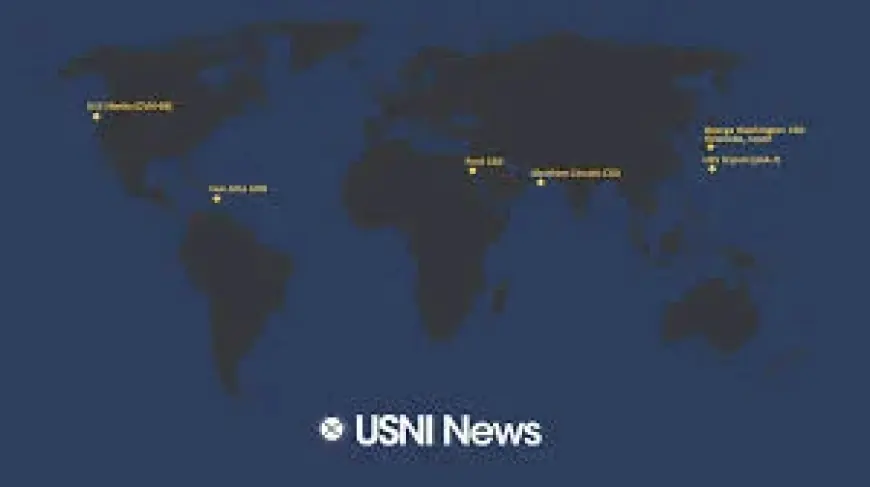
News 9 focuses on the U. S. Naval Update Map dated March 5, 2026, which presents approximate current locations of U. S. Carrier Strike Groups (CSGs) and Amphibious Ready Groups (ARGs) using available open-source information. The comparison that matters is not where they are, but how each formation is defined: what does placing CSGs and ARGs side by side reveal about the roles the map is designed to highlight?
U. S. Naval Update Map (March 5, 2026) and its open-source framing
The March 5, 2026 U. S. Naval Update Map is described as a weekly update showing the approximate current locations of U. S. CSGs and ARGs. Its scope is explicitly bounded: the map is based on available open-source information, and it states that no classified or operationally sensitive information is included. That choice shapes the product into a broad situational snapshot rather than a tactical feed, emphasizing what can be responsibly shown while still giving a view of how major naval formations are distributed.
Within that framework, the map elevates two formations as the central units of display. It describes CSGs and ARGs as “the keys to U. S. dominance over the world’s oceans, ” placing both in the same tier of strategic importance even before differentiating what each is built to do. That dual emphasis invites a direct comparison on the terms the map provides: what each group is centered on, what it brings to a mission set, and what its defining component says about intended use.
Carrier Strike Groups (CSGs): aircraft carrier center and offensive strike capability
A Carrier Strike Group, as defined in the map’s description, is centered on an aircraft carrier and includes “significant offensive strike capability. ” In a comparative sense, that definition anchors the CSG identity in two connected ideas: a single high-value capital ship at the center, and a stated capacity to deliver offensive strikes. The description does not list ship counts or supporting elements beyond that, but it does clearly present the CSG as a formation optimized around striking power, with the aircraft carrier as the organizing hub.
Because the map focuses on approximate locations, the CSG’s relevance is framed as both geographic and functional: where an aircraft-carrier-centered formation is positioned matters because it carries an offensive strike role. Yet, the map’s own constraints—open-source inputs and no operationally sensitive material—mean the location depiction is meant to be indicative rather than granular. The CSG, in this portrayal, represents a visible marker of striking capacity without specifying operational intent.
News 9 comparison: Amphibious Ready Groups (ARGs) and Marine Expeditionary Units
An Amphibious Ready Group is defined differently and with more structural specificity: it is “centered on three amphibious warfare ships, ” with a Marine Expeditionary Unit embarked. Side by side with the CSG definition, the ARG description highlights a different organizing logic. Instead of centering on an aircraft carrier, the ARG centers on a set of amphibious warfare ships and explicitly ties the naval formation to embarked Marines. The result is a formation described not primarily by strike capability, but by a ship composition and an embarked force that signals a distinct purpose.
| Feature | Carrier Strike Group (CSG) | Amphibious Ready Group (ARG) |
|---|---|---|
| Centerpiece | Aircraft carrier | Three amphibious warfare ships |
| Highlighted capability | Significant offensive strike capability | Marine Expeditionary Unit embarked |
| How the map treats it | Approximate current location shown using open-source information | Approximate current location shown using open-source information |
Analysis: The divergence in definitions reveals a deliberate editorial design in the map’s description: it frames CSGs by what they can do (offensive strike) and frames ARGs by what they carry and how they are composed (three amphibious warfare ships with a Marine Expeditionary Unit embarked). Even though both are presented as key to maritime dominance, the language used for each steers a reader toward different mental models—CSGs as strike-centered power, ARGs as amphibious formations tied directly to embarked Marines.
Still, the comparison also shows a clear alignment. Both formations are treated as stable, trackable units suitable for a weekly, open-source location update, and both are presented as strategically central. The map’s constraints—approximate positioning and avoidance of classified or operationally sensitive detail—apply equally to each, suggesting the product’s goal is a public-facing overview rather than a detailed operational picture.
The finding from the comparison is straightforward: the March 5, 2026 U. S. Naval Update Map establishes CSGs and ARGs as peer formations in importance, but it distinguishes them by spotlighting offensive strike for CSGs and embarked Marines plus amphibious ship composition for ARGs. The next confirmed test of that framing is the next weekly update of the map itself; if the product maintains the same definitions and the same open-source boundaries, the comparison suggests it will continue emphasizing role-identity over operational detail in how it presents U. S. naval power. News 9 will be watching whether future weekly updates keep reinforcing that two-lane portrayal—strike-centered groups alongside amphibious groups—without crossing into operational sensitivity.