Nws tornado outlook vs. tornado warning timing: what Michigan learned

Michigan’s latest tornado story has two threads that now collide: the March 6 suspected tornadoes that left authorities searching through rubble, and the separate questions about whether alerts were issued quickly enough after deadly tornadoes hit Southwest Michigan last week. This comparison asks what becomes clearer when the Nws risk outlook is placed beside how tornado watches and warnings are actually triggered.
March 6 storms in southern Michigan: debris searches after suspected tornadoes
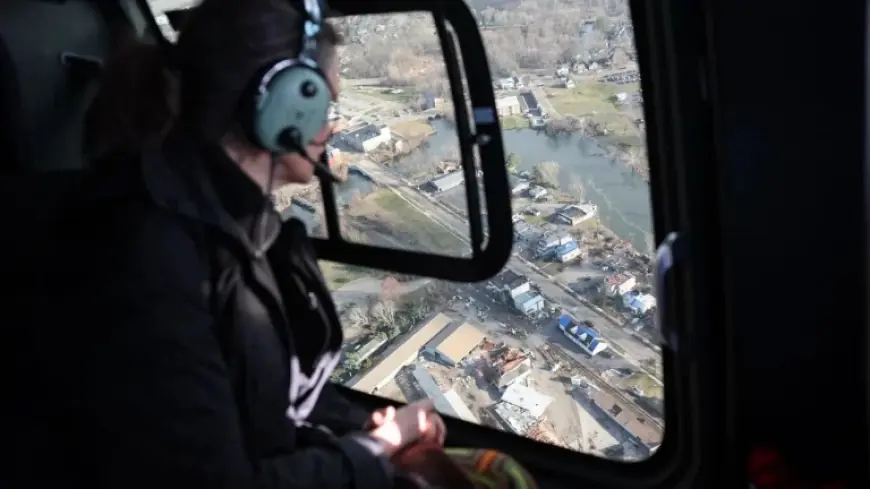
Authorities searched through rubble and debris in southern Michigan after suspected tornadoes tore through the region on March 6. That confirmed on-the-ground response provides the most concrete signal in the available record: damage occurred, and it was significant enough to leave debris fields that required searches.
Yet the March 6 account is thin on the operational details that typically shape public expectations during severe weather, such as what alerts were issued, when they were issued, and how the risk had been framed beforehand. The limited information means the comparison must focus less on the March 6 alert timeline and more on the general mechanics and expectations described in the separate Southwest Michigan episode.
Governor Whitmer and the National Weather Service: delayed watch questions after deadly tornadoes
After deadly tornadoes ripped through Southwest Michigan last week, questions rose about why a tornado warning for the area was not declared sooner. Michigan Governor Whitmer called for an investigation, and her office also called for an investigation into the National Weather Service’s delay of a tornado watch and its relation to federal cuts.
The context also lays out the operational split that often gets blurred during fast-moving events. Tornado Watches indicate a tornado is possible in the area and are issued by the storm prediction center in Norman, Oklahoma. Tornado Warnings, by contrast, show a tornado has been sighted or detected by radar and are determined by local forecast offices.
Forecasters said they reacted as quickly as possible to get the warning out. At the same time, the severity of Friday’s tornadoes surprised many: the area was under a marginal risk, with only a 2% chance of tornadoes within a 25-mile radius of any one location. A National Weather Service representative, Norman, described the day’s overall ingredients as “not particularly impressive, ” with a micro-scale interaction involving a warm front rapidly turning a simple severe thunderstorm into a deadly, significant tornado producer.
Nws risk signals vs. warning operations: where the two tracks diverge
Set side by side, the two tracks show why public frustration can build even when meteorological explanations sound plausible. On one side is the pre-event risk framing: Southwest Michigan sat in a “marginal risk” environment with a quantified “2% chance” within a 25-mile radius. On the other side is the real-time operational chain: watches come from the storm prediction center in Norman, Oklahoma, while warnings are issued by local forecast offices when a tornado is sighted or detected by radar.
The comparison reveals a structural tension rather than a simple messaging dispute. A low-probability outlook can still precede a high-impact outcome, and the watch-versus-warning system is built around different thresholds: possibility at the regional scale versus detection at the moment of danger. Norman’s description that the storm went “from zero to 100 extremely quickly” underscores why a warning can feel late even if forecasters believe they moved as fast as conditions allowed.
| Element | Risk outlook / pre-storm framing | Watch and warning issuance |
|---|---|---|
| What it communicates | Probability signals (example given: “marginal risk” and “2% chance”) | Operational alerts: watch (possible) and warning (sighted/detected) |
| Who issues it | Not specified beyond the stated “marginal risk” description | Watch: storm prediction center in Norman, Oklahoma; Warning: local forecast offices |
| Typical timing described | Not described in the context | Watches are usually announced hours before a storm, but not always |
| Failure mode highlighted | Low-probability setup still produced deadly tornadoes | Rapid storm intensification can compress warning lead time |
| Public controversy described | Surprise at severity despite “marginal risk” | Questions about whether a watch or warning should have come sooner |
Analysis: The direct comparison suggests the core problem is not only whether a single message was late, but whether people interpret a “marginal risk” and “2% chance” as reassurance, even when the system still relies on last-moment detection to escalate to a warning. That mismatch can make a fast-developing tornado feel like a breakdown in alerting, even as forecasters describe micro-scale triggers that are hard to anticipate and evolve quickly.
The next confirmed test arrives quickly: more severe storms are expected tomorrow night with the potential of tornadoes. If the Nws alert chain produces clearer, earlier watch-and-warning escalation during that next round of storms, the comparison suggests public confidence will hinge less on the initial probability label and more on whether real-time alerts track the storm’s rapid changes.