Alejandro Davidovich Fokina absent as Joao Fonseca earns first Sinner meeting

Joao Fonseca’s run at Indian Wells moved into a new phase after he beat Tommy Paul 6-2, 6-3 under the lights at Stadium 1, setting up a Tuesday meeting with Jannik Sinner. Yet the coverage framing around emerging challengers is narrowly constructed: alejandro davidovich fokina is not mentioned at all in the record provided, even as Fonseca is placed in the same conversation as the sport’s current top tier.
Joao Fonseca, Tommy Paul, and the Stadium 1 performance that set up Jannik Sinner
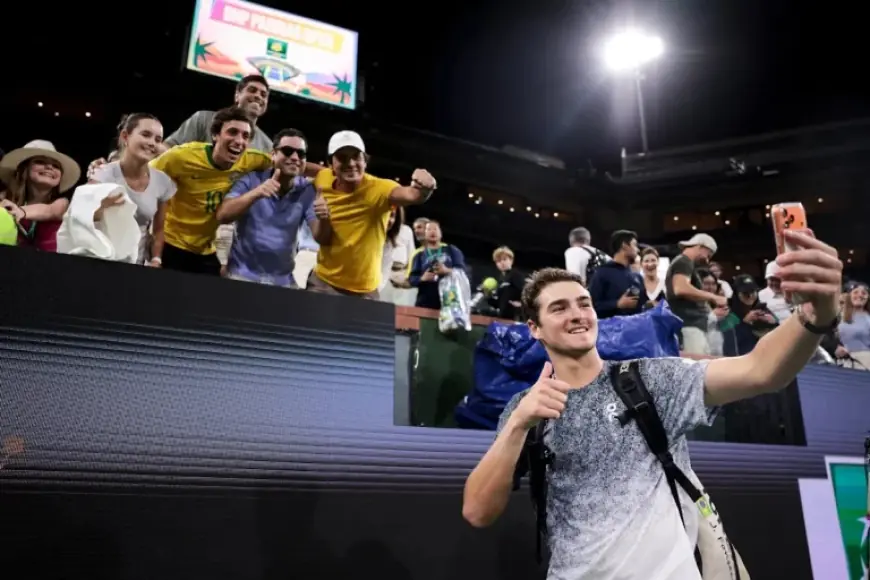
Fonseca, 19, secured what the context describes as his first meeting with either of the two players “currently dominating men’s tennis, ” Carlos Alcaraz and Jannik Sinner. The pathway was direct: a 6-2, 6-3 win over Paul in Tennis Paradise, played “under the lights at Stadium 1” with “fervent Brazilian fans behind him. ” The result also marked a milestone, with Fonseca reaching the fourth round at a Masters 1000 for the first time.
On court, the context documents a match in which Fonseca controlled baseline exchanges. A specific statistical comparison anchors that assessment: he “tallying 32 baseline points to Paul’s 12. ” Match details further underline the shape of the contest: Fonseca ended a 19-shot rally with an angled drop shot early in the second set, and later broke for 5-3 in the second using a forehand passing shot down the line.
Paul’s condition is presented with caveats that complicate clean conclusions about comparative form. The context states Paul “might not be in peak condition” and is “still finding his way following several injuries in 2025. ” At the same time, it also emphasizes Fonseca’s own health trajectory: “His recent back injury appears to be behind him. ” Those two facts coexist in the same account, leaving the win both clearly documented and partially contextualized by fitness qualifiers applied to both players.
Alejandro Davidovich Fokina and the narrowing of the “challenger” storyline
The tension inside the provided record is less about the scoreline and more about the way the broader storyline is assembled. Fonseca is introduced as “often cited” as someone who can “potentially challenge” Alcaraz and Sinner, and the context reinforces that framing through repeated references to his level, his visibility, and his stated ambitions. Still, the context does not confirm who is doing the citing, what criteria support it, or which other players are considered part of the same “challenger” category.
That gap matters because the context foregrounds the idea of a pipeline of challengers while documenting only one case in detail. The absence is explicit in what is included: alejandro davidovich fokina does not appear in the account, even though the surrounding headlines supplied for this assignment point toward a broader Indian Wells conversation. The record offered here narrows instead to Fonseca’s ascent and his first benchmark against Sinner.
What remains unclear is whether the omission is simply a function of editorial focus on Fonseca’s breakthrough night, or whether other potential contenders were discussed elsewhere and not included in the provided context. The context does not confirm any comparison between Fonseca and other tour players beyond Alcaraz, Sinner, and the specific opponent he beat, Paul. Without those additional datapoints, the “challenger” label reads as a powerful narrative hook, but not one that is fully documented inside this single account.
Jannik Sinner, Carlos Alcaraz, and the evidence of attention around Joao Fonseca
While the “challenger” framing is not fully sourced within the context, the record does provide concrete indicators of the attention now surrounding Fonseca. It notes that he spoke with reporters “in the main interview room, ” calling it “a common scenario” for him “despite never being ranked inside the Top 20. ” It also documents his social reach, stating he “already counts 1. 2 million followers on Instagram. ” On-site, the support is described in vivid terms: fans in Brazilian soccer jerseys, early lines for autographs, and a visible presence during the match.
Fonseca’s own comments also tighten the logic of why his upcoming match is being framed as a measuring stick. He described Alcaraz and Sinner as operating “in another level, ” adding that “they’re almost winning every tournament. ” He also made clear he views the spotlight as “a privilege, ” while repeating variations of the same claim: “I think I have the level, ” paired with the acknowledgement that “It needs time” and that “There is a lot to improve. ” The context documents both confidence and caution, rather than presenting a single, unqualified claim.
Still, the core investigative gap remains: the context offers a highly detailed portrait of one rising player’s moment, but it does not provide the broader field of reference implied by the “often cited” premise. If additional documentation emerged identifying who is making the challenger claim and on what basis, it would establish whether the narrative is evidence-led or largely momentum-driven. For now, the next confirmed data point in the record is straightforward: Fonseca’s Tuesday match against Sinner, the first such meeting the context confirms.